
Canada Counter-Tariff on U.S. Flooring: Rates and Exemptions
Trade reports flag 25% and 50% Canadian surtax rates on selected U.S. carpet, PVC flooring, plywood and board; classification decides each shipment.
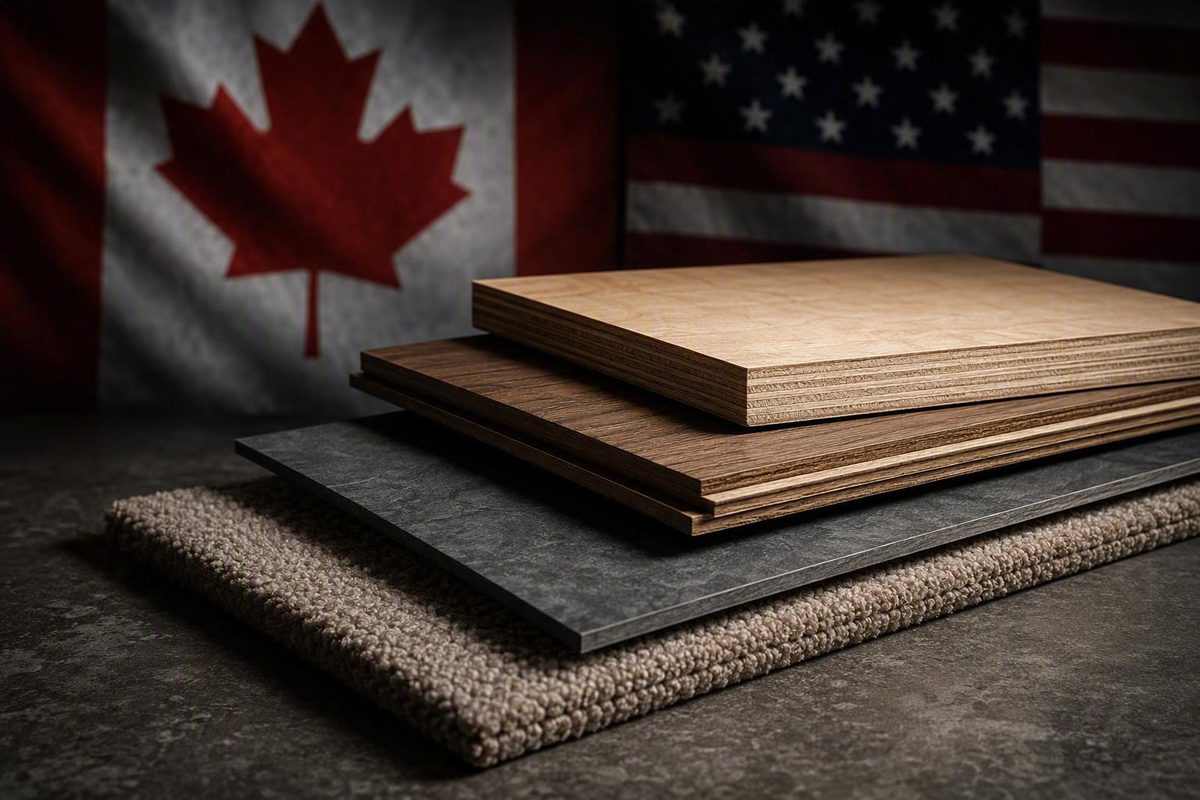
Canada’s 2026 counter-tariff can reach American-made flooring, but trade reports put only a few categories in its path: most carpet at a reported 25% (certain tufted synthetic-fibre carpet at 50%), PVC floor coverings such as LVT and VCT at a reported 50%, and hardwood plywood, MDF and particleboard as substrates at up to 50%. Finished hardwood, ceramic and porcelain tile, rubber flooring and hardwood veneer are reported outside the measure. None of this is settled product by product. The official CBSA notice sets 15%, 25% and 50% surtax tiers but names no flooring item, and the industry sources disagree on sheet vinyl, on most carpet, and even on the start date, with September 8 and August 22, 2026 both reported.
Pick a flooring category and enter a value for duty; the surtax math and the filtered table update below.
Reported Canadian counter-tariff treatment of U.S.-origin flooring, 2026
| Product | Reported rate | Type | Evidence |
|---|---|---|---|
| Carpet, most classifications | 25% most; 50% some tufted synthetic | Finished | Disputed |
Why it is disputed and what to verifyFloorDaily assigns 25% to most carpet classifications and 50% to certain tufted synthetic-fibre carpet. CTaSC says most carpet classifications fall outside the provisions. Verify: Canadian tariff item, fibre, construction, tufting method, backing, dimensions and the schedule listing the item. | |||
| LVT and VCT | 50% | Finished | Reported, unverified |
Basis and what to verifyFloorDaily reports broad 50% coverage of PVC floor coverings; CTaSC reports possible 50% for some vinyl tile. Neither is an official product ruling. Verify: composition, backing, dimensions, presentation and the Canadian tariff item. | |||
| Sheet vinyl | 50% or outside | Finished | Disputed |
Why it is disputed and what to verifyFloorDaily includes sheet vinyl in 50% PVC floor-covering coverage; CTaSC says vinyl sheet falls outside the provisions. Verify: the exact tariff item under the operative schedule. | |||
| Hardwood plywood, imported separately | 50% | Component | Reported, unverified |
Basis and what to verifyDecorative Hardwoods Association and flooring sources report 50% on certain U.S. plywood or hardwood-plywood imports. Verify: plywood construction, tariff item, origin, entry date and whether it is imported on its own rather than inside a finished plank. | |||
| Commercial broadloom, specified | 25% | Finished | Reported, unverified |
Basis and what to verifyThe Globe and Mail describes a 25% counter-tariff on the carpeting it discusses. That does not set a rate for every commercial carpet. Verify: exact construction and tariff item. | |||
| MDF and particleboard | Listed; rate not established | Component | Reported, unverified |
Basis and what to verifyReported as included substrate categories with no universal rate for every classification. Verify: board type, specifications, tariff item and applicable tier. | |||
| Engineered hardwood | — | Finished | Not established |
Why no rate is shownA plywood-core rate does not transfer to the finished plank. The completed floor needs its own Canadian tariff item based on construction and presentation at import. | |||
| Laminate | — | Finished | Not established |
Why no rate is shownAn MDF or particleboard rate does not transfer to the finished laminate board. Classify the completed product on its own construction and presentation. | |||
| Rigid core (SPC/WPC) | — | Finished | Not established |
Why no rate is shownThe reports do not name rigid core as a category, and a core-material rate does not transfer to the finished plank. Classify the completed product on its own construction and presentation. | |||
| Finished solid hardwood | Reported outside | Finished | Not established |
Basis and what to verifyReported as apparently or generally outside the provisions. Verify: finished-product classification, origin and current schedule. | |||
| Ceramic and porcelain tile | Reported outside | Finished | Not established |
Basis and what to verifyReported as apparently or generally outside the provisions. Verify: tariff item, composition, origin and current schedule. | |||
| Rubber flooring | Reported outside | Finished | Not established |
Basis and what to verifyReported as generally outside the provisions. Verify: composition and Canadian tariff item. | |||
| Hardwood veneer | No new tariff | Component | Reported, unverified |
Basis and what to verifyDecorative Hardwoods Association reports no new tariff on veneer. Verify: that the goods are veneer rather than plywood or finished flooring. | |||
Sources: FloorDaily, CTaSC, Decorative Hardwoods Association and The Globe and Mail for reported rates; CBSA Customs Notice 26-23 for the 15/25/50% tiers and the rule that GST is calculated on value for duty plus surtax. Rates are trade reports, not official classification results. — means no reported rate. Dollar figures exclude regular duty, anti-dumping duty, brokerage and provincial tax.
What the CBSA Notice Confirms and What It Leaves Out
CBSA Customs Notice 26-23 establishes the framework: surtax tiers of 15%, 25% and 50% of the value for duty on scheduled goods originating in the United States, with the rate set by the schedule that lists the tariff item. The notice says the surtax applies to commercial and personal imports alike, and that U.S.-origin goods routed to Canada through another country stay inside it.
What the notice does not do is map flooring. The available text names no carpet, vinyl, plywood or board tariff items and assigns them no tier. Every flooring rate in circulation comes from industry reporting that reads the schedules, and that reporting is not uniform.
The effective date is also unresolved in the evidence. FloorDaily and the Decorative Hardwoods Association report September 8, 2026; CTaSC reports August 22, 2026. Neither date should be treated as controlling for a specific entry without checking the final order and any later amendment, suspension, remission or repeal.
Carpet: 25% for Most, 50% for Some Tufted, or Outside Entirely
The carpet reports contradict each other. FloorDaily assigns 25% to most carpet classifications and 50% to certain tufted synthetic-fibre carpet. CTaSC says most carpet classifications fall outside the provisions. A separate Globe and Mail report describes a 25% counter-tariff on the specified commercial carpeting it discusses, which says nothing about carpet built differently.
Retail labels cannot settle this. “Commercial carpet” covers different fibres, constructions, backings, widths and presentation formats, and the tariff item turns on those details. A report about high-grade commercial broadloom does not establish that the carpet in an apartment, hotel or house attracts the same rate. What decides it: the Canadian tariff item, fibre, construction, tufting method, backing, dimensions and the schedule that item sits in.
Vinyl: LVT and VCT Reported at 50%, Sheet Vinyl Disputed
FloorDaily describes broad 50% coverage for PVC floor coverings that captures most U.S.-origin LVT, VCT, and sheet vinyl. CTaSC identifies possible 50% treatment for some vinyl tile but reports vinyl sheet as outside the provisions.
Both agree that resilient PVC tile is the category most exposed to the top tier. They part on sheet goods. Until the applicable Canadian tariff item is found in the operative schedule, neither description establishes the treatment of a particular carton or roll. Two products both sold as LVT can differ in composition, backing, dimensions or presentation and land in different tariff items.
Wood: Plywood, MDF and Particleboard Listed, Veneer and Finished Hardwood Not
The Decorative Hardwoods Association reports 50% treatment for certain U.S. plywood or hardwood-plywood imports and no new tariff on veneer. MDF and particleboard are reported as included substrate categories, though no universal rate is established for every board classification. Finished hardwood flooring is reported as generally outside the provisions, as are ceramic and porcelain tile and rubber flooring.
The warning here is narrow: separately imported plywood, MDF and particleboard may be listed. It does not transfer to the engineered hardwood plank, laminate board or rigid-core floor built on that material. The completed flooring product gets its own classification based on its own construction and presentation at import.
Why 2025 Tariff Records Do Not Answer the 2026 Question
The 2025 and 2026 measures are separate frameworks. Treating them as one continuous flooring tariff produces the wrong rate, or a wrong conclusion that a product is still covered.
- February–March 2025: Canada authorized a 25% surtax on value for duty for scheduled U.S.-origin goods. That schedule included potentially flooring-related tariff items under headings 3918, 4016, 4418, and 5701 through 5705. Coverage required both U.S. origin under the specified marking rules and classification under a listed item, as shown in the official 2025 order and schedule.
- September 1, 2025: GHY’s August 2025 trade update reported that the United States Surtax Order (2025-1) was repealed effective that date, while separate steel, aluminum and motor-vehicle measures remained. The same update described the change as removing retaliatory tariffs from U.S. goods qualifying under CUSMA rules of origin. Check the repealing instrument and any replacement measure rather than inferring the scope from the summary.
- 2026: The new framework provides 15%, 25% and 50% tiers for listed U.S.-origin goods and requires a fresh review of the current schedules, not reuse of a 2025 classification list.
The 2025 headings show where carpet, vinyl floor coverings, rubber articles and wood products have appeared before. They do not prove the same tariff item is covered in 2026, that its rate is unchanged, or that an earlier exception still applies. An old customs entry, supplier invoice, broker calculation or 2025 tariff spreadsheet is research material, not proof of current treatment.
Five Checks for a Specific Flooring SKU
“Luxury vinyl,” “engineered oak,” “commercial carpet” and “rigid core” are sales descriptions, not customs facts. Work through these five steps for each SKU.
-
Pin down construction and composition. Record the wear-layer material, backing, core construction, fibre type, manufacturing method, dimensions and packaging format. Establish whether the shipment is finished planks, tiles, rolls, panels, underlayment, veneer, plywood or separate substrate components.
-
Determine the Canadian tariff item. Classification can turn on details missing from a sales page. Do not substitute a broad heading or an American product description for the complete Canadian tariff classification.
-
Establish legal country of origin. A U.S. brand, seller, invoice, distributor or warehouse does not make the goods U.S.-origin. Flooring made elsewhere and distributed through the United States may fail the marking-origin test the surtax order uses. Goods that meet that U.S.-origin test stay inside the framework even when shipped to Canada through a third country.
-
Match the tariff item to the operative schedule and rate. The surtax applies only when the goods meet the stated origin rules and their tariff item appears in an applicable schedule. Search for the exact tariff number, not a phrase like “vinyl flooring” or “wood panels.”
-
Check the date and every available exception. Confirm which import, accounting or entry date matters under the operative order. Then check in-transit treatment, Chapter 98 or 99 provisions, remission, duties relief, duty drawback or any other applicable mechanism.
Keep the commercial invoice, technical data sheets, bill of materials, origin records, purchase order, transport documents and anything supporting an exception. If classification or origin stays uncertain, consult CBSA or a licensed customs broker rather than the retail product name.
What a 25% or 50% Surtax Adds to Landed Cost
The surtax is calculated on the customs value for duty, which is not the retailer’s selling price. Where GST applies, CBSA states that the GST calculation includes the surtax, and the surtax stacks on top of other applicable duties, including any anti-dumping duties. Both rules are in Customs Notice 26-23.
On a C$10,000 value-for-duty shipment:
| Scenario | Surtax | GST base | Surtax plus GST |
|---|---|---|---|
| 25% surtax | C$2,500 | C$12,500 (GST C$625) | C$3,125 |
| 50% surtax | C$5,000 | C$15,000 (GST C$750) | C$5,750 |
The formula is surtax equals rate times value for duty, and GST equals 5% of value for duty plus surtax.
These are illustrations, not customs assessments. They exclude ordinary customs duties, anti-dumping duties, freight treatment, brokerage, provincial sales taxes, distributor margins, delivery and installation. They also do not predict how much reaches a homeowner: an importer, distributor or retailer may absorb, share or pass the charge through. And a landed-cost figure is not an installed-floor estimate, which still depends on waste allowance, subfloor preparation, moisture work, adhesive, transitions, stairs, removal and labour.
Exceptions, Relief and the Records to Keep
The 2026 CBSA notice provides an exception for qualifying U.S.-origin goods already in transit to Canada when the surtax comes into force, provided the importer holds supporting proof.
Chapter 98 or 99 treatment can also change the result. Under the notice, goods classified in those chapters are generally exempt unless the applicable Chapter 98 or 99 tariff item is specifically listed in Schedule 4. Check that against the current order; it is not a blanket exemption.
Depending on the circumstances, an importer may be able to pursue a correction or adjustment, a refund request, duties relief or duty drawback, remission under an applicable order, or a review of origin or classification. These are possible procedures, not entitlements; eligibility depends on the precise goods, transaction, entry date, operative order and program requirements.
Before ordering or clearing a shipment, the file should hold the complete Canadian tariff item, a documented origin determination, the applicable schedule and rate, the relevant import or accounting date, full product specifications, the commercial invoice, bills of materials where components affect classification, transport and routing records, and evidence for any exception or relief claim. Then compare the tariff item with the current CBSA notice and the Government of Canada’s complete list of U.S. products subject to counter-tariffs. If the schedules still do not resolve the product, get a professional classification.
Reported 25% and 50% flooring rates show where scrutiny is needed. They are not product-specific customs determinations.
Does CUSMA Exempt U.S.-Made Flooring From the Surtax?
No. CUSMA preferential treatment is not a universal exemption from every 2026 surtax.
The 2026 order uses specified country-of-origin marking rules to decide whether goods originate in the United States for surtax purposes. That is a separate question from whether a product is described as CUSMA-compliant. A product meeting the U.S.-origin test can still attract a surtax if its Canadian tariff item is listed and no exception applies.
Does a Plywood Tariff Make Engineered Hardwood or Laminate Tariffed?
No. Reported treatment of separately imported hardwood plywood, MDF, or particleboard does not automatically establish the treatment of finished engineered hardwood, laminate or rigid-core flooring.
Classify the completed floor on its own construction and presentation at import. A supplier’s specification sheet and bill of materials supply the technical evidence, but the classification of a core material must not be substituted for the tariff item of the finished plank or panel.