
Does the Canada Tariff Apply to Vinyl Plank Flooring?
See which Canadian vinyl plank, laminate, carpet, hardwood, sheet vinyl, and tile products face the 50% U.S. duty—and estimate the added cost.
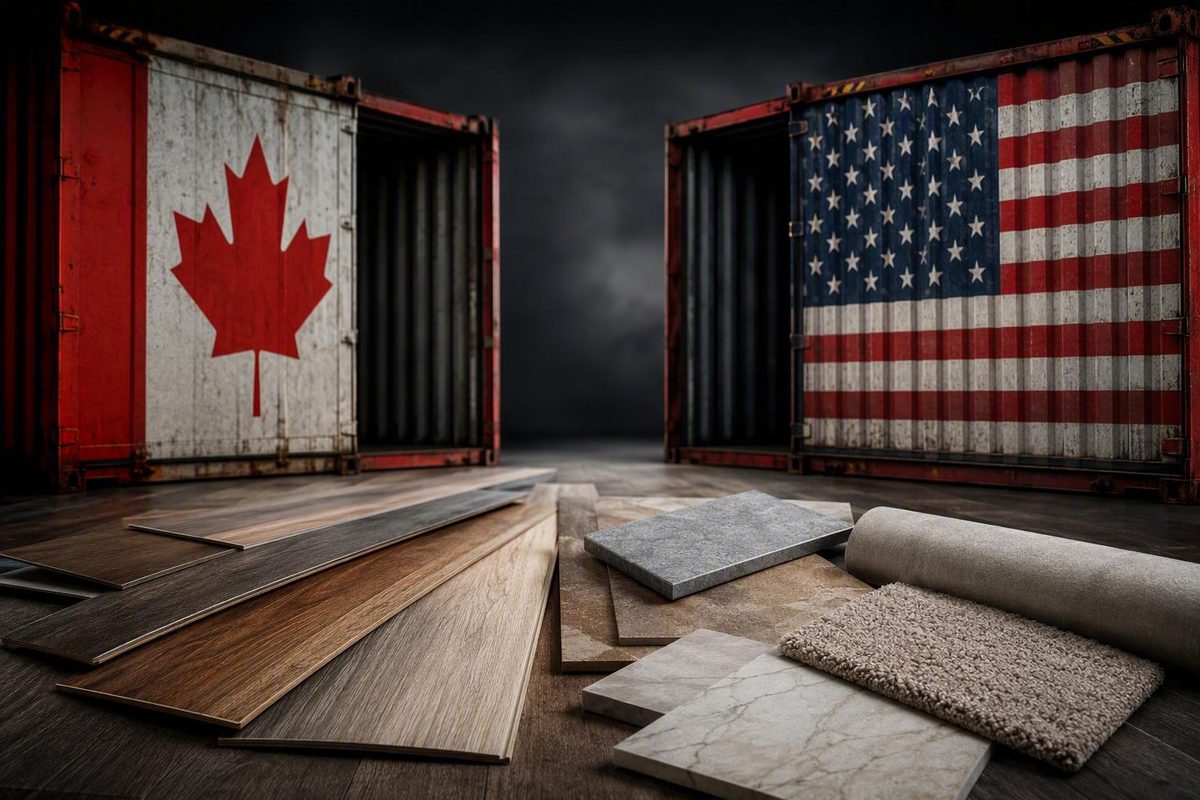
Yes—for Canadian-made rigid-core vinyl plank classified as HTSUS 3918.10.10, including qualifying SPC and WPC products, the new U.S. tariff adds a 50% duty. Canadian laminate classified under listed wood-panel provisions can also be covered. Finished hardwood under 4418.7x, ceramic or porcelain tile, and vinyl sheet under 3918.10.20 are not on the supplied list. The product’s actual classification, Canadian origin, and customs-entry date control the result—not the name printed on the carton.
Choose a flooring type and enter its pre-tariff value per square foot to check the likely classification and added duty.
This screens for the additional 50% U.S. duty. It does not calculate ordinary duty, freight, fees, taxes, or retail markup.
| Product | HTSUS Line | Result | Classification Basis |
|---|---|---|---|
| Rigid-core SPC plank | 3918.10.10.20 | Covered | Rigid solid polymer-core vinyl tile |
| Rigid-core WPC plank | 3918.10.10.30 | Covered | Specified rigid expanded polymer core |
| Glue-down LVT | 3918.10.10, potentially .40 | Verify Code | Covered when classified as vinyl tile under 3918.10.10 |
| Vinyl sheet | 3918.10.20 | Not Listed | Different provision from listed vinyl tile |
| Laminate flooring | 4410/4411/4412 | Verify Code | Covered when the finished product falls in a listed panel line |
| Engineered hardwood | 4418.7x | Not Listed | Finished hardwood flooring provision is outside identified list |
| Solid hardwood | — | Not Identified | Finished hardwood is outside the identified covered flooring lines |
| Porcelain or ceramic tile | — | Not Listed | No covered ceramic or porcelain provision identified |
| Tufted synthetic carpet | 5703.39.20 | Covered | Only the specified listed carpet provision; most carpet is not established as covered |
Sources: U.S. proclamation Annex II, current USITC tariff schedule, and Floor Daily’s flooring-code analysis. “—” means no product-specific code was supplied.
The 50% measure applies to selected products of Canada imported into the United States. It is not a tariff on every floor shipped by a Canadian company, and it does not govern flooring being imported into Canada.
The official Annex II lists the covered tariff provisions. The finished article must be classified under one of those provisions and supported as Canadian-origin before the additional duty applies. This is general guidance rather than a binding classification, origin determination, customs valuation decision, or legal opinion.
The Covered Flooring Lines Are Specific HTS Provisions
The clearest flooring classifications identified in the supplied materials are vinyl tile under 3918.10.10, one tufted synthetic carpet provision, and several wood-panel provisions that can cover laminate cores or substrates.
| Flooring | Relevant HTSUS Line | 50% Duty |
|---|---|---|
| Rigid SPC/WPC plank | 3918.10.10.20/.30 | Yes, if Canadian-origin |
| Glue-down LVT | 3918.10.10 | Generally yes if classified here |
| Vinyl sheet | 3918.10.20 | Not listed |
| Laminate | 4410/4411/4412 | Yes when classified in a listed line |
| Finished hardwood | 4418.7x | Not listed |
| Porcelain or ceramic tile | Product-specific | Not listed |
| Tufted synthetic carpet | 5703.39.20 | Yes |
| Most other carpet | Product-specific | Not established as covered |
Within heading 3918, subheading 3918.10 covers floor coverings of polymers of vinyl chloride. The USITC tariff results for 3918.10 describe 3918.10.10 as “vinyl tile” and show three statistical categories beneath it:
- 3918.10.10.20 for vinyl tile consisting of a rigid solid polymer core;
- 3918.10.10.30 for vinyl tile consisting of a specified rigid expanded polymer core; and
- 3918.10.10.40 for other vinyl tile within 3918.10.10.
Those categories are why rigid SPC and WPC planks can be covered even though the legal tariff description says “vinyl tile.” Customs classification does not necessarily follow the retail distinction between a plank and a tile.
The list also includes 5703.39.20 for a category of tufted synthetic carpet. That does not place all carpet under the measure. Carpet construction and its complete classification must match the listed provision.
Wood-panel codes under headings 4410, 4411, and 4412 are included as well. Those headings cover products such as particleboard, fiberboard—including the HDF commonly used in laminate—and plywood or similar laminated wood. Canadian laminate classified under a listed panel provision can therefore face the duty.
Finished hardwood and engineered flooring under 4418.7x are not listed in the supplied flooring analysis. Ceramic and porcelain tile are also outside the identified list. The same is true of vinyl sheet classified under 3918.10.20.
“Vinyl Plank,” SPC, and WPC Are Not Tariff Codes
LVP, LVT, SPC, WPC, rigid core, waterproof vinyl, and vinyl plank are sales or construction terms. None is a complete customs classification.
A rigid SPC plank may fit 3918.10.10.20 because it has a rigid solid polymer core. A WPC product with the specified expanded core may fit 3918.10.10.30. A flexible glue-down LVT product may fall within 3918.10.10.40. Those are plausible classifications, not rules based solely on the acronym.
Classification depends on the article’s objective characteristics when imported. Relevant records include:
- core composition and whether it is flexible, rigid solid, or expanded;
- polymer and mineral content;
- attached backing and underlayment;
- decorative, surface, and wear layers;
- dimensions and imported form;
- presentation in rolls, tiles, or boards; and
- the function of each layer.
A locking edge does not decide the tariff code. Neither does a collection name, board shape, or installation method. The importer should compare technical specifications with the tariff language and determine the complete ten-digit HTSUS classification.
Vinyl sheet illustrates why the distinction matters. It is still vinyl flooring, but the supplied analysis places it under 3918.10.20 rather than the listed 3918.10.10 provision. Calling both products “resilient flooring” does not give them the same tariff result.
Canadian Origin Requires More Than Canadian Shipping
A Canadian warehouse, distributor, invoice, seller, or port of departure does not establish that flooring is a product of Canada.
A rigid-core floor manufactured in Canada and classified under 3918.10.10 may be covered. A floor manufactured in China, purchased through a Canadian distributor, and shipped from an Ontario warehouse is not automatically Canadian-origin. It may face other duties based on its actual origin, but Canadian shipment alone does not trigger this measure.
Request the following records before accepting an origin claim:
- the finished-product manufacturer’s name and location;
- a written country-of-origin statement;
- an origin certification where applicable;
- a bill of materials or detailed construction sheet;
- the commercial invoice; and
- the classification the importer plans to declare.
Statements such as “designed in Canada,” “North American collection,” or “USMCA eligible” do not answer the manufacturing-origin question by themselves. USMCA eligibility also should not be assumed to eliminate a separate additional duty. Ordinary preferential treatment and this new measure require separate analysis.
The Official Entry Threshold Is August 19, 2026
The measure imposes an additional 50% ad valorem duty on selected Canadian products listed in Annex II. Covered goods are entered under heading 9903.03.14, with the additional duty imposed on top of otherwise applicable duties and charges.
According to the Federal Register proclamation, it applies to covered goods entered for consumption, or withdrawn from warehouse for consumption, on or after 12:01 a.m. Eastern Time on August 19, 2026.
Floor Daily reported an August 22 effective date in its flooring-industry analysis. Because that conflicts with the official proclamation materials, the August 19 threshold is the date to use unless Customs issues controlling guidance to the contrary.
The controlling event is not necessarily when the buyer ordered the floor, paid a deposit, received a quote, or scheduled installation. A shipment ordered earlier can still be covered if it is entered for consumption after the threshold. Flooring entered before the threshold does not incur this particular additional duty merely because a distributor sells it afterward.
For goods held in a customs warehouse, withdrawal for consumption may be the relevant event. The importer or customs broker should confirm the entry record rather than relying on the expected delivery date.
The Duty Is Calculated From Customs Value, Not Installation Price
The 50% duty is ad valorem. It is applied to the relevant customs value, not automatically to the homeowner’s retail carton price, labor charge, installer markup, or entire remodeling contract.
For the draft’s hypothetical shipment, a $20,000 customs value multiplied by the 50% additional rate produces a $10,000 additional duty.
That example is not a supplier quote or a conclusion that any particular shipment is covered. A complete landed-cost calculation can also include ordinary duty, freight, brokerage, processing charges, taxes, handling, and later markups.
The basic additional-duty formula is customs value multiplied by 50%.
A simple per-square-foot estimate uses the same arithmetic. If the entered value attributable to covered flooring is known per square foot, half of that value is the estimated additional duty per square foot. The calculator above performs that limited calculation; it does not determine customs value or estimate downstream markups.
The installed project price may rise by less than 50% because labor, demolition, subfloor preparation, trim, and installation supplies are not automatically subject to the flooring tariff. An importer or distributor may also absorb part of the cost or sell inventory entered before the effective threshold.
The final increase can instead exceed the customs-duty amount if percentage markups are applied to a higher landed cost. Contract language can permit separate tariff surcharges, freight adjustments, or later customs corrections.
Laminate Can Be Directly Covered or Indirectly Affected
Canadian laminate deserves separate attention because its structural core commonly involves wood-panel materials addressed by headings 4410 or 4411. Products involving plywood or similar laminated wood can implicate heading 4412.
When the imported finished laminate is itself classified under a listed provision, the tariff can apply directly. The exact heading and full tariff line depend on the product’s construction rather than the general word “laminate.”
There is also a different kind of exposure when a manufacturer imports a covered HDF, particleboard, plywood, or other panel as an input. That upstream cost can affect the manufacturer’s pricing even if the finished floor is ultimately classified elsewhere.
An input tariff does not prove that the completed plank is directly covered. A Canadian core also does not automatically establish Canadian origin for a finished floor assembled through multinational production. Direct liability must be determined from the finished imported article, its origin, classification, and entry date.
Hardwood, Tile, and Vinyl Sheet Are Outside the Identified List
Finished hardwood and engineered flooring classified under 4418.7x are not among the flooring provisions identified as covered. That supports a “no” answer for those products under this particular 50% measure.
Ceramic and porcelain tile are also not on the supplied list. Their product-specific classification should still appear on entry documents, but the evidence provided does not place them within this Canadian measure.
Vinyl sheet under 3918.10.20 is not listed, even though nearby vinyl tile provision 3918.10.10 is. That is a significant distinction: a change of tariff line within the same broader heading can change the additional-duty result.
The absence of this 50% Canadian duty does not prove that a shipment is free of all customs charges. Ordinary duties, taxes, processing fees, trade remedies, or measures tied to another country of origin may still apply.
A Supplier Should Confirm Seven Shipment Facts
Before ordering Canadian flooring, obtain written answers identifying:
- the country where the finished flooring was manufactured;
- the complete ten-digit HTSUS number proposed for entry;
- the core composition and whether it is flexible, rigid solid, or expanded;
- the expected entry-for-consumption or warehouse-withdrawal date;
- the importer of record;
- whether the quote includes the 50% additional duty and other import charges; and
- whether the price can change after a customs reclassification or rate adjustment.
Keep those answers with the technical sheets, quote, purchase order, invoice, and entry records. “Tariffs included” is too vague unless the supplier identifies the shipment, tariff measure, assumed classification, and treatment of later adjustments.
For a substantial commercial order or any project where classification changes the budget materially, have a licensed customs broker or trade attorney review the documents. An importer can also consider seeking a binding customs ruling when the construction does not fit an obvious tariff description.
Imports Into Canada Follow a Different Analysis
If the flooring is entering Canada, do not use this U.S. 50% measure or a U.S. HTSUS number as the Canadian tariff result. The Canadian importer must determine the Canadian tariff item, manufacturing origin, import date, preferential rate, current countermeasures, and any trade-remedy exposure.
Canada imposed a 25% countermeasure effective March 13, 2025, but it applied only to listed goods of U.S. origin. The supplied Canadian government product-list notice does not establish that vinyl plank flooring was included or that such a measure remains applicable to it in August 2026.
For flooring entering the United States, the practical verdict is narrower and clearer: Canadian rigid-core LVP under 3918.10.10 and Canadian laminate under covered 4410, 4411, or 4412 provisions can face the 50% duty. Finished hardwood under 4418.7x, porcelain or ceramic tile, and vinyl sheet under 3918.10.20 are not listed. Confirm the complete code, origin records, and entry date before treating any quote as duty-inclusive.