
9 Carpet Buckling Causes and What to Do Next
Severe water damage, delamination, permanent creases, contamination or widespread wear may mean replacement is the better response to the ripples.
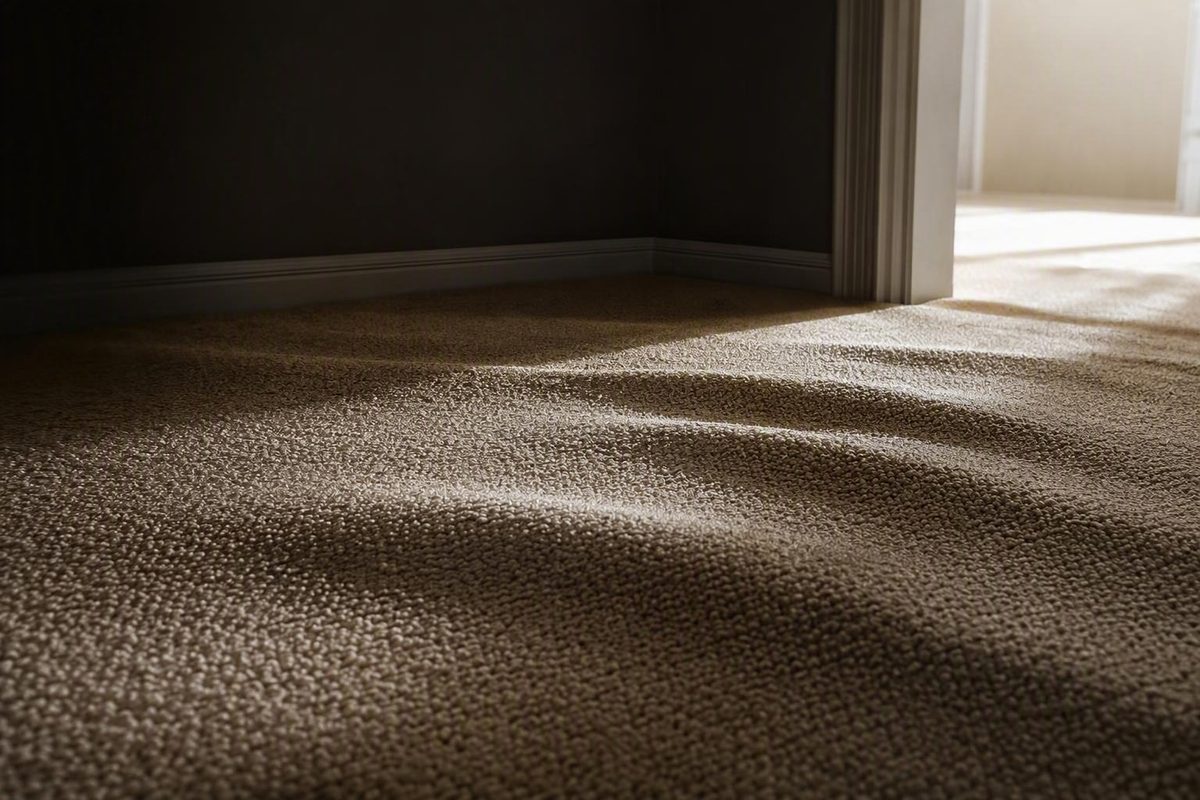
Carpet buckling is a symptom, not a diagnosis. The visible waves show that wall-to-wall carpet is no longer lying under consistent tension, but they do not reveal why. Possible contributors include installation slack, temporary moisture movement, a leak, shifted or deteriorated padding, damaged perimeter fastening, furniture movement, ordinary wear, or failure within the carpet backing.
The cause determines the response. Recently cleaned carpet may need time to dry. Damp padding or a moisture-affected subfloor must be investigated before stretching. A recent installation should be documented before anyone alters it. Dry, structurally sound carpet that has lost tension may be suitable for professional restretching. Carpet with severe water damage, delamination, permanent creases, contamination, or widespread wear may be better replaced.
What Carpet Buckling Looks Like—and Why It Deserves Attention
Carpet buckling describes wall-to-wall carpet that has become loose enough to form waves, ripples, wrinkles, bumps, or lifted areas. “Buckling,” “rippling,” and “wrinkling” are commonly used for the same visible condition, although several different problems can produce it.
Common warning signs include:
- Broad waves running across part or all of a room
- A raised ridge near a wall, doorway, seam, or transition
- Loose carpet gathered around heavy furniture
- Edges that no longer appear firmly secured
- A section that shifts or rolls slightly underfoot
- Bumps that become more noticeable in low-angle light
- A vacuum head catching, jumping, or pulling at the carpet
A shallow undulation is different from a high ridge crossing a walking path. Pronounced ripples may create a tripping or vacuum-snagging concern, and raised areas may wear unevenly under concentrated traffic. Premier Carpet Cleaning, a commercial service provider, lists visible lifting, waves, loose edges, and vacuum snagging among the signs of lost carpet tension and also cautions that insufficient or excessive corrective tension can cause problems in its carpet-stretching overview.
Until a pronounced ridge has been evaluated, limit traffic through the affected area and avoid repeatedly vacuuming directly across it. These precautions reduce exposure to the raised surface and avoid catching an already loose section with the vacuum.
Do not diagnose the cause from appearance alone. A wave that appears soon after installation does not automatically prove defective workmanship. A ripple noticed after cleaning does not prove that the cleaner permanently damaged the carpet. A summer-only ripple does not establish lasting moisture damage, and an older carpet is not necessarily beyond repair.
The most useful initial observations are:
- When the ripple first appeared
- Where it is located
- Whether it changes over time
- Whether it recurs during similar weather
- What happened shortly before it appeared
- Whether there is any odor, staining, or known water exposure
Those details help narrow the possibilities, but the surface alone rarely identifies the underlying failure.
Why Carpet Buckles: Match the Timing and Location to the Possible Cause
The available evidence does not establish one universal leading cause of carpet buckling. Some commercial sources emphasize inadequate installation tension, while others emphasize moisture. Without comparative data and an inspection, neither should be treated as the default diagnosis.
Use timing and location to create a shortlist rather than assign fault.
| Possible contributor | Clues that may point toward it | What still needs to be checked |
|---|---|---|
| Inadequate installation tension | Broad looseness; waves developing after installation; gathering near edges or heavy furniture | Installation method, perimeter attachment, seams, backing condition, and whether later moisture exposed existing slack |
| Seasonal humidity | Ripples appear or become more noticeable during humid weather and lessen in drier conditions | Recurrence pattern, indoor moisture conditions, carpet construction, padding, and any persistent loss of tension |
| Leak or flooding | Sudden buckling near plumbing, an exterior wall, or a known water event; staining, odor, or dampness | Water source, padding condition, possible subfloor moisture, contamination, and backing or adhesive damage |
| Over-wetting or slow drying after cleaning | Waves appear during or after wet cleaning | Whether the carpet and underlying materials remain damp, whether slack existed beforehand, and whether backing or adhesive was affected |
| Dragged furniture | A localized wave appears shortly after a heavy object was pulled across the floor | Edge release, seam or transition damage, shifted padding, and backing damage |
| Padding deterioration or movement | Uneven support, soft or compressed areas, recurring looseness, or a problem concentrated in a traffic lane | Whether padding is shifted, compressed, deteriorated, wet, contaminated, or unsuitable |
| Tack-strip problem | Loose perimeter, carpet pulling away from a wall, or failure near a doorway or transition | Whether the strip is damaged, loose, missing, or unable to hold the carpet |
| Age and traffic | Gradual looseness in frequently used areas, worn pile, reduced resilience, or earlier repairs | Remaining backing integrity, overall wear, contamination, and expected usefulness |
| Backing or adhesive failure | Bubbles or irregular areas that do not behave like ordinary slack; stiffness, cracking, or separation | Whether carpet layers have separated and whether moisture contributed |
Installation-related looseness does not always appear on the day of installation. Slack may become visible months later, particularly near room edges or heavy furniture. It can also become more apparent after cleaning. A contractor-directory article describes this delayed pattern and says inadequately stretched carpet may bunch near edges and heavy objects in its discussion of carpet buckling.
Humidity is more suggestive when the condition follows a repeatable pattern: waves appear during humid weather, ease when conditions become drier, and return during another similar period. That pattern suggests moisture sensitivity, but it does not show whether the movement is temporary, is revealing installation slack, or involves the padding, backing, or adhesive.
A plumbing leak, exterior water intrusion, or flood is different from ordinary ambient humidity. Odor, staining, damp trim, or a known water event should shift attention away from immediate stretching and toward finding the water source.
Mechanical displacement tends to be localized. If a sofa, cabinet, bed, or appliance was dragged shortly before a ridge appeared, report that history during the inspection.
Age and traffic can contribute to looseness, but age by itself does not decide whether to stretch or replace. An older carpet with sound backing, acceptable wear, and no moisture damage may remain repairable. A newer carpet with delamination or severe water damage may not be.
Timing and location narrow the possibilities.
A Symptom-Based Troubleshooting Decision Tree
Begin with six questions:
- Is the carpet newly or recently installed?
- Was it recently cleaned?
- Has the weather or indoor humidity changed?
- Was heavy furniture moved or dragged?
- Was there a leak, spill, plumbing failure, flood, or exterior water event?
- Is there dampness, staining, or a persistent odor?
Then follow the branch that best fits the evidence.
If the carpet was recently installed: Photograph the ripples from several angles, including wide views that show their position in the room. Locate the invoice, installation date, product information, and warranty documents. Contact the original retailer or installer before cutting, lifting, releasing, or stretching the carpet. Kingsway, a commercial surface-care publisher, recommends prompt contact with the retailer or installer because ripple correction may be covered, although actual coverage depends on the applicable warranty when recently installed carpet develops ripples.
If the carpet was recently cleaned and there are no other warning signs: Follow the cleaner’s post-service instructions, allow the carpet and underlying assembly to dry, and use ordinary ventilation or moisture-control equipment as appropriate for the home. Observe whether the waves steadily diminish. Timing alone does not establish that the cleaner caused permanent damage.
If there is an active leak, damp padding, staining, persistent odor, or suspected moisture beneath the carpet: Stop focusing on stretching. Correct the water source and arrange appropriate investigation of the affected carpet assembly. Pro-Care of Nashville, a carpet-care provider, identifies flooding, plumbing failure, prolonged moisture, and over-wetting as possible contributors to backing or adhesive problems and notes that severely water-damaged carpet may require replacement in its carpet-rippling guidance.
If a localized wave appeared after furniture was dragged: Look for an obviously released edge, opened seam, damaged transition, or irregular area beneath the carpet without pulling it up. Arrange an inspection if the ridge persists or visible damage is present.
If broad waves remain after the carpet is dry and the material otherwise appears sound: Ask an installer or carpet-repair professional for a restretching assessment. The inspection should determine whether loss of tension is the principal defect and whether the carpet can safely be released, tensioned, trimmed, and resecured.
If there are sharp permanent creases, backing separation, severe water damage, contamination, extensive wear, or repeated failure after earlier correction: Request a replacement assessment. Padding, moisture, or subfloor work may also be necessary; replacing only the visible carpet will not correct an underlying problem.
Choose the next action
- Dry and monitor: Recent cleaning or temporary humidity-related movement, with no leak, odor, staining, or known damp material.
- Investigate moisture: Active or suspected leak, damp pad, staining, persistent odor, recurring wetness, or possible moisture beneath the carpet.
- Pursue a warranty claim: Recent installation or a possible product issue; document the condition and contact the retailer or installer before alteration.
- Assess for restretching: Persistent waves in dry, structurally sound carpet whose main problem appears to be lost tension.
- Assess for replacement: Delamination, severe water damage, contamination, sharp permanent creasing, widespread deterioration, or repeated repair failure.
When more than one branch applies—for example, recently installed carpet that was also exposed to a leak—preserve the warranty documentation but address the active moisture problem first.
Buckling After Carpet Cleaning or Humid Weather
Carpet buckling noticed after cleaning does not prove, from timing alone, that the cleaner caused permanent damage. Cleaning may be the cause, a contributing factor, or simply the event that made pre-existing slack more visible.
Several explanations are possible:
- Moisture caused temporary movement in the carpet or backing.
- Cleaning revealed installation slack that was already present.
- The carpet surface dried faster than the material beneath it.
- Moisture affected a sensitive backing or adhesive.
- Excess water remained within the assembly.
- A separate leak or humidity problem occurred at about the same time.
- Furniture moved for cleaning displaced an edge or stressed the carpet.
Some post-cleaning ripples may settle as the carpet and underlying materials dry. Drying and observation are therefore reasonable when the carpet was just cleaned, the condition is improving, and there is no odor, staining, known leak, or damp area.
There is no reliable universal countdown in the supplied evidence. Drying can vary with carpet construction, cleaning method, water removal, padding, ventilation, room conditions, subfloor material, and how wet the assembly became. A fixed number of hours or days could create false reassurance in one property and unnecessary alarm in another.
Track the condition instead:
- Record the date and approximate time of cleaning.
- Note when the first ripple appeared.
- Photograph the same areas from the same angle.
- Identify every affected room.
- Record whether the waves are shrinking, unchanged, or becoming sharper.
- Note odors, stains, damp edges, or other water evidence.
- Save the cleaning invoice and record the method used.
- Note any furniture movement associated with the work.
Move from observation to investigation if the ripples persist without improvement, repeatedly return, develop sharp creases, or occur with odor, staining, dampness, or evidence of a leak. Those findings do not diagnose a specific failure, but they justify looking beyond temporary surface movement.
Seasonal buckling deserves a similar approach. If waves repeatedly appear during humid periods and ease later, record the pattern and manage excess indoor moisture. If they stop receding, remain during drier conditions, or develop defined creases, arrange an inspection.
Responsibility cannot be assigned merely from the sequence of events. The installer, cleaner, retailer, manufacturer, property manager, or occupant may hold relevant information, but cause and contractual responsibility depend on physical findings and the applicable agreements.
What Must Be Inspected Before Carpet Is Restretched
A ripple is visible at the top of a layered floor system. Before adding tension, determine whether the carpet can still accept and hold that tension and whether the materials beneath it are serviceable.
Use this inspection checklist:
- Edges: Are they secure, frayed, torn, or pulling away?
- Seams: Are they flat, aligned, intact, and closed?
- Transitions: Is the carpet secure where it meets another floor, room, doorway, or stair?
- Tack strips: Are they present, firmly fastened, undamaged, and able to grip the carpet?
- Padding: Has it shifted, compressed, deteriorated, wrinkled, become wet, or been contaminated?
- Backing: Is it flexible and intact, or is there cracking, tearing, distortion, or layer separation?
- Adhesive: Where adhesive is part of the installation, is there evidence that the bond has failed?
- Possible subfloor moisture: Is there a known leak, water event, recurring dampness, or staining that warrants further investigation?
- Creases and wear: Are the waves flexible, or have they become sharp and permanently deformed?
- Access: Can the necessary perimeter be reached without damaging nearby finishes?
Tack strips are narrow perimeter strips fitted with sharp fasteners that grip the carpet edge. Damaged strips may need replacement before the carpet can be tensioned and secured. Carpet Depot’s repair outline describes their role, calls for inspection before restretching, and says damaged strips should be replaced before the carpet is resecured.
Padding matters because it supports the carpet and can conceal movement or water exposure. Shifted padding may need repositioning. Compressed or deteriorated padding may need replacement. Wet or contaminated padding is not corrected merely by pulling the visible carpet tighter.
Backing separation, often called delamination, is different from ordinary looseness. Structurally intact carpet can lose room-wide tension while its layers remain bonded.
Correct active leaks and investigate wet padding or suspected subfloor moisture before applying mechanical tension. Clues that justify a broader moisture investigation include:
- Recurring dampness
- Persistent musty odor
- Water staining
- Known saturation of the padding
- Recent plumbing failure
- Exterior water intrusion
- Buckling that repeatedly returns with water events
These are prompts for investigation, not diagnostic tests. A homeowner can check for visible clues and known leaks, but distinguishing tension loss from padding displacement, adhesive failure, delamination, or a concealed moisture problem may require controlled lifting and an in-person assessment.
How Professional Carpet Restretching Works
Restretching is commonly considered when the carpet is dry and structurally sound and loss of tension appears to be the primary defect. The goal is not simply to press down a wave. It is to restore controlled tension across the installation and secure the carpet at the perimeter.
A typical workflow includes:
- Assessing the room and carpet. The installer reviews the ripple pattern, seams, transitions, edges, wear, backing condition, furniture, and moisture history.
- Creating working access. Enough furniture is moved or repositioned to reach the necessary perimeter and use the equipment.
- Inspecting underlying components. Accessible tack strips, padding, seams, and transitions are checked before final tensioning.
- Releasing the carpet. Selected edges are carefully disengaged from the perimeter fastening.
- Applying controlled tension. A power stretcher pulls the carpet across a broad span of the room.
- Trimming when necessary. Excess material produced by restoring tension may need to be removed.
- Resecuring the edges. The carpet is attached to serviceable tack strips and finished at walls, doorways, and transitions.
- Checking the result. The installer examines the surface, seams, edges, and repaired areas before furniture is returned.
A power stretcher is the principal room-wide tensioning tool. A knee kicker is generally used for positioning, alignment, and engaging carpet near edges rather than as an equivalent substitute for power stretching. Father and Son Carpet Cleaning makes the same distinction between room-wide power stretching and the more limited positioning function of a knee kicker in its carpet-repair overview.
Additional work may be required if tack strips are loose, padding has shifted, a seam is failing, or a doorway transition is damaged. These are not incidental details: the carpet needs sound support and a secure perimeter capable of holding the restored tension.
The installer must balance opposing risks. The appropriate method depends on the carpet’s construction and condition, room layout, installation system, and applicable manufacturer instructions.
Restretching corrects tension loss. It does not stop a plumbing leak, dry wet underlying materials, remedy contaminated padding, rebond severely separated backing, or reverse widespread deterioration. It also cannot guarantee that buckling will never return. Recurrence remains possible if the original cause is missed, moisture conditions return, the perimeter fastening fails, or the carpet is no longer structurally stable.
DIY Limits: Safe Checks Versus High-Risk Repair Work
Homeowners and property managers can take several useful, comparatively low-risk steps without attempting mechanical repair:
- Check for known plumbing leaks and exterior water entry.
- Review whether the problem followed cleaning, humid weather, or furniture movement.
- Use the home’s ordinary ventilation or moisture-control equipment where appropriate.
- Photograph and measure the affected areas.
- Preserve invoices, warranties, cleaning records, and installation documents.
- Remove lightweight, easily movable objects before an inspection.
- Lift heavy furniture or use suitable moving aids instead of dragging it.
- Limit traffic over pronounced ridges.
- Avoid vacuuming directly across a high buckle.
Mechanical restretching is a different category of work. It can involve releasing carpet from sharp perimeter fasteners, using a power stretcher, cutting excess material, working around seams and transitions, and resecuring the edges without damaging the carpet or surrounding finishes.
Carpet Depot identifies the sharp fasteners and the need to avoid backing damage, while its repair sequence includes perimeter release, power stretching, trimming, and resecuring—work that calls for appropriate tools and judgment in its repair guidance.
A knee kicker alone is generally not a reliable substitute for applying controlled tension across a room.
Before altering recently installed carpet, read the installation contract and warranty. Some warranties may impose requirements concerning installation or corrective work, so unauthorized alteration could complicate the documentation or claim process; S&S Floors, a commercial repair provider, specifically advises checking warranty requirements before undertaking DIY stretching in its professional-versus-DIY comparison.
Professional assessment is especially appropriate when:
- The affected area is large.
- Buckling recurs after drying or earlier repair.
- Several causes are plausible.
- Moisture is suspected.
- Seams, stairs, doorways, or transitions are involved.
- The carpet has tears, sharp creases, or possible backing damage.
- Padding may be wet, shifted, or contaminated.
- The carpet’s structural condition is uncertain.
That does not mean every shallow ripple requires immediate paid repair. Drying, documenting, checking for leaks, and monitoring a temporary condition may be reasonable. The line to avoid is high-tension, cutting, or perimeter work when the cause and carpet condition are not understood.
Restretch, Replace, or File a Warranty Claim?
The decision should be based primarily on condition and cause, not on a universal age cutoff.
| Finding | Restretching may make sense | Replacement or broader remediation may make more sense |
|---|---|---|
| Moisture | Carpet and underlying materials are dry, with no ongoing leak or identified moisture damage | Active leak, wet or contaminated padding, suspected damp subfloor, severe water damage, or recurring moisture |
| Backing | Backing is intact and flexible; looseness is the principal defect | Delamination, tearing, cracking, adhesive failure, or widespread distortion |
| Ripple shape | Broad, flexible waves without permanent folds | Sharp, set-in creases or damage along the ridge |
| Wear | Pile remains acceptable and the carpet has useful life left | Widespread wear, matting, deterioration, or damage beyond the rippled area |
| Stains and odors | Cosmetic condition remains acceptable to the owner | Major staining, persistent odor, or contamination makes retention inappropriate or undesirable |
| Repair history | First occurrence with an identifiable, correctable cause | Buckling repeatedly returns after competent correction |
| Padding and perimeter | Limited pad or tack-strip work can restore a sound assembly | Extensive padding, seam, transition, tack-strip, or subfloor work substantially changes the project |
| Overall value | Repair scope is proportionate to the carpet’s expected remaining usefulness | The combined work is difficult to justify for already worn or extensively damaged carpet |
A typical restretching candidate is dry, structurally sound carpet whose main defect is broad looseness or rippling. The backing should remain intact enough to accept renewed tension, and there should be no unresolved moisture problem.
Replacement or broader remediation is more likely when there is severe water damage, contaminated or moisture-damaged padding, backing separation, permanent sharp creases, widespread deterioration, major staining, persistent odor, or repeated buckling after earlier correction. A Colorado Springs service provider similarly distinguishes structurally sound rippled carpet from carpet affected by severe wear, permanent staining, moisture-damaged padding, or widespread deterioration in its repair-versus-replacement discussion.
Age matters because older carpet may have more wear, less remaining usefulness, and a more vulnerable backing. It is not an automatic verdict. Consider actual condition, the room’s needs, associated repair work, and how long the carpet is expected to remain in service.
Keeping existing carpet can cost less than full replacement in an appropriate case, but the available price comparisons come from local commercial providers and should not be treated as universal financial evidence. If the repair requires extensive padding replacement, seam work, moisture investigation, furniture handling, or subfloor work—and the carpet is already worn—the better value may be replacement.
For a recent installation, use a warranty-first workflow:
- Photograph each ripple in wide and close views.
- Record when it appeared and whether it changes.
- Retain the sales invoice, product information, installation record, and warranty.
- Note cleaning dates, humidity-related recurrence, leaks, spills, and furniture movement.
- Contact the original retailer or installer.
- Ask who is authorized to inspect or alter the carpet.
- Request the diagnosis and proposed correction in writing where practical.
- Do not cut or restretch the carpet until you understand how alteration may affect the claim.
Coverage and responsibility depend on the applicable contract, manufacturer terms, maintenance history, cleaning method, documented cause, and authorized-repair requirements. A recently developed problem is not necessarily covered, and its timing alone does not establish fault.
Cost, Scheduling, and Preventing the Ripples From Returning
A useful quote should define the work rather than provide only a per-room figure. Price can vary with:
- Square footage
- Room shape and perimeter length
- Number and height of ripples
- Furniture quantity and weight
- Seams, doorways, transitions, and closets
- Stairs or landings
- Damage severity
- Tack-strip replacement
- Padding repositioning or replacement
- Seam or transition repair
- Moisture investigation
- Access and occupied-room constraints
- Number of rooms
- Local labor conditions
Published figures should be treated as individual provider estimates, not national averages. One Salt Lake City-area provider gives an illustrative range of $100 to $300 for a “standard room” but does not define the room’s dimensions; it also says area, furniture movement, repair type, and severity affect the price in its stated repair-cost guidance. A separate Colorado Springs provider lists $100 to $150 per room for 2026, demonstrating how location and date can shape a quoted figure.
Do not combine local estimates into a universal average. Ask whether the quote includes furniture movement, closets, hallways, tack strips, seams, transitions, trimming, disposal, or a return visit. Also ask how concealed wet padding, damaged backing, or another condition discovered after work begins would change the scope and price.
Duration varies for similar reasons. An open rectangular room with little furniture differs substantially from connected furnished rooms containing doorways, seams, closets, or underlying repairs. A fixed completion promise made before evaluation may not account for those conditions.
When requesting a quote, provide:
- Room dimensions or approximate square footage
- Clear photographs from several angles
- Number and location of ripples
- Whether waves cross seams or doorways
- Furniture quantity and unusually heavy pieces
- Installation date
- Product and padding information, if available
- Cleaning date and method
- Leak, flood, spill, or humidity history
- Previous restretching or repair history
- Known padding, tack-strip, seam, or moisture concerns
- Warranty or property-management requirements
To reduce the chance of recurrence:
- Require installation methods appropriate to the carpet, room, and manufacturer instructions.
- Use padding suited to the carpet and installation system.
- Manage excess indoor moisture.
- Correct plumbing and exterior leaks promptly.
- Remove and dry spills appropriately.
- Follow suitable post-cleaning drying practices.
- Lift heavy furniture or use appropriate moving aids instead of dragging it.
- Check that repaired transitions and perimeter edges remain secure.
- Monitor previously affected areas during later humid periods and after future cleaning.
Lasting prevention depends on correcting the cause, not merely flattening the visible wave.
Frequently Asked Questions
Will carpet buckling go away on its own after it dries?
It can, but not always. A shallow ripple that appears during humid weather or immediately after cleaning may diminish once the carpet and underlying materials dry. There is no universal drying period because construction, cleaning method, padding, ventilation, room conditions, and underlying moisture all affect the result.
If the ripple steadily improves and there is no leak, odor, staining, or damp area, monitoring may be reasonable. If it persists, recurs, becomes sharply creased, or appears with moisture warning signs, arrange an inspection. Drying cannot correct permanent tension loss, delamination, damaged padding, or an unresolved leak.
Is a knee kicker enough to fix a small carpet ripple?
A knee kicker may be useful for positioning and securing carpet near an edge, but it is not equivalent to a power stretcher for applying controlled tension across a room. Even a small visible ripple can be part of a broader tension problem.
Whether limited edge work is sufficient depends on the ripple’s location, room layout, perimeter attachment, backing condition, and cause. Do not treat a knee kicker as a universal pull-and-tuck solution, particularly where seams, transitions, recent installation, or possible moisture damage are involved.
Can carpet be restretched without removing all the furniture?
Sometimes. A contractor may be able to move furniture within the room or work in stages, depending on the room shape, carpet layout, item weight, and required perimeter access. Complete removal is not automatically necessary for every project.
Furniture can nevertheless obstruct stretcher placement, conceal damage, or block the edges that must be released and resecured. Ask what must be removed, what the crew will move, and whether furniture handling is included in the quote. Remove small objects, electronics, breakables, and personal items in advance unless instructed otherwise.
How much does professional carpet restretching cost?
One Cincinnati-area repair provider publishes an estimate of $100 to $300 for a standard room, depending on size and complexity, but does not define “standard room.” That is an individual commercial estimate rather than a national average in the provider’s cost comparison.
A local quote may differ based on room dimensions, furniture, seams, doorways, stairs, number of rooms, damage, tack strips, padding, transitions, moisture investigation, and local labor. Request an itemized scope showing whether the price covers stretching alone or also the underlying work needed for a durable repair.
Who should I contact if the carpet buckled soon after installation?
Contact the retailer or original installer first. Photograph the carpet, retain the invoice and installation documents, record when the ripples appeared, and note any cleaning, humidity, leak, or furniture events.
Ask for an inspection and confirm whether the contract or warranty restricts who may perform corrective work. Do not cut, lift, or restretch recently installed carpet until you understand the claim procedure. Prompt reporting preserves evidence, but it does not guarantee coverage or establish fault.
What to Do Next
Keep people and vacuums away from pronounced ripples. If the carpet was recently installed, document it before anyone alters it. If it was recently cleaned, allow it to dry while watching for odor, staining, persistent dampness, or other signs that warrant moisture investigation.
Correct active leaks and wet underlying materials before applying tension. If the carpet is dry, structurally sound, and still loose, request a professional restretching assessment. If the backing, padding, or carpet is badly damaged, assess replacement or broader remediation instead.
Flattening the surface is only a durable repair when the condition that caused or exposed the looseness has also been addressed.