
Laminate Bubbling Has Different Causes and Next Steps
A swollen seam after a spill differs from a ridge spanning several rows near a wall, so inspect both moisture sources and installation constraints.
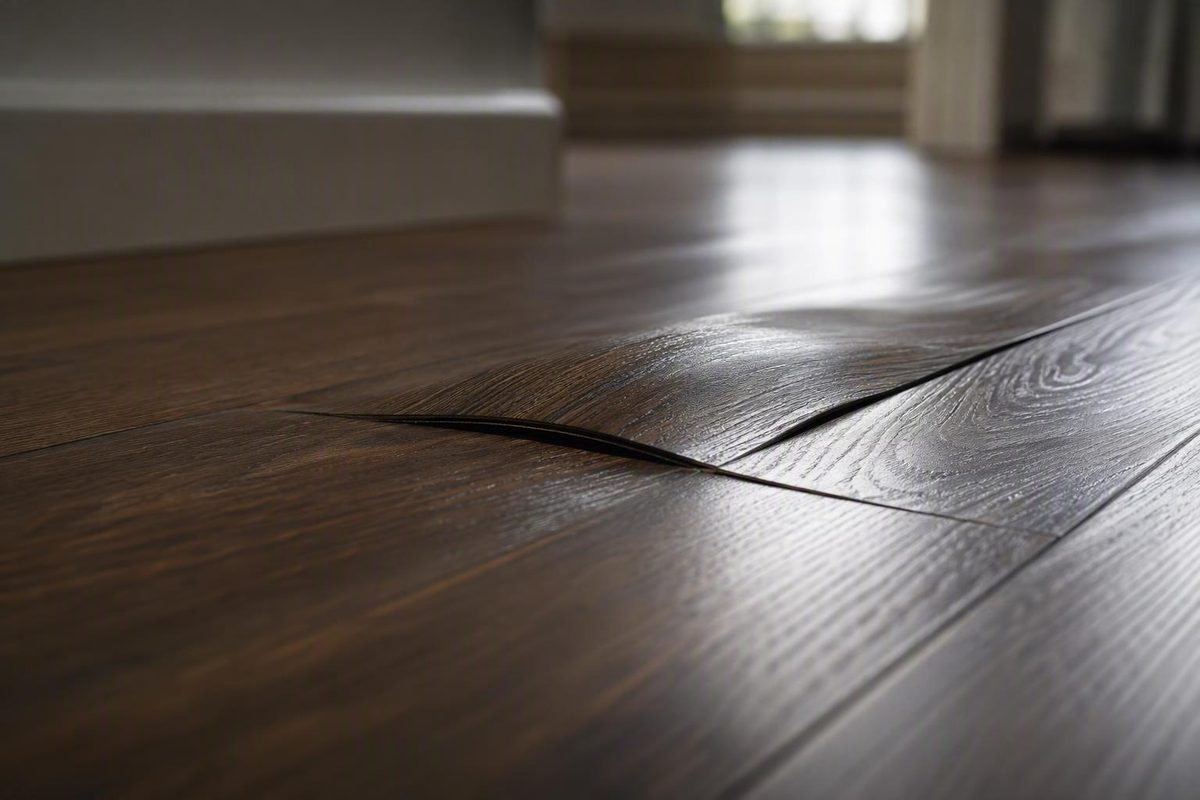
“Laminate bubbling” describes an appearance, not a diagnosis. A raised spot could be localized surface separation, a seam swollen by water, a warped plank, a bond problem in a glue-down installation, or several floating-floor rows lifting under pressure.
Those defects do not share one reliable repair. Before trying to flatten the area, stop any active water source, document the damage, identify the flooring and installation system, and determine whether the problem affects the decorative surface, the plank’s core and joints, or several connected boards.
The guidance available from flooring retailers and restoration providers is general and sometimes conflicting. It does not replace the installation, care, repair, and warranty documents for your exact product. Treat the steps below as a conservative first-response framework, not a visual diagnosis or universal repair procedure.
First, identify what “bubbling” means on your floor
Flooring guides use bubbling, swelling, lifting, warping, peaking, and buckling inconsistently. Tapi, for example, describes bubbling as small lifted, soft, or air-pocket-like areas in the laminate surface, sometimes at seams, while distinguishing that condition from broader lifting or warping of whole boards in its laminate-bubbling guide.
Start with what you can observe rather than choosing a repair based on the word bubble.
A localized surface issue
A localized defect may appear as:
- A small raised patch within one plank
- A thin area of decorative material lifting from the layer beneath it
- A soft or hollow-feeling spot
- A small ridge confined to one seam
- A surface change that does not move the entire plank
This pattern may involve separation within the plank’s layered construction. Appearance alone, however, cannot establish whether the cause is moisture, a bond problem, manufacturing quality, installation, or another condition.
A swollen seam or plank
Possible signs that more of the plank is involved include:
- A rounded or raised seam
- Edges that no longer sit flush with neighboring boards
- Softness near the affected joint
- A cracked, open, or unstable seam
- Distortion that remains after visible water is gone
- Damage concentrated where liquid could have entered a joint
Laminate commonly has a wood-fiber core. Water entering a vulnerable seam can be absorbed by that core, causing expansion and distortion of the surface or locking edges. Prattville Carpet describes this layered construction and seam-swelling mechanism in its overview of laminate bubbling.
Warping or broader buckling
If the raised area crosses several planks, follows a row, or forms a ridge near a wall, it may reflect broader floor movement rather than one surface blister. Look for:
- Several connected boards lifting together
- A ridge extending across rows
- Movement over a wider area
- Lifting near a wall, doorway, cabinet, pipe, or transition
- Boards appearing tight against trim or another fixed element
- A symptom that changes as indoor conditions change
A floating floor is connected across the room without being continuously bonded to the subfloor. It needs the movement clearance specified for that particular product. If constrained, the floor may press against a wall or obstruction and lift.
A hollow spot in a glue-down installation
A hollow area in glue-down laminate is not necessarily equivalent to a swollen click-lock plank. Commercial guides report trapped air, insufficient adhesive contact, uneven or contaminated subfloors, moisture, and material separation as possibilities, but they do not provide a dependable visual test that distinguishes among them.
Record the symptom before acting
Answer these questions first:
- What is the exact product? Check receipts, cartons, spare boards, installation records, or markings on an accessible plank.
- Is it floating or glue-down? Floating click-lock boards connect to one another; glue-down products depend on an adhesive bond to the substrate.
- Where is the defect? Note whether it is within one surface, at a seam, across a whole board, or spread over several rows.
- How does it feel? Record softness, hollowness, cracking, movement, and joint instability without repeatedly flexing the area.
- When did it appear? Consider spills, cleaning, appliance use, plumbing events, storms, and indoor-condition changes.
- Is it changing? Compare dated photographs or place removable painter’s tape beside—not on—a fragile surface to mark the affected extent.
This will not always produce a diagnosis. It can, however, prevent a localized cosmetic treatment from being applied to swollen-core damage or a constrained floating floor.
Take these steps before trying to flatten or repair the floor
The immediate goal is to prevent additional exposure, preserve evidence about the cause, and avoid making an uncertain defect harder to assess.
1. Stop active water
If there is an active spill, plumbing leak, appliance leak, overflowing fixture, or exterior water entry, stop or contain it before addressing the flooring. Shut off the affected fixture or appliance only when that can be done normally and safely; otherwise, call the appropriate tradesperson.
Do not replace a plank while water is still entering the floor assembly. Commercial guidance consistently places correction of the moisture source before flooring repair.
2. Remove accessible surface water
Blot or pick up standing water with dry, absorbent materials. Do not wet-mop the damaged area or use a steam cleaner. Both methods can introduce additional moisture at vulnerable seams; Tapi specifically identifies damp and steam cleaning as reported contributors to laminate bubbling in its care and repair discussion.
If the spilled substance requires special cleaning, consult the flooring manufacturer’s care instructions before applying a solution.
3. Reduce continued moisture exposure
Ventilate the room when conditions make that useful, or operate a dehumidifier to reduce ambient and residual moisture.
Treat this as damage control, not proof of recovery. A dehumidifier does not repair a leak, establish that concealed materials are dry, or reliably reverse an expanded fiberboard core. PuroClean likewise states that dehumidification may limit additional damage but does not reverse existing swelling in its laminate-bubbling guidance.
4. Keep traffic off an unstable area
Avoid walking, rolling furniture, or placing heavy loads over a soft, raised, or moving board. Do not test it by jumping on it, repeatedly pressing it flat, or covering it with a heavy object.
If the area presents a trip concern, restrict access until it can be assessed. Do not tape directly over a delicate finish or improvise a cover that transfers weight onto the raised spot.
5. Inspect the surroundings
Check beyond the visible defect:
- Adjacent planks and seams
- Baseboards and lower wall surfaces
- The floor around a dishwasher or refrigerator
- Sink cabinets and plumbing penetrations
- Toilets, tubs, showers, and nearby fixtures
- Exterior doors and walls
- Accessible areas below the room
Dampness, staining, soft trim, recurring condensation, or a wider field of distorted boards may indicate a broader moisture problem. Location is a clue, not proof of the source.
6. Document the condition
Take overview and close-up photographs, then record:
- When the defect was first noticed
- Its location and approximate extent
- Known spills, leaks, or cleaning events
- Whether it is growing or changing
- Any staining, odor, softness, or joint movement
- Relevant appliance, plumbing, or weather conditions
- Product information, receipts, and installer details
Before removing flooring or trim, check the terms of any applicable product warranty, installation agreement, or insurance policy. Documentation and inspection requirements are contract-specific.
7. Avoid invasive spot treatments
Until the product and defect are known, do not:
- Apply a hairdryer, heat gun, iron, steam, or damp cloth
- Cut, drill, puncture, or sand the surface
- Inject wood glue or another adhesive
- Hammer or tap the raised area
- Clamp or heavily weight it
- Trim plank edges to create space
These actions permanently alter the existing condition and may be incompatible with the flooring or installation system. Obtain product-specific guidance before attempting any of them.
Trace moisture from above, beside, or below the flooring
Moisture is a frequently reported contributor to raised laminate, but “water damage” is not a complete diagnosis. Determine where the exposure may have originated, whether it is continuing, and which parts of the floor assembly may be affected.
Moisture from above
Consider a recent spill, pet bowl, plant container, wet footwear, open window, overflowing fixture, or cleaning event. Ask:
- Did liquid remain on the floor or reach a seam?
- Was it removed promptly?
- Does the damage match the spill area?
- Are seams more affected than plank centers?
- Did the raised area appear immediately or later?
- Does softness or distortion remain after the surface dried?
One small area associated with a promptly removed spill may justify cautious drying and observation. Recurring swelling or distortion extending beyond the apparent spill is more concerning.
Wet or steam cleaning
Repeated wet cleaning may introduce small amounts of water at joints even when no dramatic spill occurred. Steam cleaning adds moisture and should not be assumed suitable unless the exact flooring manufacturer permits it.
Plumbing or appliance leakage
Damage near a dishwasher, refrigerator, washing machine, sink, toilet, tub, shower, water heater, or plumbing wall warrants inspection of that nearby source. Proximity does not establish causation, so avoid replacing flooring until the suspected fixture or appliance has been checked.
If practical, stop using a suspect appliance until its supply and drain connections are assessed. A plumber or appliance technician is generally the appropriate professional for active equipment or piping leaks.
Indoor humidity
Commercial guides report sustained indoor humidity as a possible contributor to dimensional change, but their recommended ranges conflict. Do not adopt one generic humidity target for every laminate floor.
Use the range in the current installation and warranty documents for the exact product. Also look for localized dampness or condensation that may warrant building or ventilation assessment.
A damp wood subfloor
Moisture may affect the underside of laminate or a wood subfloor even when no standing water is visible above. Recurring distortion, staining below the room, or symptoms unrelated to a known surface spill justify further investigation.
A dry-feeling surface does not establish the condition of concealed materials. If checking the subfloor requires lifting connected flooring, involve a flooring installer or moisture professional.
Moisture associated with concrete
Commercial sources also identify moisture associated with concrete as a possible contributor to recurring or widespread symptoms. The evidence supplied here does not support one universal reading threshold or testing method for every laminate, underlayment, adhesive, and slab assembly.
Follow the test method and acceptable conditions specified by the manufacturers of the flooring, adhesive, and underlayment. Seek assessment when moisture persists, its source is hidden, or the subfloor cannot be examined without removing flooring.
Check installation pressure, the subfloor, and underlayment
If no spill or leak is apparent, do not assume moisture is absent—but do not assume it is the only possible cause. Commercial flooring guidance also identifies insufficient perimeter clearance, installation tension, acclimation problems, uneven or damp subfloors, and unsuitable underlayment as possible contributors.
Why floating floors need movement space
A floating laminate floor is not continuously glued or nailed to the subfloor. It needs product-specified clearance at room edges and fixed obstructions.
If constrained, connected rows may press against a wall or obstruction and lift. The pattern may include:
- Several raised planks
- A ridge across multiple rows
- Peaking near a wall
- Movement near a doorway
- Lifting around a pipe or cabinet
- Symptoms that vary with indoor conditions
This differs from a small surface blister, even though both may be called bubbling.
Look for possible constraints
Without dismantling the floor, inspect visible areas around:
- Walls and baseboards
- Door frames and thresholds
- Pipes and floor penetrations
- Cabinet ends and islands
- Built-ins and fixed partitions
- Transition strips
- Trim that appears tight against the flooring
A visible gap in one location does not prove that the whole floor has adequate clearance. Do not remove trim or cut boards based on suspicion alone. A qualified installer can compare the installation with the exact product requirements.
There is no universal expansion-gap measurement for every laminate product or room. Follow the current instructions for the flooring, including any requirements at doorways, transitions, pipes, large rooms, and fixed objects.
Consider the pattern
A small spot within one board is more consistent with a localized defect than a ridge spanning several boards. Multi-board lifting or distortion concentrated near a wall may point toward broader movement, substrate conditions, or concealed moisture.
These are screening clues, not diagnostic tests. Different causes can produce similar-looking symptoms.
Evaluate the subfloor before replacement
Before installing a replacement board, establish whether the exposed subfloor is:
- Dry under the applicable product requirements
- Sufficiently flat for the flooring system
- Stable and undamaged
- Free of residue or contamination
- Compatible with the required underlayment or adhesive
A replacement installed over the same unresolved condition may develop similar damage.
Understand the role of underlayment
Underlayment sits between laminate and the subfloor.
The correct underlayment, orientation, seam treatment, and moisture-control arrangement are product-specific. Do not add or substitute layers without checking the flooring instructions. Underlayment is not a substitute for stopping an active leak or preparing the substrate.
Treat acclimation as product-specific
Commercial sources recommend different acclimation periods. That disagreement does not support one fixed rule.
Follow the instructions for the exact flooring, packaging, and site conditions. If installation records exist, note whether the room, flooring, and subfloor were prepared and documented as required.
Use a conservative repair-or-replace decision
Drying and repair are not interchangeable. Drying addresses continued exposure; replacement addresses material that remains physically damaged after the source or installation problem has been corrected.
PuroClean states that swollen laminate boards rarely regain their original shape, while other commercial guides suggest that limited recent damage may become less noticeable after drying. The evidence does not establish that an expanded fiberboard core will reliably return to its original dimensions.
When drying and monitoring may be reasonable
Careful observation may be reasonable when all of the following are true:
- The exposure was very recent and small
- The source is known and has been stopped
- Surface water was removed promptly
- No additional moisture is appearing
- The affected area is limited
- The surface is not persistently soft or cracked
- Seams remain aligned and stable
- No broader lifting or recurring distortion is visible
- Monitoring is consistent with the product’s care instructions
Keep traffic light, compare dated photographs, and do not force the area flat.
There is no evidence-backed waiting period that applies to every floor. Base the decision on whether the source is resolved, applicable moisture requirements are met, and distortion remains—not on a generic number of days.
Signs favoring replacement evaluation
Ask an installer to evaluate replacement when you find:
- Persistent swelling after the moisture condition is corrected
- Softness or crushing in the surface or core
- Cracking, chipping, or surface separation
- A distorted or broken seam
- A loose or unstable locking joint
- Permanent warping or edge lift
- Multiple affected boards
- Recurring symptoms
- Damage above a damp or deteriorated subfloor
- A raised area that continues to spread
A board may be dry but still permanently distorted. Removing moisture does not necessarily restore an expanded core or damaged locking profile.
Match the response to the defect
| Observed condition | Appropriate next step |
|---|---|
| Small, recent spill; stable surface and seams | Stop the source, dry conservatively, document, and monitor |
| Localized surface lifting | Obtain product-specific assessment; do not assume glue or heat is suitable |
| Persistent swollen seam or soft core | Evaluate the affected plank for replacement |
| Several rows lifting near a wall or obstruction | Have a flooring installer check movement clearance and other constraints |
| Hollow area in glue-down flooring | Identify the adhesive system, substrate condition, and product before repair |
| Recurring or widespread distortion | Investigate concealed moisture, subfloor conditions, and installation factors |
Correcting the underlying cause is a prerequisite to permanent repair. Replacing one board does not necessarily mean replacing the entire floor; feasibility depends on access, the locking system, adjacent-board condition, installation method, and compatible replacement material.
Understand the options for replacing an individual plank
Individual click-lock planks can sometimes be replaced, but there is no universal procedure. The appropriate method depends on the product, board location, locking profile, room layout, and surrounding floor condition.
A damaged plank near a wall
For a board relatively close to an accessible wall, a professional may:
- Remove the necessary trim.
- Record plank orientation and row sequence.
- Disassemble rows until the damaged board is reached.
- Inspect the exposed underlayment and subfloor.
- Correct residual moisture or substrate problems.
- Install a compatible replacement.
- Reassemble the floor and restore the required clearance.
Flooring Supplies describes row disassembly as one possible approach for a board near a wall in its laminate repair guide. Treat that as a high-level option, not a procedure suitable for every locking system.
A damaged plank in the middle of the room
Some published methods involve cutting the damaged board into sections, removing it, modifying the replacement profile, and using adhesive to secure the new board. This is an invasive, skill-dependent repair—not a universal DIY shortcut.
Cutting an installed floor can damage adjacent boards, the underlayment, or the replacement opening. It also permanently modifies the installation. Check the flooring manufacturer’s repair instructions and your own warranty terms before authorizing a cut-out method.
Inspect beneath the removed board
Before closing the opening, inspect accessible areas for:
- Residual dampness
- Staining or residue
- Underlayment damage
- Subfloor deterioration or irregularity
- Damage to adjacent plank edges and locking profiles
- Evidence of inadequate movement clearance
Do not install the replacement until the underlying moisture, substrate, or constraint problem has been corrected.
Check replacement material first
Look for spare boards from the original installation and compare:
- Manufacturer and collection
- Product code
- Dimensions and thickness
- Locking profile
- Attached pad, if present
- Texture, gloss, pattern, and edge treatment
- Color under the room’s actual lighting
Compare it before dismantling or cutting the existing floor.
Use an experienced installer when the board is in the middle of the room, the locking system is unknown, surrounding boards are damaged, moisture still needs investigation, or controlled cutting would be required.
Avoid popular fixes that can create a second problem
Some commercial guides recommend slitting a bubble, injecting adhesive, applying heat, or weighting the area. Action Carpet & Floor Decor, for example, suggests adhesive injection for some minor bubbles and heat for defects attributed to trapped air in its repair article.
The supplied sources do not provide manufacturer validation or a reliable diagnostic boundary showing when those methods apply. A homeowner cannot safely infer from appearance alone that a raised area is trapped air rather than swollen core, surface separation, substrate movement, or expansion pressure.
Cutting, slitting, or drilling
A cut through the wear surface is permanent. If the diagnosis is wrong, the original defect remains and the floor gains a visible opening. Cutting also changes the condition that a manufacturer, installer, or assessor may need to inspect.
Injecting adhesive
Adhesive compatibility depends on the product, substrate, existing adhesive, and installation method. A glue intended for one repair should not be assumed suitable for a different laminate construction.
In a glue-down floor, a hollow sound does not establish why the bond is missing.
Applying heat or adding moisture
Do not apply heat unless the manufacturer provides a procedure for the exact defect and product.
Likewise, adding a damp cloth to an unexplained raised area is not a conservative response when moisture may have contributed to the damage.
Weighting the spot
A weight may temporarily make a raised area appear flatter, but it does not identify or correct:
- An expanded core
- Residual moisture
- A damaged locking joint
- Pressure across several rows
- A damp or uneven subfloor
- An incompatible adhesive condition
If the defect returns after the weight is removed, its cause remains unresolved.
Pre-repair checklist
Before cutting, heating, gluing, drilling, trimming, or weighting:
- Identify the exact flooring product.
- Determine whether it is floating or glue-down.
- Read its current care, installation, repair, and warranty documents.
- Confirm that the moisture source has been stopped.
- Determine whether concealed moisture requires assessment.
- Establish whether the surface, core, joint, or several boards are affected.
- Check for broader lifting and possible constraints.
- Photograph the undisturbed condition.
- Ask the manufacturer or installer whether the method is permitted.
- Confirm that compatible replacement material is available.
When those questions cannot be answered, professional plank-replacement evaluation is more defensible than experimenting on the visible surface.
Prevent recurrence and know which professional to call
Prevention depends on controlling moisture and avoiding installation stress. A cosmetic repair is unlikely to last if the underlying condition remains.
Reduce future moisture exposure
- Clean spills promptly with dry, absorbent materials.
- Repair plumbing and appliance leaks rather than relying on towels or trays as permanent containment.
- Use restrained cleaning methods.
- Avoid wet or steam cleaning unless expressly permitted for the exact flooring.
- Prevent recurring water exposure around pet bowls and plant containers.
- Investigate repeated dampness near doors, fixtures, cabinets, and appliances.
- Maintain indoor conditions within the flooring manufacturer’s specified range.
Do not substitute a generic humidity target for the product documentation; the commercial sources in the evidence base publish conflicting ranges.
Prepare future installations correctly
For installation or replacement, confirm:
- A clean, dry, sufficiently flat and stable subfloor
- Moisture assessment using the method required for the flooring system
- Compatible underlayment or adhesive
- Product-specified movement clearance
- Correct treatment at walls, pipes, doorways, transitions, and fixed objects
- Acclimation when and as required by the manufacturer
- Correction of active leaks and continuing substrate moisture
Do not install replacement material until the leak, moisture condition, subfloor defect, or movement restriction has been addressed.
Call the professional suited to the cause
Call a plumber for an active or suspected supply, drain, fixture, or concealed piping leak.
Call an appliance technician when a dishwasher, refrigerator, washing machine, or another appliance appears to be the source.
Call a qualified flooring installer for suspected movement constraints, locking-system problems, product identification, controlled disassembly, or plank replacement.
Call a water-damage or building-moisture professional for widespread wet materials, persistent subfloor moisture, recurring unexplained damage, musty odors, or suspected hidden moisture. PuroClean reports that trapped moisture beneath laminate can support mold growth, but bubbling alone does not establish that mold is present or prove a health hazard in its discussion of concealed moisture.
Use this decision path:
- Stop active water.
- Remove accessible surface moisture without wet or steam cleaning.
- Photograph and document the symptoms.
- Identify the flooring and installation system.
- Inspect for moisture from above, beside, and below.
- Look for broader movement and possible constraints.
- Follow the exact product instructions.
- Monitor only recent, limited damage that remains stable.
- Evaluate replacement when swelling, softness, joint damage, or distortion persists.
- Correct the underlying condition before permanent repair.
Do not begin by forcing the raised area flat. The actual defect and the exact product instructions—not a generic heat, glue, cutting, or weighting trick—should determine the repair.
Frequently asked questions
Can laminate bubbling go away after the floor dries?
A very small, recent moisture event may become less noticeable after the source is stopped and the area dries. Drying cannot be relied upon to restore a fiberboard core that has already expanded.
If the surface remains soft, seams stay raised, joints become unstable, or the plank remains warped, have it evaluated for replacement. There is no universal waiting period; judge the floor by persistent distortion and the product’s applicable moisture requirements.
Does laminate bubbling always mean there is water underneath the floor?
No. Moisture is a frequent contributor, but raised laminate is also associated in commercial guidance with inadequate movement clearance, installation tension, uneven or damp subfloors, unsuitable underlayment, glue-down bond problems, and localized surface separation.
The pattern provides clues but not proof. A swollen seam after a spill differs from a ridge spanning several rows near a wall, so inspect both moisture sources and installation constraints.
Can a single bubbled laminate plank be replaced?
Sometimes. A click-lock board near a wall may be accessible by disassembling rows. A board in the middle of the room may require a more invasive professional procedure.
Feasibility depends on the locking system, plank location, adjacent-board condition, availability of compatible material, and correction of the underlying problem. Replacing one plank does not automatically require replacing the entire floor.
Should I inject glue or use a hairdryer on a laminate bubble?
Not as a general treatment. Commercial guides mention glue injection and heat, but they do not establish a dependable way to distinguish a suitable adhesive defect from swollen-core damage, surface separation, or expansion pressure.
Identify the product, installation system, and likely cause first. Obtain manufacturer or installer guidance before attempting an invasive spot repair.
When should I call a plumber, flooring installer, or water-damage professional?
Call a plumber for an active or suspected plumbing leak and an appliance technician when a leaking appliance appears responsible.
Call a flooring installer when several boards are lifting, the floor may be constrained, the locking system is unknown, or a plank must be removed or replaced.
Call a water-damage or building-moisture professional for widespread wet materials, persistent subfloor moisture, recurring unexplained damage, musty odors, or suspected hidden moisture. Do not wait for a cosmetic flooring repair while water is still entering the assembly.