
Is Mid-Range Engineered Hardwood Worth It in 2026?
Mid-tier flooring is losing market support. Compare construction, installation costs, repair options, and ownership fit before choosing engineered wood.
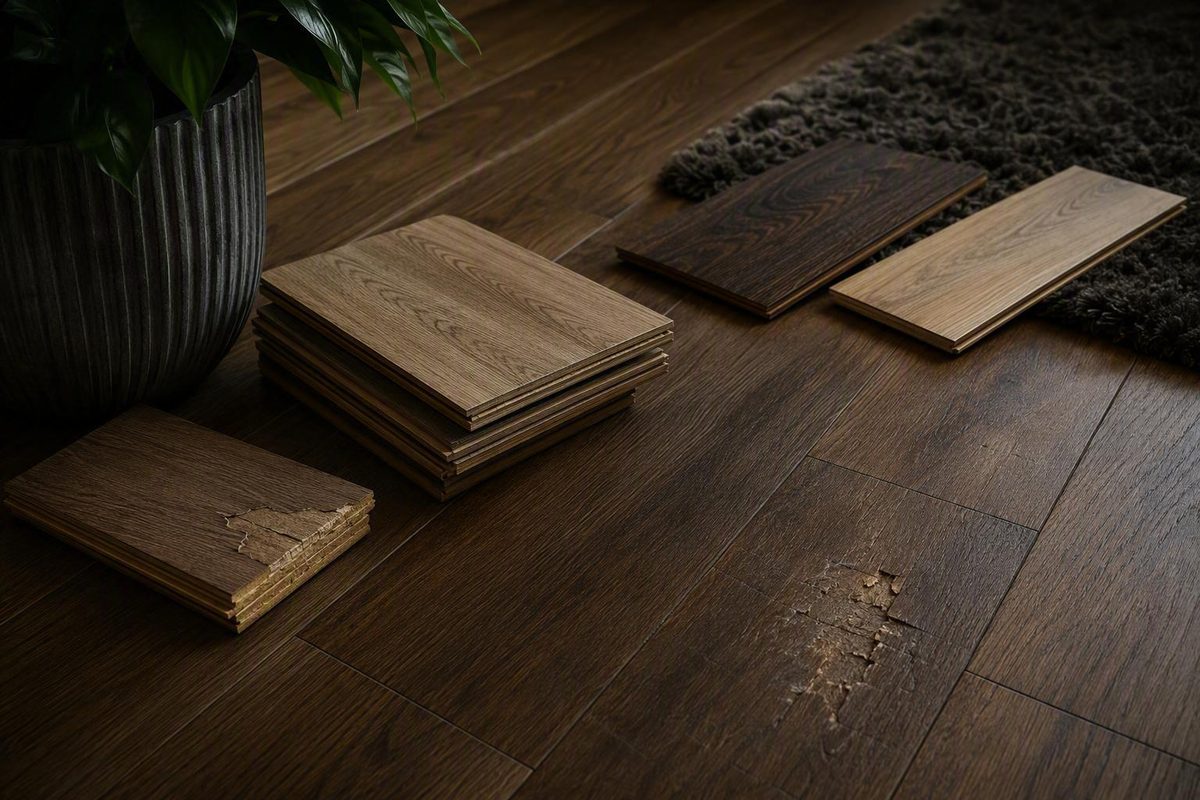
No—not as the default compromise. U.S. hardwood volume fell 6.8% in 2025, from 676 million to 630 million square feet, and the decline was concentrated in the middle while entry-level and high-end engineered products held up better. Mid-range engineered hardwood can still be worth buying, but only when a specific product proves its value; splitting the difference on price alone now puts you in the category’s fastest-eroding bracket (Floor Covering News’ 2026 hardwood market report).
That market pattern does not prove a mid-tier plank is less durable. It does mean buyers should expect less certainty about continuing SKU availability, matching stock, installer familiarity, and comparable local sales than the familiar “middle is safest” rule implies. The cited market report does not provide national figures for those support measures, so verify them locally rather than assuming the middle tier remains the most broadly supported.
The Moderate-Price Argument Is Reasonable
The consensus view has a sound basis: bargain flooring can conceal a thin veneer, inconsistent milling, limited room approvals, or no practical repair path, while premium flooring may charge heavily for appearance. A mid-priced product can avoid both problems by buying adequate construction without paying for unusually long boards, selective grading, uncommon colors, or extra width.
Price also fails as a universal quality standard. One seller places mid-range material at approximately $4–$7 per square foot and premium material at $7–$12 or more (retailer cost guide). A manufacturer uses approximately $5–$8 per square foot for mid-range material (manufacturer pricing overview). Another commercial seller puts the middle at roughly $7–$12.
Those overlapping ranges show why the moderate-price argument sometimes works. A well-documented $6 product may be substantially better than a vague $4 product without carrying premium decorative costs. Conversely, a $7 label could describe the middle tier in one showroom and the start of premium in another.
The consensus is therefore right about one thing: neither the cheapest nor the most expensive floor automatically offers the best value. It is wrong to treat the middle price as evidence that a product has captured the useful features of both extremes.
The Market Is Becoming a Barbell
Hardwood sales declined from $1.845 billion in 2024 to $1.774 billion in 2025, a 3.8% drop. Volume declined faster, falling from 676 million to 630 million square feet. Engineered wood nevertheless increased its category share from approximately 75% to 77%.
Within engineered hardwood, higher-end 5/8- to 3/4-inch products and premium grades continued to perform well, while entry-level 3/8-inch products remained stable. A Johnson Hardwood executive described a “noticeable decline in volume” in the middle, tied partly to constrained consumer spending.
These fractions describe the product brackets reported in the market coverage, not the hardwood wear layer. Wear layers are commonly specified in millimeters and must be checked separately. A 5/8-inch-thick plank can still have a surface too thin for conventional sanding.
The evidence supports a narrow verdict. It shows eroding demand in the middle, not defective construction across every mid-tier collection. A documented middle product can still be the right floor. The burden of proof has simply shifted: its specifications, installed cost, replacement-stock outlook, and repair options must justify choosing the shrinking bracket over a stable entry product or a genuinely better premium one.
Enter your material budget and product thickness; the checker identifies which market bracket your project occupies and estimates the quoted cost range.
This is a market-position screen, not a quality grade. Enter material prices before labor, then identify the product’s overall construction bracket.
| Bracket | Price Screen | 2025 Market Signal | What Must Justify It |
|---|---|---|---|
| Entry 3/8-inch product | Below the cited ~$4 mid-range starting point | Stable | Room approval, disclosed core, acceptable milling, and low all-in cost |
| Middle Between reported extremes | ~$4–$7 in one seller’s range; other definitions overlap | Noticeable volume decline | Documented improvement over entry, plus replacement and repair support |
| Premium 5/8–3/4-inch product or premium grade | ~$7–$12+ in one seller’s range | Continued to perform well | Usable wear layer, written refinishing approval, milling, or site-specific benefits |
Sources: Floor Covering News full-year 2025 hardwood report; seller ranges of ~$4–$7 mid-range, ~$7–$12+ premium, and ~$3–$10 labor. Price bands overlap and are not national quality standards.
A Mid-Tier Label Must Buy Verifiable Construction
The first specification to request is the hardwood wear-layer thickness, not merely total plank thickness. The wear layer is the real wood above the core and affects how much material is available for surface repair.
Use these figures as screening guidance rather than sanding guarantees:
- Under 2 mm: Treat cautiously when future sanding matters.
- Approximately 2–3 mm: Commercial guidance suggests this may permit one carefully controlled light sanding.
- At least 3 mm: Provides more material than a thinner veneer but does not guarantee refinishing.
One commercial comparison says 2–3 mm veneers can generally tolerate one light sanding, while thinner 1–2 mm veneers generally cannot (veneer and cost comparison). Contractor guidance in the draft recommends 3–6 mm when refinishing is a priority, but that remains a screening rule rather than an industry guarantee.
Obtain written confirmation of how much usable hardwood lies above the tongue, groove, or locking joint and whether sanding is permitted. Nominal thickness alone does not establish refinishing eligibility.
Core construction also needs disclosure. Engineered flooring may use plywood, high-density fiberboard, oriented strand board, or another layered core. None is universally best. Its suitability depends on the subfloor, moisture exposure, joint design, installation method, radiant-heat system, emissions requirements, and consequences if water reaches the core.
Inspect milling separately. Boards should sit flat, connect consistently, and have reasonably uniform dimensions. Irregular joints and thicknesses can create gaps, height differences, extra waste, difficult installation, and more complicated board replacement. Retail specification guidance identifies dimensions, joint fit, core disclosure, wear layer, board length, and finish as more useful signals than price alone (specification comparison).
A middle-tier premium has not been earned if the seller cannot provide the technical sheet, installation manual, warranty, wear layer, core construction, approved rooms, permitted installation methods, moisture limits, finish information, and refinishing rules.
Installed Cost Can Erase the Apparent Compromise
Material price is only one line of the project budget. Published professional labor estimates range from approximately $3–$10 per square foot, depending on location and complexity. One manufacturer places combined engineered-wood material and professional installation at approximately $7–$20 per square foot. These ranges describe different scopes and should not be added automatically.
Every quote should separate the costs that can overwhelm a small difference between product tiers:
| Cost Area | Required Detail |
|---|---|
| Floor and delivery | Cartons, tax, waste, handling |
| Existing surface | Removal, disposal, damaged areas |
| Subfloor | Moisture testing, flattening, repair |
| Installation | Labor, adhesive, fasteners, underlayment |
| Completion | Trim, transitions, stairs, cleanup |
| Future repair | Spare cartons and board replacement method |
Ask competing bidders to price the same scope. A low labor quote is not comparable if it omits moisture testing, floor flattening, vapor control, adhesive, transitions, or cleanup.
For ownership planning, divide the all-in initial project cost by the assumed years of service. An $18,000 project equals $2,250 per year over eight years, $1,200 per year over 15 years, or $720 per year over 25 years. Those are arithmetic scenarios, not lifespan forecasts.
Then compare two repair cases. In the first, assume no refinishing and use the period you realistically expect to keep the floor. In the second, add an estimated future refinishing cost and extend the service period only as far as you consider credible. Do not assume a nominally thick plank guarantees an additional sanding cycle.
A five-year owner may rationally choose a stable entry product with suitable room approvals rather than paying for repair potential that will never be used. A long-term owner may obtain better value from premium construction with a documented wear layer, accurate milling, written refinishing approval, and matching stock.
Engineered Construction Still Solves Real Site Problems
Engineered hardwood’s layered construction generally provides greater dimensional stability than a single piece of solid wood. Depending on the exact product, that can make installation over concrete, with some radiant-heating systems, or by floating or glue-down methods practical. Manufacturer guidance describes these as category-level possibilities, not universal approvals (engineered-versus-solid guide).
That distinction matters when judging the middle tier. A mid-priced floor explicitly approved for your slab, room, heating system, and installation method can be worth more than a premium product that is unsuitable for the site.
For concrete or below-grade work, require the moisture test specified by the manufacturer, written slab approval, the required vapor-control system, and compliance with flatness tolerances. A slab that appears dry is not a substitute for testing.
For radiant heat, confirm the maximum temperature, startup procedure, conditioning requirements, moisture limits, approved adhesive or underlayment, and compatibility with the heating-system instructions.
Ordinary engineered hardwood is not waterproof. Dimensional stability does not make the hardwood face or core immune to standing water. Water reaching the core can contribute to warping or buckling, while a thin wear layer may limit later repair (engineered-hardwood limitations). Recurring leaks, seepage, or flood exposure can make a specifically warranted resilient floor more rational than any engineered-wood tier.
The surface also remains real wood. Pets, grit, rolling furniture, sunlight, and dropped objects can produce scratches, dents, fading, gouges, and edge wear. One homeowner reported that engineered hickory remained acceptable after approximately 12 years with children and a large dog, despite visible wear, but later learned the thin surface could not be refinished as expected (homeowner account). That account illustrates the consequence of an undisclosed or misunderstood wear layer; it does not predict category-wide longevity.
Installation Method Changes Repair Value
A floor may be floated, glued, nailed, or stapled only when the product, subfloor, and room permit that method.
A floating installation can simplify some projects, but it depends on subfloor flatness, approved underlayment, expansion gaps, continuous-floor limits, transitions, and restrictions around fixed cabinets or islands. Sound and movement should be evaluated from the actual assembly rather than assumed from the word “floating.”
Glue-down installation can suit concrete but adds requirements for slab moisture, adhesive compatibility, coverage, working time, cleanup, and vapor control. Discuss isolated-board replacement before installation; it may not be simple.
Nail- or staple-down installation requires a compatible wood subfloor and explicit approval for mechanical fastening. Familiarity with the method does not override the manufacturer’s fastener and spacing requirements.
This is where weakening middle-tier support can matter. Ask the installer whether the exact SKU is familiar, how individual boards would be replaced, and whether matching stock can be obtained. No national contractor-familiarity or SKU-retention figures were supplied in the market report, so written local answers are more useful than a broad claim about the category.
Buy spare boards from the same production run when practical. Store them as directed. For smaller surface defects, the wood-floor filler guide covers repair materials separately.
The Stable Extremes Serve Different Buyers
A budget engineered floor can be reasonable in a dry, low-risk room, rental turnover, temporary renovation, or short ownership period. Its lower material price does not remove the need for moisture testing, preparation, approved installation materials, or competent labor.
Premium engineered hardwood is justified when the increase buys a thicker usable wear layer, written refinishing approval, better-suited core, more accurate milling, broader site approvals, useful warranty coverage, longer average boards, or dependable matching stock. Decorative grade alone is a weaker reason to upgrade.
Solid hardwood remains a strong long-term option where site conditions and the subfloor permit it. It generally offers substantially more wood above the joint and greater potential for repeated sanding, while engineered construction offers broader stability and installation possibilities (solid-versus-engineered guide).
LVP, SPC, rigid core, and laminate lack a hardwood face and cannot be sanded. They may nevertheless fit projects where spill tolerance, visual consistency, rental use, or minimum initial cost matters more than authentic wood. Their water warranties and subfloor requirements remain product-specific.
If sound hardwood already exists, obtain a refinishing quote before paying for demolition and replacement. Resale should also be treated locally. Engineered hardwood may appeal to buyers, but the result depends on neighborhood expectations, home price, floor condition, and style rather than a guaranteed return (hardwood resale discussion).
The Buying Rule Favors Documented Extremes
Choose the least expensive product that meets the documented needs of the room, installation, and ownership plan. In the current market, that often means selecting a suitable entry product or paying for a clearly superior premium floor rather than assuming the middle combines both advantages.
A mid-range floor remains defensible when it discloses a useful wear layer, suitable core, sound milling, room approval, installation options, repair strategy, matching-stock outlook, and competitive all-in cost. Leave unknown specifications marked as unknown; do not replace them with verbal assurances.
Reject the middle-tier premium when refinishing promises are verbal, core construction is vague, the manual is unavailable, moisture limits are missing, preparation is excluded from the quote, or the extra price buys only color and branding. In those cases, the moderate choice is not moderate risk—it is an inadequately documented product in the bracket losing volume fastest.