
Best Engineered Hardwood: Choose by Room and Specification
Choose engineered hardwood by moisture risk, subfloor, installation method, wear layer, finish, emissions documentation and warranty—not brand hype.
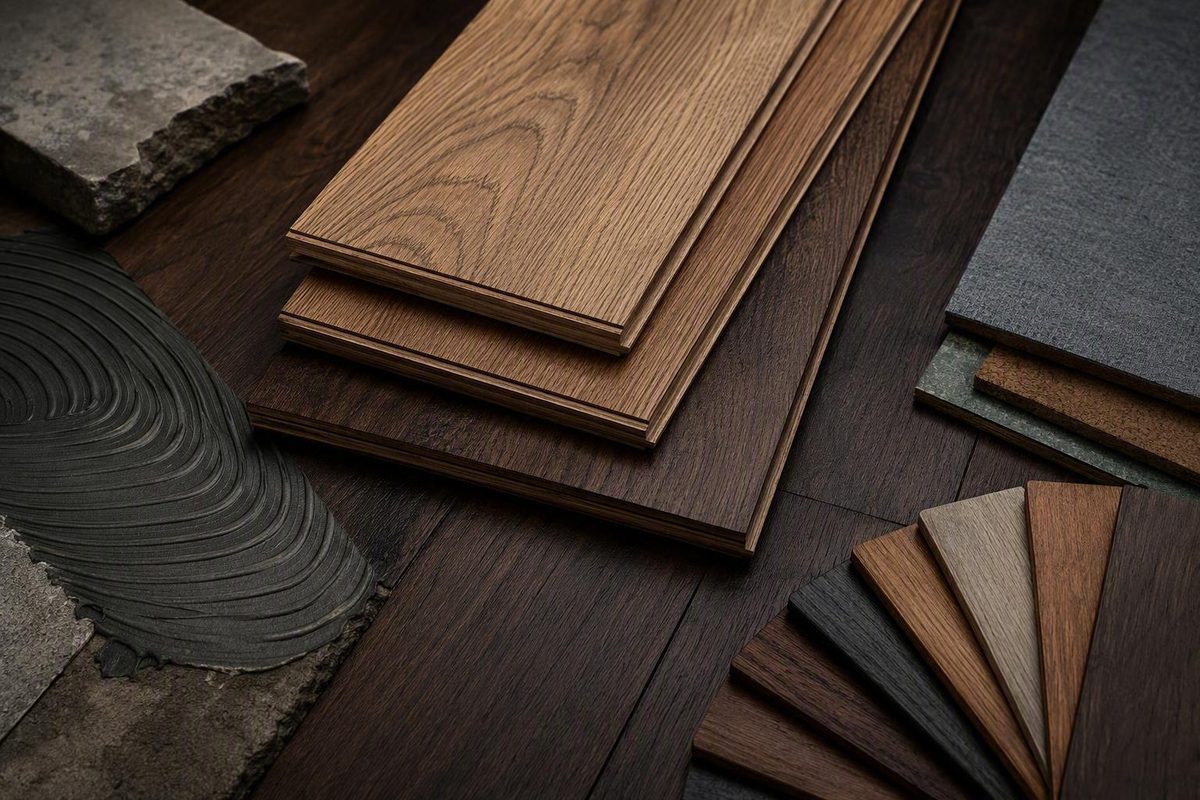
There is no single best engineered hardwood for every house. The best product is the one whose exact SKU suits the room, subfloor, moisture conditions, installation method and expected repairs—and documents those facts before you buy.
For most dry living spaces, a strong default is:
- a real-wood veneer at least 2.5 mm thick if future sanding matters;
- a factory finish in a low- or medium-sheen appearance;
- written approval for your subfloor, grade level and installation method;
- a readily available matching stair nose, reducer and other required trim;
- a warranty whose exclusions you can realistically satisfy; and
- TSCA Title VI labeling when the product contains regulated composite-wood components.
If the floor will go over concrete, radiant heat or below grade, those conditions—not color or brand—should lead the decision.
Best choice by situation
| Situation | Prioritize | Stop if… |
|---|---|---|
| Dry living room or bedroom | Desired appearance, documented construction, appropriate installation method | The seller cannot produce the SKU’s installation guide and warranty |
| Busy household or pets | Matte or low-sheen finish, forgiving grain/color variation, spare planks | You expect a long finish warranty to cover ordinary scratches or dents |
| Concrete slab or below grade | Product explicitly approved for that location, compatible glue or floating system, slab moisture plan | The slab has not been tested or moisture exceeds the product-system limit |
| Radiant heat | Written approval for the exact species, construction and heating system | The instructions omit temperature and moisture limits |
| Future sanding and color changes | NWFA Certified Refinishable product or documented wear layer meeting the relevant benchmark | Only total plank thickness is disclosed |
| Full bathroom or recurring leaks | Usually a different flooring category | You are relying on “waterproof” marketing instead of the written exclusions |
For a broader room-and-subfloor decision path, start with how to choose an engineered hardwood floor. If installation method is the unresolved issue, use the engineered hardwood installation checklist.
1. Match the floor to moisture and the subfloor first
Engineered construction does not make wood immune to water. One major manufacturer’s 2026 warranty says its engineered wood resists topical water damage for up to eight hours, but also says the floor is not a waterproofing barrier and excludes full bathrooms with a shower or tub. That is why the written warranty matters more than the word “waterproof” on a display card (AHF Products warranty). Mirage likewise says highly moist environments, including full and half bathrooms, are not recommended for hardwood (Mirage installation FAQ).
Over concrete or below grade, choose only a SKU whose instructions approve the location and specify the full assembly: vapor control, underlayment or adhesive, moisture-test method and limits. Shaw’s engineered-hardwood instructions, for example, require a clean, flat, dry and structurally sound substrate, set concrete test limits, and allow engineered flooring on, above or below grade under stated conditions (Shaw installation instructions). Those figures are product instructions, not universal limits; the National Wood Flooring Association says the flooring manufacturer’s instructions should supersede its general guidance (NWFA Installation Guidelines).
2. Buy enough real wood for the repair plan
Do not confuse overall plank thickness with wear-layer thickness. The latter is the real wood available above the engineered core and is the relevant specification when evaluating whether a floor can be sanded.
The NWFA’s voluntary Certified Refinishable program uses minimum wear layers of 2.5 mm for factory-finished smooth flooring, 2.5 mm at the lowest point for sculpted or distressed flooring, and 3.2 mm for unfinished engineered flooring. It also notes that its sanding guidance generally advises against sanding when remaining wear thickness is below 3/32 inch (NWFA program explanation).
A 2.5 mm veneer is therefore a useful threshold when one future full sanding is important, but it is not a promise of a particular number of sandings. Bevel depth, surface sculpting, previous sanding, flatness and the technician’s process all affect what remains. The safest evidence is certification for the specific product; NWFA publishes its current list of participating manufacturers and distinguishes unfinished from factory-finished products (NWFA Certified Refinishable manufacturers).
If the veneer is thinner or undisclosed, treat the floor as a recoat-or-replace product unless the manufacturer states otherwise. Learn what must be verified before abrasive work in how to refinish engineered hardwood safely.
3. Choose finish by maintenance, not an inflated warranty number
A long residential warranty does not mean the surface cannot scratch. The AHF warranty cited above excludes marks, scuffs, scratches, gouges, dents and cuts, along with moisture and environmental damage. Read what “wear-through” means, who receives coverage, whether labor is included, and which cleaners, adhesives and humidity range are required.
For a busy home, low or medium sheen and visible grain variation generally make small marks less conspicuous than a glossy, uniform dark floor. Finish chemistry still matters: lacquered factory finishes are commonly selected for easy residential cleaning, while oiled floors require a different maintenance routine and can be refreshed with compatible oil (Kährs flooring FAQ). Order samples, view them upright and flat in daytime and artificial light, then inspect several cartons before installation because natural color and grain vary.
4. Verify radiant-heat approval SKU by SKU
Do not accept “engineered wood works over radiant heat” as a complete answer. Get written approval for the product, wood species, heating type, installation method, vapor control and maximum surface temperature. Kährs, for example, excludes several species from its general radiant-heat recommendation and limits wood-floor surface temperature to 80°F/27°C (Kährs flooring FAQ). Another brand may set different conditions.
5. Check emissions and sourcing claims precisely
For U.S. purchases containing regulated hardwood plywood, MDF or particleboard, look for the required TSCA Title VI compliant label. EPA says regulated composite panels and finished goods manufactured in or imported into the United States after March 22, 2019 must be certified as compliant; the rule covers hardwood plywood, MDF and particleboard used in products including flooring (EPA consumer guidance). Compliance is a baseline formaldehyde requirement, not proof that every possible VOC is absent.
If responsible forest sourcing is important, ask whether the specific flooring carries an FSC label rather than relying on a company-level sustainability statement. FSC says a label on the finished product signals that materials met chain-of-custody requirements through the supply chain (FSC chain of custody).
The five-document buying test
Before paying a deposit, collect these for the exact style and SKU:
- Product data sheet showing total thickness, wear-layer thickness, dimensions and finish.
- Installation instructions approving the room, grade, subfloor and method.
- Moisture-testing and environmental limits.
- Complete residential warranty, including water, scratch, labor and transfer exclusions.
- Care instructions plus documentation for emissions or sourcing claims you value.
Reject a product when the retailer substitutes a generic brochure for SKU-level documents. Appearance can break a tie, but documented fit should decide which engineered hardwood is best for the room.