
Engineered Hardwood vs LVP: Choose by Room
Real wood and renewal favor engineered hardwood in dry rooms; waterproof-rated LVP suits moisture, easy upkeep, and a lower initial cost.
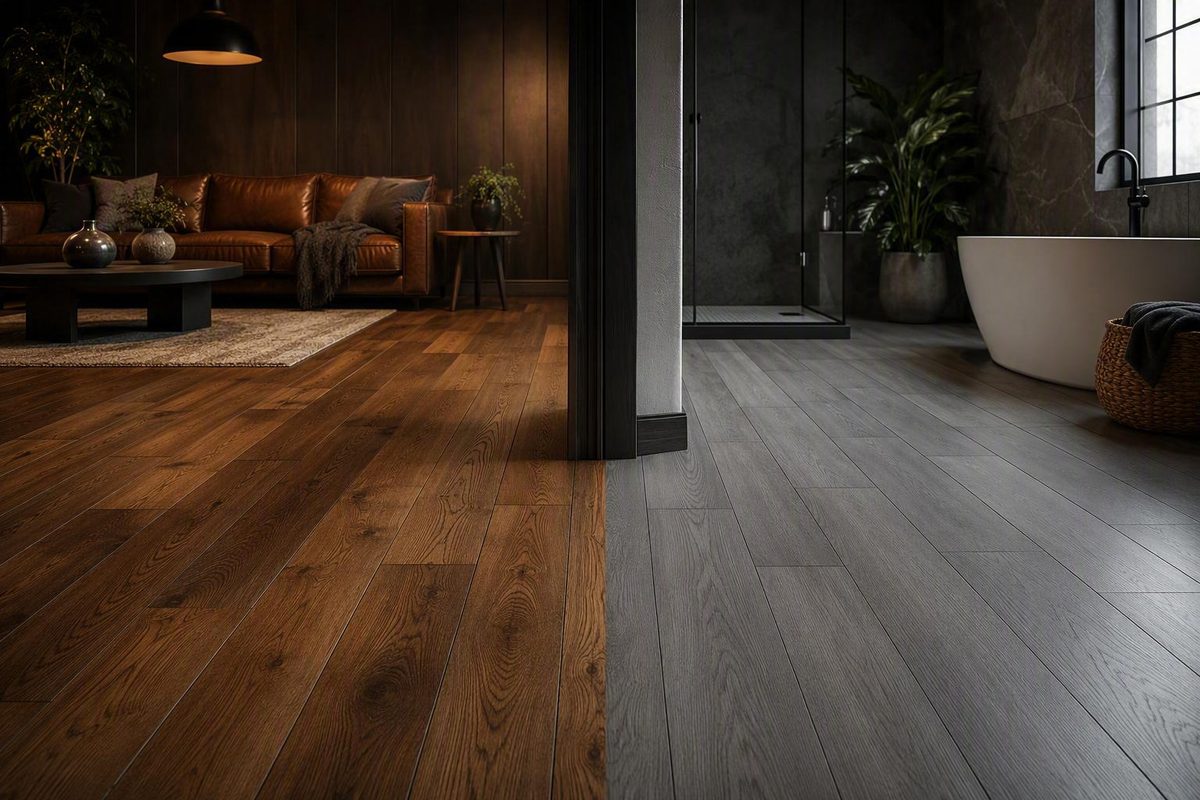
Engineered hardwood is usually the better choice for dry living areas when you want a genuine wood surface and the possibility of future renewal. Waterproof-rated luxury vinyl plank (LVP) is usually safer where spills, moisture, simple upkeep, rental use, or a lower initial cost matter more.
Neither category wins everywhere. The room, subfloor, exact product, installation method, traffic, maintenance habits, and ownership horizon can reverse the decision.
The short answer: choose by room conditions, not the flooring label
Start with the conditions the floor must survive. A premium engineered hardwood in a dry, climate-controlled living room solves a different problem from an entry floor exposed to wet shoes or a floating floor installed over a basement slab.
Use this table as a starting point, then check the technical sheet and warranty for the exact product.
| Room | Usual front-runner | Deciding condition | Required product check |
|---|---|---|---|
| Dry living room | Engineered hardwood | Genuine wood appearance and future renewal matter | Maintained humidity, installation method, and refinishing permission |
| Bedroom | Either | Authenticity versus cost and easy care | Subfloor compatibility, acoustics, and approved underlayment |
| Kitchen | LVP, conditionally | Frequency of spills and speed of cleanup | Kitchen approval and exact topical-water terms |
| Full bathroom | Waterproof-rated LVP | Repeated splashes and standing-water risk | Explicit full-bath approval plus flood and perimeter exclusions |
| Laundry room | Waterproof-rated LVP | Leaks, overflows, and appliance loads | Laundry-room approval, joint terms, and appliance requirements |
| Entry or mudroom | Waterproof-rated LVP | Wet grit, shoes, pets, and frequent cleaning | Scratch, indentation, stain, and wet-area provisions |
| Concrete basement | Waterproof-rated LVP | Slab moisture and below-grade exposure | Below-grade approval, slab testing, vapor control, and installation method |
These are conditional recommendations. Some water-resistant hardwood products provide added spill protection, while some engineered products prohibit installation in full bathrooms. One Mohawk locking engineered floor, for example, permits installation on multiple grade levels where excessive moisture is absent but expressly excludes full bathrooms (Mohawk’s engineered-hardwood installation instructions).
For an appearance-led renovation you expect to keep for years, favor engineered hardwood with a documented renewal path. For frequent spills, a rental property, or a tighter initial budget, LVP is usually the practical front-runner. Either can work in a bedroom: choose engineered hardwood for natural grain and variation, or LVP when cost and easy care matter more.
What you are actually buying: real veneer versus a printed vinyl surface
Engineered hardwood has a top veneer of genuine hardwood bonded to a layered plywood, fiberboard, or similar core. The visible grain, knots, color variation, and texture come from real wood. Its layered construction is intended to provide greater dimensional stability than a single solid-wood board.
LVP is synthetic flooring. Its construction generally includes a backing, a vinyl-based or rigid core, a printed design layer, and a transparent protective wear layer. Printing and embossing create the wood look; the visible pattern is not a slice of a tree.
| Specification | Engineered hardwood | LVP |
|---|---|---|
| Surface | Genuine hardwood veneer | Clear wear layer over a printed image |
| Core | Layered plywood, fiberboard, or similar construction | Flexible vinyl, WPC, SPC, or another rigid-vinyl construction |
| Visual character | Natural variation unique to the wood surface | Designed repeat pattern; realism varies by product |
| Renewal | Some products permit touch-up, recoating, or sanding | Cannot be sanded and refinished |
| Ask for | Veneer thickness, finish, core, and written refinishing permission | Wear layer, core, total thickness, finish, and locking system |
Veneer thickness matters because sanding removes part of the real-wood surface. But the thickness printed on a sample label does not guarantee that sanding is allowed. Obtain written approval for recoating or refinishing rather than assuming that a particular veneer thickness allows a fixed number of sanding cycles.
For LVP, wear-layer thickness is also only one specification. Compare the finish, core, total plank thickness, locking profile, backing or attached pad, installation method, and warranty exclusions. A thick wear layer cannot compensate for weak joints, an unsuitable substrate, or installation outside the approved conditions.
Two common rigid-core labels are:
- WPC: wood-plastic or wood-polymer composite, generally described as thicker, softer, and quieter underfoot.
- SPC: stone-plastic or stone-polymer composite, generally denser and more rigid and potentially more resistant to indentation.
Neither construction is universally superior. Compare equivalent-quality products under the traffic, furniture loads, moisture exposure, and installation conditions expected in your home.
Water resistance: distinguish spills, seams, subfloor moisture, and floods
Engineered hardwood is generally water-resistant rather than waterproof. Its layered construction may be more dimensionally stable than solid wood, but the surface is still wood. Prolonged moisture can stain the finish, swell the material, distort boards, or damage the core.
Water-resistant hardwood products do exist. Shaw, for example, describes its Repel hardwood as having a splash-resistant finish rather than presenting it as universally waterproof (Shaw’s Repel hardwood description). Added spill protection does not automatically establish suitability for a full bathroom, basement, standing water, or flooding.
When an LVP package says “waterproof,” divide that claim into four questions:
- Is the plank itself resistant to topical water?
- Are the installed joints warranted as watertight?
- Does the installation protect the subfloor and perimeter?
- Does the warranty cover flooding or water trapped beneath the floor?
Those are different promises.
Shaw’s summarized LVP warranty illustrates the distinction. It states that floating-product joints are warranted as watertight, yet excludes flood damage and moisture intrusion from the subfloor. Coverage also depends on proper installation and maintenance (Shaw’s LVP warranty highlights). Waterproof marketing therefore does not make the complete room assembly floodproof.
For full bathrooms, laundry rooms, and moisture-prone basements, waterproof-rated LVP is usually the lower-risk category—but only when the exact product is approved for that room and grade level. In kitchens, either category may work. LVP provides more margin for routine spills; engineered hardwood requires faster cleanup and acceptance that a leak or unnoticed standing water can damage wood.
Before buying either floor, find these provisions in the technical sheet and warranty:
- Full-bathroom and laundry-room approval
- Above-, on-, or below-grade approval
- Topical-spill definition and cleanup window, if stated
- Joint or seam coverage
- Concrete and wood-subfloor moisture limits
- Required vapor retarder or moisture-control system
- Flood, plumbing leak, appliance leak, and trapped-water exclusions
Durability and repair: compare the kind of damage, not one vague score
“Durable” can mean scratch-resistant, dent-resistant, stain-resistant, repairable, or able to tolerate water. Those characteristics do not always travel together.
| Damage mode | Engineered hardwood | LVP |
|---|---|---|
| Surface scratches | Real wood can scratch; finish and species matter | Often has an advantage, but scratches still occur |
| Gouges, cuts, or tears | Can gouge or chip; localized touch-up may be possible | Can gouge, cut, tear, or puncture |
| Dents and indentation | Varies by wood, veneer, core, finish, and load | Varies among flexible, WPC, SPC, and other products |
| Stains | Finish and cleanup time affect the result | Often easier to clean, but mats and chemicals may discolor it |
| Fading or sheen change | Wood changes with light and age | Printed surfaces can fade or change sheen |
| Moisture damage | Prolonged water can affect wood and core | Plank may resist water while moisture reaches beneath it |
| Wear-through | Qualifying wood may be recoated or refinished | Worn design cannot be restored by sanding |
LVP often has a practical advantage against routine surface scratches and stains, but it is not scratch-proof or dent-proof. Sharp objects, dragged furniture, concentrated loads, rolling chairs, grit, and unsuitable mats can cause cuts, gouges, punctures, indentation, or discoloration. Performance varies substantially by core, finish, product grade, and installation.
Engineered hardwood can scratch and gouge because its surface is genuine wood. Its potential advantage appears after damage: depending on the product, the floor may accept a color repair, finish touch-up, maintenance coat, or full refinishing. Confirm which treatments the manufacturer permits before treating “refinishable” as a buying benefit.
LVP cannot be sanded and refinished.
For pets, ignore “pet-proof” as a complete decision rule. Evaluate four separate exposures:
- Claw and grit scratches
- Urine or water cleanup time
- Liquid entry at seams and perimeter gaps
- Indentation from crates, furniture, or feeding stations
Also read the warranty’s definition of wear. That distinction can make a long wear warranty much narrower than it first appears.
Cost, maintenance, and useful life
LVP generally costs less to buy and install. Engineered hardwood usually requires a higher upfront budget, but a qualifying product may offer a renewal path rather than immediate replacement when the finish becomes worn.
Use published prices only as examples. A 2022 Robbins article estimated engineered-hardwood material at $4–$10 per square foot, plus $3–$8 per square foot for professional installation. It estimated LVP at $2.50–$5 per square foot, plus $1–$3 per square foot for installation (Robbins’ 2022 engineered-hardwood and LVP comparison). These are older manufacturer estimates, not current national bids.
As a more recent but local example, a Washington, DC, Maryland, and Northern Virginia contractor quoted approximately $8.50 per square foot all-in for engineered hardwood and $5–$7 per square foot for LVP in 2026 (Potomac Floors’ 2026 DMV pricing example). Those figures reflect one contractor and market, not universal pricing.
Compare actual bids line by line:
| Quote item | Engineered hardwood | LVP |
|---|---|---|
| Flooring and overage | ____ | ____ |
| Removal and disposal | ____ | ____ |
| Subfloor or slab repair | ____ | ____ |
| Moisture mitigation or vapor control | ____ | ____ |
| Underlayment or approved adhesive | ____ | ____ |
| Transitions, trim, and floor-height changes | ____ | ____ |
| Stairs, vents, and detail labor | ____ | ____ |
| Installation labor | ____ | ____ |
| Total installed cost | ____ | ____ |
Maintenance also differs. Engineered hardwood generally needs prompt spill cleanup and a manufacturer-approved cleaning method that does not saturate the boards. Many LVP products tolerate more moisture during routine cleaning, but the care guide still controls which cleaners, steam equipment, vacuums, pads, and mats are permitted.
Do not rely on a category-wide lifespan promise. Useful life varies with product grade, traffic, grit, sunlight, furniture loads, moisture, installation quality, maintenance, and replacement-part availability. For engineered hardwood, it also depends on whether the exact surface can be recoated or refinished.
LVP can be the better value when low initial cost, straightforward cleaning, and a shorter ownership horizon dominate. Refinishable engineered hardwood can make more sense for a long-term renovation when genuine wood is worth the additional initial cost and the home can maintain the required conditions.
Installation risk: subfloor and moisture can decide before style does
Both categories are available in floating and glue-down systems. Engineered hardwood may also permit nail- or staple-down installation. These options are product-specific: similar-looking boards from two collections may allow entirely different methods.
Instructions often require an enclosed building, completed wet trades, operating HVAC, acclimation or moisture equilibrium, moisture testing, a clean and flat substrate, and perimeter expansion space.
Manufacturer limits are examples, not universal rules. Somerset generally specifies 60–80°F and 30–50% relative humidity for its SolidPlus engineered flooring and requires moisture testing even when conditions appear dry (Somerset’s engineered installation guide).
Bella Cera specifies 60–75°F and 30–50% relative humidity for the engineered flooring covered by its instructions. It permits above-, on-, or below-grade installation subject to its subfloor and moisture requirements (Bella Cera’s engineered-hardwood instructions).
Some engineered hardwood can be installed over concrete or below grade, but “approved over concrete” is not permission to skip slab testing. The flooring, adhesive, vapor-control system, slab condition, grade level, and moisture-test results must work together.
Radiant heat is another product-level decision. Either category may be compatible when the exact flooring and installation assembly are approved. Confirm the maximum floor or system temperature, startup schedule, underlayment, adhesive, sensor placement, and operating instructions.
Before ordering, complete this installation check:
- [ ] Identify the subfloor: plywood, OSB, concrete, tile, or another surface.
- [ ] Test wood or concrete moisture using the methods required by the flooring and adhesive manufacturers.
- [ ] Measure flatness across the full installation area.
- [ ] Confirm floating, glue-down, nail-down, or staple-down approval.
- [ ] Identify the required vapor retarder, moisture membrane, pad, or adhesive.
- [ ] Confirm perimeter and transition expansion space.
- [ ] Obtain written approval for the room, grade level, concrete slab, and radiant-heat system.
- [ ] Verify who is responsible if installation conditions cause a product or labor claim.
How to compare exact products without being misled by the warranty
Complete this checklist for the two specific products—not for “engineered hardwood” and “LVP” as broad categories.
| Engineered-hardwood shortlist | LVP shortlist |
|---|---|
| Brand, collection, and exact SKU: ____ | Brand, collection, and exact SKU: ____ |
| Veneer thickness: ____ | Wear-layer thickness: ____ |
| Wood species and finish: ____ | Finish or protective coating: ____ |
| Plywood, fiberboard, or other core: ____ | WPC, SPC, flexible, or other core: ____ |
| Total plank thickness: ____ | Total plank thickness: ____ |
| Approved installation methods: ____ | Locking system and installation method: ____ |
| Written recoating permission: ____ | Attached pad or approved underlayment: ____ |
| Written sanding/refinishing permission: ____ | Exact “waterproof” or “watertight” definition: ____ |
| Maintained temperature and humidity: ____ | Installation and operating temperatures: ____ |
| Bathroom, laundry, and grade approval: ____ | Bathroom, laundry, and grade approval: ____ |
| Concrete and radiant-heat approval: ____ | Concrete and radiant-heat approval: ____ |
| Required moisture tests and limits: ____ | Required moisture tests and limits: ____ |
| Subfloor and flatness requirements: ____ | Subfloor and flatness requirements: ____ |
| Approved adhesive or pad: ____ | Approved adhesive or pad: ____ |
| Acclimation instructions: ____ | Acclimation instructions: ____ |
| Labor-warranty responsibility: ____ | Labor-warranty responsibility: ____ |
| Spare planks available to purchase: ____ | Spare planks available to purchase: ____ |
Read exclusions before the headline duration. Robbins, for example, identifies a 50-year warranty for one engineered-hardwood collection, but that number alone does not show how the floor will look after decades of use or whether a particular type of damage is covered (Robbins’ engineered-hardwood comparison).
Shaw’s summarized terms list a lifetime limited residential warranty for certain 20-mil products and a 30-year limited residential warranty for certain 12-mil products. The same summary excludes or limits claims involving scratches, cuts, punctures, indentation, floods, subfloor-moisture intrusion, improper maintenance, unsuitable locations, and installation noncompliance (Shaw’s LVP warranty highlights).
A “lifetime,” “50-year,” or “30-year” warranty is not a promise that the floor will retain its original appearance for that period. It is a limited claim term subject to the written definitions, installation rules, maintenance obligations, proof requirements, remedies, and exclusions.
Before paying a deposit, ask five final questions:
- Is the room wet, spill-prone, or below grade?
- Is the subfloor flat, dry, sound, and ready for the approved installation system?
- Do I specifically want a genuine wood surface?
- Do I expect to repair, recoat, or renew this floor rather than replace it?
- Does the exact warranty cover my room and intended use—not merely the plank under ideal conditions?
Choose engineered hardwood when the room is reasonably dry, genuine wood matters, and the exact product provides the installation and renewal options you want. Choose LVP when moisture exposure, easy upkeep, or lower initial cost outweighs the value of real wood. The reliable comparison is always exact SKU against exact SKU, checked against the room, subfloor, installation method, repair plan, and warranty exclusions.