
How to Clean Engineered Hardwood With Less Moisture
Sweep or vacuum first, wipe spills promptly, and use only a finish-compatible cleaner—never a wet or steam mop.
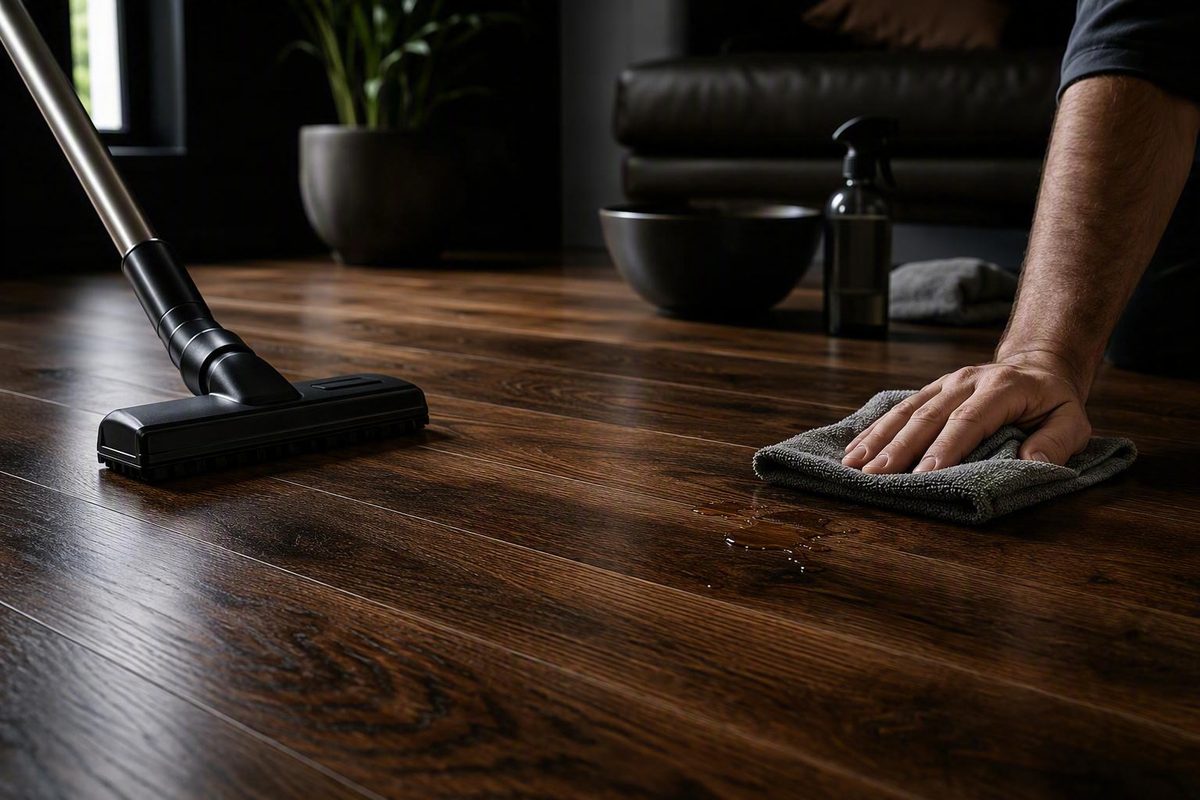
To clean engineered hardwood safely, begin by sweeping, dust-mopping, or vacuuming on the bare-floor setting. Wipe spills immediately with a dry or slightly damp cloth. If dry cleaning is not enough, use only a cleaner made for the floor’s finish. Do not use a wet mop or steam mop. If you cannot identify the finish, check the flooring manufacturer’s care instructions or ask a flooring professional before selecting a cleaner.
Related: Laminate vs Engineered Hardwood: Choose by Priority.
The safe cleaning routine at a glance
Follow this three-step routine:
- Remove loose debris. Sweep, dust-mop, or vacuum using the bare-floor setting.
- Clean spills promptly. Wipe them up with a dry or slightly damp cloth.
- Use a compatible cleaner only when needed. If soil remains after dry cleaning, choose a product made specifically for the installed finish.
Routine care should start with debris removal rather than liquid cleaning. This handles ordinary dust and grit without introducing moisture or an unnecessary cleaning product.
The National Wood Flooring Association’s maintenance guidance supports this general approach for wood floors. However, it does not provide separate technical instructions for engineered hardwood. Engineered products and finishes vary, so instructions for the installed flooring should take priority when choosing a cleaner or considering work beyond routine maintenance.
Choose the method by what is on the floor
Match the method to the floor’s condition instead of automatically washing the entire surface.
| Floor condition | First response | Avoid | If that is not enough |
|---|---|---|---|
| Loose dust or grit | Sweep, dust-mop, or vacuum on the bare-floor setting | Starting with liquid cleaner | Repeat dry cleaning where debris remains |
| Fresh spill | Wipe immediately with a dry or slightly damp cloth | Leaving it for later or wet-mopping the area | Continue wiping gently until removed |
| Broader soil after dry cleaning | Use a cleaner made for the installed finish | Universal formulas and unverified mixtures | Ask a flooring professional for a compatible product |
| Persistent dullness | Stop repeated cleaning and reassess | Assuming that more cleaner will solve it | Check whether product-appropriate recoating may be possible |
How to handle spills without over-wetting the floor
Treat a spill as an immediate, contained spot-cleaning task:
- Take a clean, dry or slightly damp cloth.
- Wipe up the spill immediately.
- Continue only as much as necessary to remove the spilled material.
- Stop when the spot is clean rather than extending the task into wet mopping.
Keep the response focused on the affected area, whether the spill reaches one plank or several.
Do not add a general-purpose cleaner automatically. If a mark remains, use a cleaning product only after confirming that it is intended for the floor’s finish. Follow the directions for that specific product rather than borrowing an application method or dilution ratio from another formula.
Cleaning methods to avoid
Do not use a wet mop or steam mop on engineered hardwood.
The National Wood Flooring Association says wet and steam mops can damage wood and its finish over time, and instead recommends dry debris removal and prompt spill cleanup with a dry or slightly damp cloth (NWFA).
That warning does not identify the exact form of damage that would occur in every engineered product. Construction methods differ, so avoid inferring a specific problem involving the veneer, core, adhesive, seams, or plank structure. The practical rule is simply to avoid wet and steam mopping.
Vinegar, oils, waxes, detergents, abrasive products, and homemade mixtures should not be treated as universally suitable for engineered hardwood. Finish compatibility varies, and there is no single dilution ratio or fixed quantity of liquid that can be prescribed for every floor.
Pick a cleaner by finish, not by a universal formula
Compatibility with the installed finish is essential when choosing a cleaner. Look for a product made specifically for that finish, ideally with guidance from a flooring professional.
If you do not know the finish, check the flooring product name, purchase records, installation paperwork, or current manufacturer care instructions. A professional familiar with the installed floor may also be able to recommend a suitable product.
There is no universal cleaner, brand, or homemade formula established as appropriate for all engineered hardwood. Application directions may also differ among products, so do not assume that cleaner should always be sprayed directly on the floor or always applied to a pad. Follow the directions for the exact flooring and cleaning product instead.
Set a schedule based on actual use
There is no rigid daily, weekly, or monthly schedule that applies to every engineered hardwood floor. Maintenance needs vary with use, wear, and household lifestyle.
Use the floor’s condition as your prompt:
- Remove debris when it accumulates rather than waiting for a scheduled full-floor cleaning.
- Address spills immediately, regardless of the normal cleaning routine.
- Use a finish-compatible cleaner only when dry methods do not adequately remove broader soil.
- Reassess the problem if appropriate cleaning no longer improves the floor’s appearance.
Room use can change over time, so the cleaning routine may need to change with it. The goal is to respond to visible debris, spills, and soil without making liquid cleaning an automatic calendar task.
When cleaning is not the same as restoring the finish
If the floor remains dull after appropriate cleaning, stop treating the appearance as ordinary removable soil. Recoating means applying a new coat of wood-floor finish; it is a separate maintenance process, not a more intensive version of cleaning.
Although recoating may renew a dull wood floor, that does not mean every engineered product can or should be recoated. The general guidance does not establish product-specific eligibility for recoating, refinishing, or other restoration work. Wear-layer thickness alone should not be used to make that decision.
Before proceeding, consult the flooring manufacturer’s documentation or a qualified flooring professional familiar with the product. Until then, avoid repeated cleaning applications intended to correct an appearance problem that routine care has not resolved.