
Laminate vs Engineered Hardwood: Choose by Priority
Laminate's scratch edge can disappear when repeated liquid reaches vulnerable seams. Whether engineered wood can be refinished is product-specific.
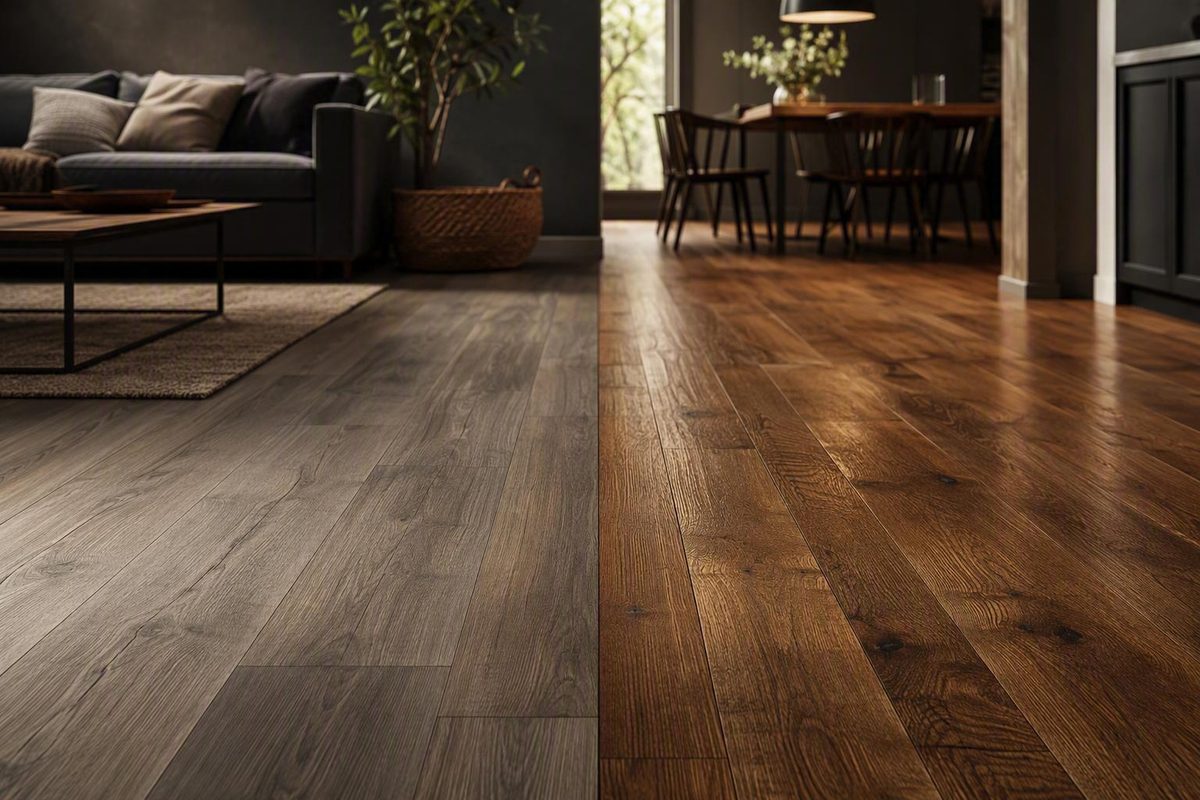
Choose the floor that fits how your home actually lives.
By Sam Petrakis, flooring installer and refinisher since 2003 · Updated August 8, 2026
Editorial note: This comparison synthesizes product-category guidance from flooring retailers and manufacturers. It is not an independent laboratory test, and product-specific installation instructions and warranties take priority over category-wide conclusions.
The short answer: choose by priority, not by category
In a laminate vs engineered hardwood comparison, the better choice depends on what the floor must endure and how you want it to look after years of use. Laminate generally starts with an advantage in upfront price, surface-scratch resistance, and approachable floating installation. Engineered hardwood starts with an advantage in authentic grain, natural texture, and possible surface renewal. These are broad tendencies rather than guarantees supported by this construction and performance comparison.
| Priority | Laminate | Engineered hardwood |
|---|---|---|
| Visible surface | Printed wood image beneath a protective wear surface | Genuine hardwood veneer |
| Typical price position | Usually lower, although premium products can overlap with entry-level engineered wood | Usually higher, with cost influenced by species, veneer, finish, and construction |
| Appearance | Realism varies; texture and printed patterns may repeat | Natural grain, knots, color variation, and texture |
| Surface scratches | Generally resists scratching and abrasion well | Can scratch because the exposed surface is real wood |
| Moisture limitations | Water entering seams, edges, or a fiberboard core can cause permanent swelling | More stable than solid wood under humidity changes, but still vulnerable to water damage |
| Installation | Commonly click-lock and floated over an approved underlayment | May be floated, glued, nailed, or stapled when the product permits |
| Refinishing | Cannot be sanded or refinished | Some products can be screened or refinished, subject to construction and manufacturer guidance |
| Likely best fit | Budget renovations, rentals, DIY projects, pets, children, and scratch-prone traffic areas | Living spaces where genuine wood character and documented renewal potential justify the premium |
Start with laminate if you have a constrained budget, plan to install the floor yourself, or expect claws, toys, grit, and frequent traffic to be the main threats. Its protective surface commonly handles routine abrasion better than a real-wood face, although performance differs among products.
Start with engineered hardwood if genuine grain and wood texture are central to the project. Its visible veneer is real hardwood rather than a printed reproduction, and qualifying products may offer repair or refinishing options unavailable with laminate.
A premium laminate can cost more than basic engineered hardwood. A moisture-rated engineered product may suit a room where a standard laminate does not, while a specifically approved laminate may provide broader spill coverage than an engineered product with a restrictive warranty. Product grade, subfloor condition, installation quality, room conditions, and warranty language can reverse a general recommendation.
There is no meaningful overall winner because “durability” is not one test. Scratch resistance, dent resistance, edge damage, water performance, stain resistance, repairability, and appearance are separate criteria. Choose the floor that performs best against the risks that actually exist in your room.
What laminate and engineered hardwood are actually made of
The fundamental difference is the surface you see and walk on.
Laminate is a layered floor that commonly combines a backing, a fiberboard-based core, a printed decorative image, and a clear protective wear surface. The design layer reproduces wood grain photographically; it is not a hardwood veneer. Calling the entire plank synthetic can nevertheless be misleading because many laminate products contain a compressed wood-fiber core.
Engineered hardwood has a genuine hardwood veneer bonded to a layered base. Depending on the product, that base may use plywood, fiberboard, or another wood-based construction. Engineered hardwood is real wood at its exposed face, but it is not one solid piece of lumber from top to bottom as explained in this guide to wood-look flooring construction.
| Floor and layer | What it does | What it means in the room |
|---|---|---|
| Laminate wear surface | Protects the printed image | Supports resistance to scratches, abrasion, and stains; sanding would damage the design |
| Laminate design layer | Supplies the wood color and pattern | Allows many visual styles, but the grain is reproduced rather than naturally formed |
| Laminate fiberboard core | Gives the plank its body and joint profile | Provides rigidity but may swell if water reaches it |
| Laminate backing | Balances and supports the plank | Does not make every product waterproof or eliminate subfloor requirements |
| Engineered hardwood finish | Protects the real-wood face | Influences scratch, stain, sheen, and maintenance performance |
| Engineered hardwood veneer | Supplies visible grain and texture | Produces natural variation and may allow limited renewal when expressly approved |
| Engineered layered core | Supports and stabilizes the veneer | Generally handles humidity changes better than solid hardwood, though it remains moisture-sensitive |
| Optional backing or balancing layer | Contributes to plank stability | Performance depends on the complete construction, not simply the real-wood surface |
Construction explains much of the practical difference. Laminate’s wear surface absorbs routine contact before damage reaches the printed image. Engineered hardwood’s finish protects genuine wood, but scratches and dents can mark that wood. In return, the real surface may allow a touch-up, screening, or refinishing process that would destroy laminate.
Both materials differ from solid hardwood. A solid hardwood board is wood through its thickness. Engineered hardwood has a real-wood face over a layered core. Laminate may contain wood fiber, but it has no genuine hardwood wear surface.
Do not use “real wood” as shorthand for universally better performance. It describes the visible material, not whether the floor is suitable for a particular dog, leak risk, room, slab, or installation method.
Appearance, texture, sound, and the feel of the finished floor
Engineered hardwood has the more direct claim to natural appearance because its visible layer is genuine wood. Its grain, knots, mineral streaks, color shifts, and texture come from the tree. Boards may still be sorted, stained, distressed, or finished to create a coordinated collection, but the underlying variation is natural.
Laminate builds its appearance from printed imagery. Better products may combine detailed printing with embossed texture, sometimes aligning that texture with the printed grain. This can produce a convincing floor at normal viewing distance, but it does not eliminate possible pattern repetition, artificial-looking knots, or a sheen that looks different under strong light.
The useful question is not “Does laminate look fake?” It is “Does this laminate look convincing in this room?” Likewise, a real-wood surface is not automatically attractive. Grading, stain color, plank variation, finish sheen, bevel design, and the surrounding finishes still matter.
Before deciding:
- Lay out several full planks together. One sample cannot reveal pattern repetition or the full range of natural variation.
- Rotate and rearrange the boards. Look for identical knots, grain clusters, and color patches in laminate.
- View them in daylight and at night. Low-angle light can reveal gloss, texture, and edge details that showroom lighting hides.
- Inspect the joints. Bevel depth and color affect whether the floor reads as individual boards or a continuous field.
- Look from standing height. Close inspection is useful, but most people experience flooring while walking through a room.
- Compare the samples with fixed finishes. Cabinets, trim, stairs, and nearby wood can make a mismatched tone more obvious.
Sound and underfoot feel are not determined by surface material alone. Substrate condition, approved underlayment, plank construction, room acoustics, furniture, installation method, and workmanship all contribute.
Take samples home and test them underfoot if the retailer permits. Use only the underlayment allowed for the selected product rather than assuming that a thicker pad is better. If acoustic performance matters in an upper story or multifamily building, compare the flooring instructions with any applicable building requirements before purchasing.
Durability by type of damage: scratches, dents, wear, and water
Saying one floor is “more durable” hides the distinctions that matter. Evaluate each likely failure mode separately.
Scratches and abrasion
Laminate generally performs well against routine surface scratching because contact occurs at its protective wear surface rather than directly on wood. That makes it a sensible starting point for homes with pets or children and for hallways, entry areas, and other busy spaces. Product construction and intended-use ratings still matter; scratch-resistant does not mean scratch-proof.
Engineered hardwood can scratch because its exposed surface is genuine wood. The result depends on the species, finish, texture, color, construction, and use.
Dents and impact
Scratch resistance and dent resistance are different. Claws and tracked grit create different loads from a dropped pan, narrow furniture foot, or high heel.
Do not infer dent resistance from appearance, price, thickness, or category name. Compare the documentation for the exact products and, if appropriate, test expendable samples with controlled household contact.
Stains and chipped edges
An intact laminate surface can provide a practical barrier against ordinary stains, but damaged edges and exposed seams are more vulnerable. A chip that reaches the design layer or core cannot be corrected by sanding.
Water intrusion
Water on the top surface, water entering a seam, and moisture rising from below are different events. Laminate is particularly vulnerable when water reaches a fiberboard core through an edge, joint, cut perimeter, or underside. Swelling changes the plank itself and cannot be sanded away.
Engineered hardwood can also stain, swell, distort, or separate when exposed to excessive moisture. Its layered construction generally gives it greater dimensional stability than solid hardwood under changing humidity, but that is not the same as being waterproof.
Repair and renewal
| Damage | Likely first response | Important limitation |
|---|---|---|
| Minor laminate scratch | Clean the area and use an approved color-matched touch-up product if permitted | A cosmetic repair does not recreate the factory wear surface |
| Failed laminate wear surface | Replace the affected plank or section | Laminate cannot be sanded or refinished |
| Swollen laminate seam | Stop the moisture source and replace distorted planks as required | Core swelling is structural damage, not merely a surface defect |
| Superficial engineered-wood scratch | Use a finish-compatible touch-up method approved for the product | Unapproved spot work can alter color, sheen, or finish integrity |
| Engineered-wood dent | Determine whether to accept, disguise, or professionally repair it | The appropriate method depends on the finish, veneer, and construction |
| Isolated damaged plank | Investigate board replacement | Access and replacement methods differ among floating, glued, nailed, and stapled floors |
A badly worn or swollen laminate plank generally requires replacement because sanding would remove its protective surface and printed design.
For a closer look at the terminology and limitations of fillers used on genuine wood surfaces, see this guide to choosing and using wood floor filler. Always confirm compatibility with the engineered floor’s factory finish before attempting a repair.
Pet owners should score two risks separately:
- Scratch exposure: Claws, running, grit near doors, moved crates, and sliding bowls.
- Liquid exposure: Water dishes, wet paws, repeated accidents, and spills that may remain unnoticed.
Laminate may lead on scratch resistance while losing its advantage if repeated liquid reaches vulnerable seams. Engineered hardwood may show scratches sooner but offer more cosmetic repair options in a qualifying product. The household’s actual damage pattern matters more than a general “pet-friendly” label.
Moisture and room suitability: read the warranty before choosing
Moisture is not one condition. Before deciding whether either floor belongs in a kitchen, bathroom, laundry room, basement, or over concrete, identify the exposure:
- Ambient humidity changes the moisture content of flooring over time.
- Brief surface spills are limited events that can be wiped up promptly.
- Standing water remains at seams and perimeters long enough to penetrate.
- Plumbing or appliance leaks may force water beneath the finished floor.
- Concrete vapor reaches the flooring assembly from below.
A product that tolerates a brief top-down spill is not necessarily approved for standing water, recurring wetting, below-grade installation, or the moisture conditions of a particular slab.
When water reaches laminate’s seams, edges, underside, or fiberboard core, the material can swell. Drying may stop continued exposure, but it cannot be assumed to restore a deformed core to its original dimensions.
Engineered hardwood generally responds to humidity changes more predictably than solid hardwood because of its layered construction. It can nevertheless stain, swell, distort, or delaminate under excessive moisture. Greater dimensional stability is a relative advantage, not immunity from water.
Neither category is universally waterproof. Selected products may carry water-resistant or waterproof claims, but coverage depends on the definitions and exclusions in the particular warranty. Product-level ratings—not the category name—govern moisture-prone applications as this manufacturer comparison cautions.
| Location | Main concerns | Verify before purchase |
|---|---|---|
| Kitchen | Sink and dishwasher leaks, spills, refrigerator supply lines, traffic | Explicit kitchen approval, spill limits, perimeter requirements, appliance rules, and leak exclusions |
| Bathroom | Frequent splashing, wet bath mats, fixture leaks, high humidity | Explicit bathroom approval, standing-water limits, sealing instructions, fixture details, and exclusions |
| Laundry room | Washer overflow, supply-line failure, vibration, floor drains | Explicit laundry approval, appliance and drain requirements, installation method, and leak exclusions |
| Basement | Below-grade humidity, slab vapor, seepage, past flooding | Below-grade approval, required moisture evaluation, specified vapor control, and flood or seepage exclusions |
| Concrete slab | Moisture transmission, slab condition, flatness, installation compatibility | Approved slab conditions, required testing, specified moisture-control system, and permitted installation method |
Do not recommend either category for a wet or below-grade room without product-level documentation. A retailer’s room suggestion, a salesperson’s assurance, or a large “waterproof” label does not replace the complete installation manual and warranty.
Also distinguish surface coverage from assembly protection.
Obtain the installation instructions and full warranty before ordering. If those documents are unavailable before purchase, pause the decision.
Installation and DIY difficulty
Laminate is usually the more approachable DIY option because many products use click-lock joints assembled as a floating floor over an approved underlayment. The planks connect to one another rather than being fastened directly to the substrate.
That simplicity is relative. “No nails or glue” does not mean “no preparation.” The exact instructions may still require a suitable substrate, specified moisture conditions, expansion space, transitions, approved accessories, and a particular installation sequence.
Engineered hardwood has a broader range of possible installation methods. Depending on the product and substrate, it may be:
- Floated with locking or bonded joints
- Glued to an approved substrate
- Nailed to a wood subfloor
- Stapled to a wood subfloor
These options can be useful, but they may introduce adhesive specifications, fastening requirements, specialized tools, or professional-installation conditions. The available methods vary by product according to this comparison of engineered and laminate construction and installation.
Pre-purchase installation checks
For either material, verify in the exact manual:
- Whether the substrate type is approved
- The manufacturer’s flatness and substrate-condition requirements
- Any required wood or concrete moisture evaluation
- The specified underlayment, vapor retarder, adhesive, or moisture-control system
- Required expansion space at walls and fixed objects
- Transition requirements at doorways, room changes, or large spans
- Door and appliance clearance after the floor height changes
- Installation direction and locking-joint sequence
- Instructions for cabinets, islands, and other fixed objects
- Approval over concrete, radiant heat, or an existing floor, if applicable
Do not assume that a floating floor can go over every existing surface. Likewise, do not assume either category is approved over concrete, radiant heat, or below grade without documentation for the exact product.
Preparation affects movement, sound, feel, and long-term performance.
DIY suitability checklist
A DIY installation is a more reasonable candidate when most of these statements are true:
- Room shape: The layout is largely rectangular, with manageable closets, doorways, and obstacles.
- Substrate condition: The substrate is sound and can be brought within the documented requirements.
- Moisture risk: There is no unresolved leak, seepage, or slab-moisture problem.
- Tools: You have the tools and protective equipment specified by the installation and tool manuals.
- Cutting skill: You can make accurate end, rip, jamb, vent, and transition cuts without damaging joints.
- Planning: You can calculate starting and ending row widths and follow the required joint pattern.
- Documentation: You can satisfy any testing, adhesive, installation-method, or recordkeeping requirements.
- Time: You can complete the preparation and first rows without rushing.
Laminate is generally easier when both products are otherwise suitable, but an uncomplicated floating engineered product may be more approachable than a laminate installation in a difficult layout. Glued or fastened engineered hardwood often benefits from professional experience.
Upfront price versus total ownership cost
Laminate is generally less expensive than engineered hardwood, although premium laminate and entry-level engineered products can overlap. As one broad retailer example—not a current national or local quote—Lowe’s published December 2024 estimated installed prices of $1–$6 per square foot for laminate and $4–$12 per square foot for engineered wood. Lowe’s notes that prices, promotions, styles, and availability vary, so the figures are useful only for rough orientation within its December 2024 buying guide.
Build the budget from the complete project:
| Cost item | Your estimate |
|---|---|
| Flooring material | $ |
| Ordering waste and layout allowance | $ |
| Delivery and handling | $ |
| Existing-floor demolition | $ |
| Disposal fees | $ |
| Subfloor repair or preparation | $ |
| Required moisture evaluation | $ |
| Vapor control or moisture mitigation | $ |
| Underlayment | $ |
| Adhesive, fasteners, or installation accessories | $ |
| Transitions and stair pieces | $ |
| Baseboards or shoe molding | $ |
| Door and jamb adjustments | $ |
| Appliance or furniture movement | $ |
| Installation labor | $ |
| Cleaning and final touch-up | $ |
| Reserve planks for future repairs | $ |
| Total project cost | $ |
Request like-for-like quotes. If one contractor includes demolition, substrate preparation, transitions, and trim while another lists only planks and basic installation, the totals are not comparable. Match quality tiers as well: the cheapest engineered hardwood and a premium laminate are not representative of their entire categories.
Material price alone does not determine ownership cost. Laminate generally requires plank or floor replacement once its wear surface fails or its core swells. That possibility has value only when the veneer, finish, condition, installation, and manufacturer guidance permit the proposed work.
Do not assign either floor a universal lifespan. Traffic, grit, pets, maintenance, leaks, sunlight, substrate condition, installation, product construction, and tolerance for visible wear all affect when an owner decides that replacement is necessary. Do not assume every engineered floor can be refinished or that refinishing will be practical for isolated damage.
The supplied evidence also does not establish a guaranteed resale return from engineered hardwood. Real wood may matter to some buyers, but the premium depends on neighborhood expectations, property price, competing listings, installation quality, and condition. Homeowner discussions illustrate how widely opinions and anecdotal estimates vary, with participants recommending that buyers examine nearby comparable homes rather than assume a fixed return in this Houzz flooring discussion.
If resale is the main reason for spending more, inspect recent nearby listings and sales in the same property bracket. Determine whether buyers in that market distinguish engineered hardwood from laminate and whether the rest of the home supports the upgrade.
The final decision checklist for your room and household
Choose the exact product after matching it to the scenario—not before.
Laminate is a strong starting point for:
- A budget renovation where controlling initial cost is essential
- A rental where scratch resistance and replacement cost are primary concerns
- A straightforward DIY project over a suitable substrate
- A pet-heavy home where claws and tracked grit are more likely than prolonged spills
- A hallway, play area, or other scratch-prone high-traffic space
Engineered hardwood is a strong starting point for:
- A main living area where genuine grain and texture are central to the design
- A project where natural variation is preferable to printed consistency
- Long-term ownership when the selected product has documented renewal potential
- An installation that benefits from an approved glued, nailed, stapled, or floating method
- A homeowner willing to accept some wood wear in exchange for a genuine hardwood surface
Specifications to compare for laminate
Do not stop at color and plank width. Compare:
- Disclosed abrasion or use rating and its intended application
- Wear-surface warranty and exclusions
- Core material and edge or joint design
- Water-resistance or waterproof warranty definitions
- Approved rooms and below-grade status
- Required underlayment and moisture-control system
- Substrate and radiant-heat approvals
- Maximum room dimensions and transition requirements
- Procedure for replacing an isolated plank
- Availability of matching transitions and future replacement stock
A rating is useful only when it is disclosed and connected to the intended use. Do not infer one from price, thickness, or marketing language.
Specifications to compare for engineered hardwood
Ask for:
- Veneer thickness
- Wood species and surface texture
- Factory finish system and sheen
- Plywood, fiberboard, or other core construction
- Approved floating, glue-down, nail-down, or staple-down methods
- Room, grade, concrete, and radiant-heat approvals
- Required substrate, moisture, and acclimation procedures
- Explicit manufacturer permission for screening, sanding, or refinishing
- Restrictions related to bevels, texture, stain, or factory finish
- Procedure for replacing one damaged board
Veneer thickness is relevant to renewal, but no single number guarantees that a floor can be refinished. Texture, bevels, damage depth, installation method, finish type, and manufacturer restrictions may also determine what is possible.
Ask about future repairs now
Before ordering, find out whether unopened cartons or individual planks can be obtained later.
Ask how the installation method affects isolated-board replacement:
- A floating floor must be repaired using the procedure specified for its joint system.
- A glued floor requires a method compatible with its adhesive and substrate.
- A nailed or stapled floor requires an approved fastening or replacement procedure.
Confirm the care rules
For each finalist, ask:
- Which cleaners are approved?
- Is controlled damp cleaning permitted?
- How quickly must spills be removed?
- Are wet mops prohibited?
- Is steam cleaning expressly prohibited?
- Which vacuum heads are permitted?
- Are rugs, pads, furniture glides, or rolling chairs subject to restrictions?
- Does pet-accident coverage differ from ordinary spill coverage?
Routine care for both categories generally centers on removing grit with sweeping or suitable vacuuming, followed by carefully controlled cleaning with an approved product. Excess water is a poor default, and steam should not be used unless the exact flooring manufacturer expressly permits it consistent with this laminate and hardwood care guidance.
A practical decision tree
-
Establish moisture conditions first. Resolve leaks and identify whether the room faces occasional spills, standing-water risk, below-grade humidity, or slab moisture. Eliminate products without explicit approval.
-
Set the complete installed budget. Include preparation, moisture control, accessories, trim, labor, and waste—not merely the advertised plank price.
-
Choose the required level of realism. If only genuine grain and natural board variation will satisfy you, focus on engineered hardwood. If a convincing wood look is sufficient, compare laminate samples closely.
-
Identify the likely damage. Consider scratches, liquids, dents, edge impacts, and stains separately.
-
Match installation to your capability and substrate. A click-lock floor may suit a careful DIY installer, but only after the documented substrate and moisture requirements are met.
-
Decide how you expect to repair the floor. Laminate usually relies on board replacement. Engineered hardwood may offer touch-up, board replacement, screening, or refinishing where documented.
-
Consider the ownership period. For a short renovation horizon, lower upfront cost may dominate. For long-term ownership, documented repair and renewal options may justify spending more.
Use the sample-and-document rule: take physical samples home, obtain the complete installation guide and warranty, and compare two or three exact products rather than choosing solely by category name. A well-specified, correctly installed laminate can be a better floor than engineered hardwood poorly matched to the room. A suitable engineered product can be the better investment when genuine wood and documented renewal potential matter.
Frequently asked questions
Is laminate or engineered hardwood better for dogs and children?
Laminate is generally the stronger starting point when scratches, tracked grit, toys, and heavy traffic are the main concerns. Engineered hardwood can scratch or dent because its exposed face is real wood.
Evaluate liquids separately. Water bowls, accidents, spills, and wet shoes may reach seams or remain unnoticed. A scratch-resistant laminate is not automatically the better choice if its moisture warranty does not cover the expected exposure.
Can engineered hardwood be refinished, and how many times?
Some engineered hardwood can be refinished, but there is no universal number. Eligibility depends on the veneer, remaining usable wood, finish, bevels, texture, condition, installation, and manufacturer instructions.
Obtain written guidance for the exact product if future refinishing matters. Laminate cannot be refinished because sanding removes its protective surface and printed image.
Can laminate or engineered hardwood be installed in a bathroom or basement?
Only when the exact documentation approves the room, grade level, substrate, installation method, and expected moisture exposure. Neither category is automatically suitable for every bathroom or basement.
For bathrooms, verify standing-water limits, perimeter requirements, fixture details, and plumbing-leak exclusions. For basements, verify below-grade approval, slab requirements, moisture-control instructions, and flood or seepage exclusions.
Which is cheaper to install: laminate or engineered hardwood?
Laminate is generally cheaper to install because many products use a floating click-lock system. Engineered hardwood can also float, but products requiring glue, nails, or staples may add materials, tools, skill, and labor as reflected in this manufacturer comparison.
Preparation can change the result. Compare quotes that include the same demolition, substrate work, moisture control, trim, transitions, waste, and furniture handling.
How should laminate and engineered hardwood be cleaned?
Remove grit with a soft broom, dust mop, or vacuum attachment approved for hard flooring. Follow with the exact manufacturer-approved cleaner, using only as much liquid as the instructions allow. Wipe spills promptly.
Avoid unapproved abrasive products, polishes, excessive water, and improvised cleaning mixtures. Do not use a steam mop unless the manufacturer expressly permits it; retailer guidance specifically warns that moisture and heat can damage engineered wood layers in this care and comparison guide.
Choose the exact floor, not just the category. Laminate generally leads on upfront affordability, surface-scratch resistance, and straightforward floating installation. Engineered hardwood leads on genuine wood character and possible renewal. Before buying, confirm room approval, moisture limits, installation requirements, repair options, care restrictions, and total installed cost. The best floor is the one whose construction and warranty match the room and the way your household actually lives.