
Engineered Wood vs Laminate vs Hardwood: Best Fit
Laminate's protective layer may resist minor scratches well, but the floor cannot be sanded after deep damage. The choice turns on surface wear versus repairability.
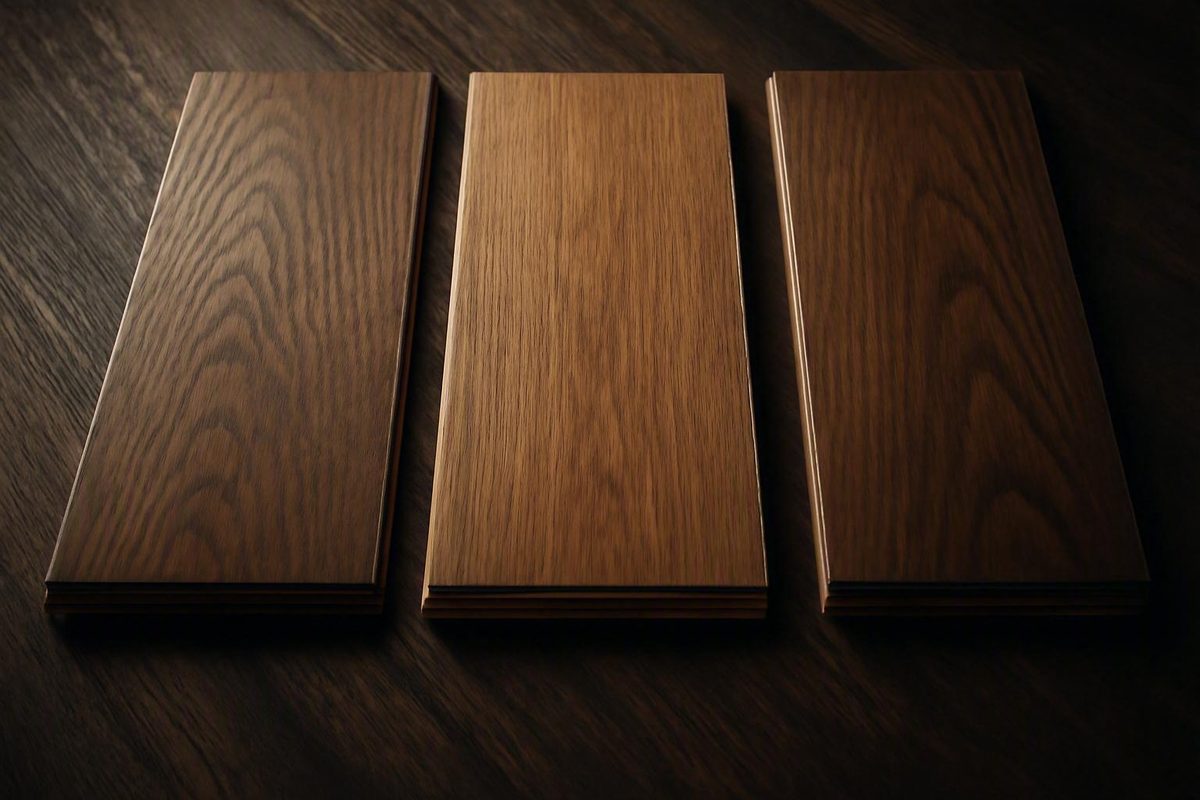
The comparison between engineered wood flooring vs laminate vs hardwood begins with one clarification: in this guide, “hardwood” means solid hardwood. Engineered flooring also has genuine hardwood at the visible surface, but its layered construction changes how it responds to humidity, where it may be installed, and whether it can be refinished.
There is no universal winner. Laminate generally prioritizes affordability, scratch resistance, and approachable floating installation. Engineered wood combines a real-wood surface with greater dimensional stability and more installation possibilities than solid hardwood. Solid hardwood offers the greatest potential for future sanding and refinishing.
The right choice depends on the room, subfloor, moisture exposure, household traffic, desired appearance, installation constraints, repair expectations, and total project cost. Category comparisons can narrow the field, but the specifications, installation instructions, care guide, and warranty for the exact product must determine the final choice.
The three flooring options at a glance
The quickest way to narrow your options is to decide whether genuine wood at the surface is essential. Then eliminate products that are not approved for the room, subfloor, grade level, and intended installation method.
| Comparison point | Laminate | Engineered wood | Solid hardwood |
|---|---|---|---|
| Visible surface | Printed wood design beneath a protective wear layer | Genuine hardwood veneer | Genuine hardwood |
| Core construction | Usually a fiberboard-based core with backing and surface layers | Layered plywood, fiberboard, or comparable core beneath the veneer | One piece of timber |
| Natural variation | Designed pattern; images may repeat among planks | Natural grain and board-to-board variation | Natural grain and board-to-board variation |
| Typical installation | Floating click-lock installation is common | May float, glue, nail, or staple when approved | Commonly nailed or stapled to a suitable wood subfloor |
| Dimensional stability | Product-dependent; still requires expansion space | Generally more stable than solid hardwood as humidity changes | Expands and contracts more readily as humidity changes |
| Surface scratch resistance | Often strong because of the protective wear layer | Depends on species, finish, product quality, use, and care | Depends on species, finish, product quality, use, and care |
| Refinishing potential | Cannot be sanded and refinished like wood | None to limited, depending on veneer and construction | Generally the greatest |
| Moisture caution | Water entering joints or reaching a vulnerable core can cause damage | Greater stability does not mean waterproofing | Generally best in dry, stable, approved spaces |
| Relative upfront cost | Usually lowest, with premium exceptions | Commonly between laminate and solid wood, with substantial overlap | Often highest, depending on species, grade, and construction |
| Likely best fit | Budget-conscious, scratch-heavy, or DIY-oriented projects | Projects requiring real wood plus installation flexibility | Dry, stable rooms where future renewal is a priority |
These are category tendencies, not guaranteed rankings. A premium laminate may outperform an entry-level engineered floor for surface wear. A thick-veneered engineered product may offer a meaningful renewal path, while a thin-veneered product may not. A high-quality solid floor can still be unsuitable for a particular room or subfloor.
The broad cost order is usually laminate first, engineered wood next, and solid hardwood highest, but product grades overlap. Laminate pricing can rise with wear features, spill protection, texture, and construction, while engineered-wood pricing varies with veneer thickness, species, style, and brand (Avalon Flooring’s category comparison).
It is also important to separate surface durability from repairability. Laminate’s protective layer may resist minor scratches well, but the floor cannot be sanded after deep damage. Real wood may mark more readily, yet solid hardwood—and some engineered products—can potentially be renewed rather than replaced. A three-category comparison similarly distinguishes laminate’s scratch-resistant surface from the greater refinishing potential of solid hardwood and the more limited options of engineered wood (Carpet One’s flooring overview).
Before buying, review the exact product’s finish, core construction, veneer thickness, installation methods, room approval, maintenance instructions, and warranty. The category name alone cannot predict performance.
Construction: what each floor is actually made from
Construction determines what you see, how the floor responds to environmental changes, and what options remain after damage.
Solid hardwood is generally milled from one piece of timber. The visible face and the material beneath it are parts of the same board. That gives solid flooring more usable wood for possible future sanding, subject to the plank’s profile, condition, previous refinishing, and installation.
Engineered wood has a genuine hardwood veneer bonded to a layered plywood, fiberboard, or comparable core. It is accurate to describe the visible surface as real hardwood, but not to imply that every engineered plank is one solid piece of wood. Products using plywood or cross-layered cores are designed to moderate dimensional movement compared with solid boards.
Laminate generally combines a backing layer, fiberboard-based core, printed design layer, and clear protective wear layer. Its wood appearance comes from an image rather than exposed hardwood grain. Because the core commonly contains wood-derived fiber, describing all laminate as entirely synthetic can be misleading. A retailer’s construction guide illustrates the central distinction: solid wood is one piece of lumber, engineered flooring places real hardwood over a multilayer core, and laminate uses a photographic image over a fiberboard core (Signature Flooring’s construction comparison).
Those differences have practical consequences:
- Appearance: Solid and engineered floors reveal genuine grain. Natural color, figure, knots, and mineral marks vary among boards. Laminate can reproduce many species and finishes, but printed images may repeat. Plank dimensions, embossing, image variation, layout, and viewing distance all influence how noticeable that repetition is.
- Humidity response: Solid wood generally expands and contracts more as indoor humidity changes. Engineered construction usually moderates that movement, although performance remains product-specific.
- Sanding: Solid wood normally provides the greatest amount of usable material. Engineered flooring can be sanded only when its veneer, surface treatment, condition, and manufacturer instructions permit it. Sanding laminate would destroy its protective layer and printed design.
- Water intrusion: Water reaching a vulnerable laminate core can cause swelling. Engineered and solid wood also require moisture control, regardless of whether a particular product offers enhanced spill protection.
- Installation: Laminate commonly floats. Engineered flooring may support several installation methods. Solid hardwood is commonly mechanically fastened to a suitable wood subfloor.
Construction is therefore more than a marketing specification. It helps determine the floor’s likely weaknesses and whether damage can be repaired, refinished, or only replaced.
Durability is not one score: scratches, dents, swelling, fading, and wear
Asking which floor is “most durable” is too broad. A floor may resist scratches but perform poorly after water reaches its core. Another may mark more easily yet offer a better restoration path. Compare scratches, dents, water damage, appearance changes, dimensional movement, and repairability separately.
Scratches and surface wear
Laminate’s protective wear layer generally provides strong resistance to minor scratches, stains, and routine traffic. That makes quality laminate a sensible starting point for homes with dogs, children, tracked-in grit, or frequently used rooms.
Engineered and solid hardwood expose real wood at the surface. Both can scratch, and a hard factory finish does not make either category scratch-proof. Performance varies with the wood species, finish, surface texture, household use, grit control, pet nails, furniture protection, and maintenance.
Engineered construction primarily improves stability beneath the surface. It does not turn the hardwood veneer into a laminate wear layer. A premium laminate may therefore outperform an entry-level engineered product for surface wear while still lacking genuine grain and an equivalent refinishing path.
Dents and impact damage
Scratch resistance and dent resistance are not the same property. Real-wood floors can dent under concentrated impact, and laminate can suffer deep surface or edge damage even when it performs well against ordinary abrasion.
Compare complete products, including their finish, construction, use classification, care requirements, and manufacturer guidance.
Water and swelling
Laminate’s vulnerable point is commonly its core. A promptly cleaned spill on the protected surface is not the same event as water entering a joint, exposed edge, or underside. If a fiberboard core swells, the affected plank generally cannot be restored by sanding.
Engineered and solid wood also require protection from unsuitable moisture. Greater dimensional stability in engineered flooring does not make the surface or core universally waterproof.
Fading and appearance changes
Flooring appearance can change with exposure and age. Real wood may change color according to species and finish. Laminate performance is product-specific, even when a manufacturer advertises fade-resistant features.
If the room receives strong sunlight, ask the manufacturer or seller how the exact product should be protected and maintained.
Dimensional movement
Solid hardwood responds more directly to changing indoor humidity because the entire plank is natural wood. Engineered flooring generally moves less because of its layered construction. Laminate also requires the expansion space stated in its installation instructions.
Dimensional movement should not be confused with surface wear. A floor can remain visually unscratched while still reacting to unsuitable environmental or installation conditions.
Repairability after severe damage
The categories have different broad repair paths:
- Laminate: Deeply damaged, swollen, or worn planks generally require replacement because the printed surface cannot be sanded.
- Engineered wood: Possible options range from finish renewal to limited sanding or plank replacement, depending on the veneer and manufacturer instructions.
- Solid hardwood: Usually offers the broadest sanding and refinishing potential, assuming enough usable wood remains and the floor is otherwise suitable.
For homes with pets or children, laminate often leads in surface scratch resistance, while real wood offers greater restoration potential. Retail guidance similarly notes that laminate commonly resists scratches well, but water reaching the sides or underside can swell the core and damaged laminate cannot be refinished (Avalon Flooring’s laminate and engineered-wood comparison).
Moisture, humidity, and room-by-room suitability
Flooring discussions often treat dimensionally stable, water-resistant, and waterproof as interchangeable. They are not.
- Dimensional stability describes resistance to expansion and contraction as environmental conditions change.
- Water resistance describes limited tolerance of spills or moisture under stated conditions.
- Waterproofing is a product-specific claim that must be interpreted through the manufacturer’s specifications, installation instructions, test conditions, and warranty.
Engineered wood is generally more dimensionally stable than solid hardwood because of its layered core. Some engineered products are consequently approved for concrete slabs, below-grade locations, or radiant-heating systems where solid hardwood may be less practical. That does not make every engineered product waterproof or suitable for every damp room.
Solid hardwood moves more with changing humidity and is generally best suited to dry, climate-controlled spaces approved for the product. Suitable indoor conditions matter after installation as well as during it.
Laminate often handles routine surface wear and promptly cleaned spills well. Some products provide enhanced joint or edge protection, but water reaching a vulnerable fiberboard core can still cause swelling. Product-level distinctions are essential: manufacturer comparisons identify specific waterproof lines rather than establishing that all laminate or engineered wood is waterproof (Bruce’s product-level comparison).
Room-by-room priorities
Living rooms and bedrooms: Appearance, underfoot character, sunlight exposure, and future repair or refinishing plans often matter more than maximum spill protection. All three categories may be candidates if the product and subfloor are approved.
Entries and hallways: Prioritize grit control, scratch resistance, joint protection, and easy cleaning. Laminate may be attractive for surface wear, but wet footwear and exterior-door leaks still require prompt attention.
Kitchens: Check whether the exact product is approved for kitchens. Review its spill instructions, joint or seam requirements, perimeter details, and guidance for installation around appliances.
Basements: Require explicit below-grade approval. Confirm slab or subfloor suitability, moisture requirements, vapor-control instructions, and the permitted installation method. Neither laminate nor engineered wood receives automatic basement approval.
Bathrooms: Frequent splashing and the possibility of standing water make product selection especially demanding. Choose none of these categories without explicit manufacturer approval for the bathroom and intended installation.
For concrete slabs, follow the product requirements for slab condition, moisture testing, vapor control, preparation, adhesive or underlayment, and installation method.
Engineered wood commonly offers more options over concrete and radiant heating than solid hardwood, but compatibility still depends on the exact product, heating system, species, temperature requirements, subfloor, and installation method (Robbins’ solid and engineered guidance).
Clean spills promptly on all three categories. If a product is advertised as waterproof, determine exactly which surfaces, joints, edges, installation conditions, and water events the claim covers.
Installation methods, subfloors, and DIY difficulty
Laminate is generally the most approachable category for a first-time DIY installer. It commonly uses click-lock planks assembled as a floating floor over an approved underlayment. Because the planks connect to one another rather than being fastened throughout the field, the work may require fewer specialized fastening tools.
“Floating” does not mean that preparation is optional. The existing surface and subfloor must meet the product’s stated requirements for suitability, condition, flatness, cleanliness, and moisture. Do not assume laminate can be installed over every old floor merely because floating installation is possible.
Engineered wood offers the widest range of potential methods:
- Floating: Planks connect to one another without being fastened throughout the field.
- Glue-down: Planks are bonded to an approved, prepared base with the specified adhesive.
- Nail-down or staple-down: Planks are mechanically fastened to an approved wood subfloor.
Not every engineered product permits every method. Product construction and subfloor compatibility determine what is allowed.
Solid hardwood is commonly nailed or stapled to a suitable wood subfloor. Installation requires appropriate fastening equipment, layout planning, board selection, and control of environmental conditions, making it more likely to justify professional installation. A broad retailer guide similarly distinguishes floating laminate and flexible engineered applications from solid hardwood, which it recommends leaving to experienced installers in many cases (Lowe’s flooring buying guide).
Renovation conditions can narrow the choices:
- A concrete slab may prevent conventional nail-down installation unless an approved system is provided.
- Added floor height can affect doors, appliances, stairs, baseboards, and transitions.
- Existing flooring may remain only if the new floor’s instructions permit it.
- Radiant heat and below-grade locations require explicit product approval.
- Adhesive, underlayment, fastener, and vapor-control requirements vary by product.
Before ordering, verify:
- The approved subfloor materials
- The approved installation method
- Whether existing flooring may remain
- The product’s preparation and moisture requirements
- Required underlayment, adhesive, fasteners, or vapor control
- Acclimation or conditioning instructions
- Expansion-space and transition instructions
- Radiant-heat and below-grade approval
- Whether the installation instructions require particular installer qualifications for the coverage you expect
Treat the installation manual as part of the product specification, not as paperwork to read after delivery.
Repair, refinishing, and routine care
A floor’s ability to avoid damage and its ability to recover from damage are separate purchasing considerations.
Solid hardwood generally has the greatest refinishing potential because usable wood extends below the surface. That does not guarantee a fixed number of sanding cycles. Plank profile, previous sanding, remaining material, damage, fastening, and the floor’s overall condition all affect what is possible.
Engineered wood may permit screening, recoating, sanding, or limited refinishing only when its veneer, construction, condition, surface treatment, and manufacturer instructions allow it. “Engineered wood can be refinished” is incomplete unless the exact product’s approved procedure is known.
As an illustrative manufacturer estimate rather than a universal threshold, Robbins says an engineered product with a veneer of approximately 4 millimeters may permit limited refinishing, while a veneer under approximately 2 millimeters may not be refinishable (Robbins’ veneer guidance). Those measurements do not guarantee that another product can be sanded.
Laminate cannot be sanded and refinished like hardwood. Sanding would remove or damage the protective wear layer and printed image. A severely worn, swollen, or deeply damaged plank generally needs replacement.
Ask how a future repair would be performed before selecting a floating, glued, or mechanically fastened floor.
Keep spare planks from the original purchase when practical. Preserve the carton label, receipt, specifications, installation guide, care instructions, and warranty so that future repairs can be matched to the correct product.
This guide to matching wood-floor filler to the defect explains why the repair material must suit the type of gap or damage.
Routine care should begin with dry methods:
- Sweep or dust mop regularly.
- Use a suitable bare-floor vacuum.
- Control grit at entrances.
- Use furniture pads.
- Lift rather than drag heavy objects.
- Keep pet nails maintained.
- Clean spills promptly.
Do not generalize damp-mop, wet-mop, or steam-mop advice across the three categories. Cleaning permissions vary by product and finish. Use only the cleaners and moisture levels authorized in the exact care instructions. Comparative guidance for hardwood and laminate likewise recommends avoiding standing moisture and using prompt spill cleanup and furniture protection (Diffen’s care comparison).
For real wood, maintain the indoor environmental conditions stated by the manufacturer. Preventive care is normally less disruptive than correcting widespread finish damage or moisture-related movement.
Cost and long-term value without misleading price promises
At the category level, laminate is generally the least expensive, engineered wood commonly costs more, and solid hardwood is often the highest-cost option. There is substantial overlap: premium laminate can exceed entry-level engineered products, while species, veneer thickness, plank dimensions, finish, construction, and brand can move a wood floor well above its category’s starting point. Commercial comparison guides support the broad ordering but also show that product features materially affect price (Signature Flooring’s category guide).
Do not compare a laminate material price with a fully installed hardwood proposal. Every quote should use the same measured area and project scope.
A total-project worksheet should ask for:
- Flooring quantity
- Cutting and layout allowance
- Delivery and job-site handling
- Existing-floor removal and disposal
- Underlayment
- Adhesive, fasteners, or other installation materials
- Required moisture testing or vapor control
- Subfloor preparation or repair
- Baseboard, shoe molding, reducers, thresholds, and transitions
- Door adjustments
- Appliance and furniture handling
- Stair components or other custom work
- Installation labor
- Cleanup
- Applicable taxes or permit-related charges
- Spare material for future repairs
Any numerical price comparison should identify its date, location, product grade, measured area, waste assumption, preparation work, and included labor. Without that context, a per-unit price can create a false impression of savings.
Long-term value is not simply “most expensive equals best.” Laminate may reduce the initial outlay but cannot be refinished. Engineered wood may provide a limited renewal option. Solid hardwood generally offers the broadest refinishing path, but that work still has a cost and depends on the floor remaining suitable.
When comparing proposals, ask:
- What repair procedure is approved for a damaged plank?
- Can spare boards be retained, and is matching stock likely to remain available?
- Does the engineered product have a documented refinishing procedure?
- What work would be required if a larger section needed replacement?
- What preparation, furniture handling, cleanup, or temporary disruption is included?
- Which maintenance or moisture conditions affect the protection being offered?
Avoid calculating fixed ownership costs decades into the future from generalized lifespan estimates. Household traffic, moisture events, installation quality, maintenance, repair availability, and changing design preferences can all alter the result.
Resale value is also local and uncertain. Some buyers may prefer genuine wood, but the available evidence does not establish a guaranteed premium or return on the upgrade. For a starter home or short ownership period, compare flooring in nearby comparable properties and consider whether the added cost matches likely buyer expectations. A homeowner forum illustrates how strongly opinions about laminate, engineered wood, and return on investment can vary by project and local price point, but it should be treated as anecdotal rather than predictive (Houzz flooring discussion).
Best choice by homeowner and project scenario
The most useful recommendation is conditional: begin with your priority, then eliminate products that do not fit the room or subfloor.
Tight budget or first DIY floor
Start with quality laminate. Its click-lock floating format is commonly more approachable, and the material is generally less expensive.
Before buying, verify room approval, subfloor requirements, underlayment, expansion instructions, locking procedure, care requirements, and the boundaries of any moisture claim. Do not choose solely by carton price.
Pets, children, or scratch-heavy traffic
Laminate is usually the surface-wear leader. Its protective layer commonly resists minor scratching and stains better than exposed real wood.
The trade-off is restoration. Deep damage or core swelling generally requires plank replacement rather than sanding. If you prefer real wood, compare complete finish systems and samples rather than assuming engineered construction makes the surface more scratch-resistant.
Authentic wood over concrete
Investigate engineered products explicitly approved for the slab and selected installation method. Engineered flooring can provide genuine grain while allowing floating or glue-down installation where conventional solid-hardwood fastening may not be practical.
Approval still depends on the slab, moisture requirements, vapor control, preparation, underlayment or adhesive, and grade level.
Humidity variation
An approved engineered product is generally the stronger real-wood candidate because its layered core reduces dimensional movement relative to solid hardwood.
That advantage is stability, not immunity from leaks or unsuitable indoor conditions.
Dry, climate-controlled long-term home
If future sanding and refinishing are central priorities, solid hardwood is the strongest candidate. It works best where the room, subfloor, grade level, environmental conditions, and installation method suit the product.
Choose it for its renewal potential—not because it guarantees a particular lifespan or financial return.
Starter home or short ownership horizon
Compare the upgrade cost with flooring in nearby comparable homes. Genuine wood may appeal to buyers, but there is no reliable basis for assuming the local market will repay the full premium.
Condition, color, workmanship, and continuity between rooms may matter alongside the material category.
Kitchen
Let the exact specifications and installation documents decide. Check kitchen approval, spill-cleanup instructions, joint requirements, perimeter details, appliance-related installation guidance, and the scope of any water-protection claim.
Neither “engineered” nor “water-resistant laminate” is sufficient information by itself.
Basement
Require explicit below-grade approval and a documented plan for slab or subfloor moisture. Confirm the installation method, preparation, underlayment or adhesive, and vapor-control requirements.
Do not treat engineered stability or laminate spill protection as automatic basement approval.
Bathroom or frequent standing-water location
Select none of these categories without explicit manufacturer approval for that application. A product-specific waterproof claim may make a particular floor viable, but only under its stated installation and use conditions.
The decision path is straightforward:
- Decide whether you want genuine wood or a printed wood look.
- Eliminate products not approved for the room, grade level, subfloor, heating system, and installation method.
- Decide whether surface scratch resistance or restoration after damage matters more.
- Compare complete installed quotes using the same scope.
- Review the exact moisture, maintenance, installation, repair, and warranty documents before ordering.
The product-specification and warranty checklist
Marketing labels describe categories broadly. Product documents tell you what you are actually buying.
For engineered wood
Check:
- Hardwood veneer species and thickness
- Core material and construction
- Overall plank dimensions
- Finish system and surface texture
- Whether recoating, screening, or sanding is permitted
- The approved refinishing procedure
- Approved floating, glue-down, nail-down, or staple-down methods
- Compatible subfloors and installation materials
- On-grade and below-grade approval
- Radiant-heat compatibility
- Acclimation or conditioning instructions
- Environmental and subfloor-moisture requirements
- The precise boundaries of any water-protection claim
For laminate
Check:
- Core construction
- Manufacturer-supplied wear or use classification
- Plank thickness and joint design
- Attached pad or required underlayment
- Installation dimensions and transition instructions
- The boundaries of any spill-resistant or waterproof claim
- Whether protection applies to the surface, joints, edges, perimeter, or underside
- Approved rooms and grade levels
- Cleaning restrictions
- Replacement-board availability
- Approved repair procedures
For solid hardwood
Check:
- Wood species and visual grade
- Plank width, length, and thickness
- Factory-finished or site-finished construction
- Finish and approved maintenance products
- Required subfloor
- Approved fastening method
- Grade-level restrictions
- Acclimation or conditioning instructions
- Indoor environmental requirements
- Expansion and perimeter instructions
- Radiant-heat limitations
- Sanding or recoating guidance
For every floor
Ask the seller or manufacturer:
- Is the product approved for this specific room and grade level?
- Which subfloors and installation methods are approved?
- What moisture testing or preparation is required?
- What does any “waterproof” or “water-resistant” claim actually cover?
- Does that claim apply to joints, edges, perimeter exposure, or moisture from below?
- Which cleaners and cleaning methods are permitted?
- What environmental conditions must be maintained?
- What repair procedures are approved?
- Which installation or maintenance conditions affect the warranty?
- Is professional installation required for the coverage being offered?
Do not rely on verbal sales language when the answer should appear in a specification, installation guide, care document, or warranty. Request written product-level confirmation before ordering.
Obtain itemized quotes using the same room measurements and scope. Compare preparation, accessories, trim, transitions, removal, labor, and moisture-control work—not merely the price of flooring cartons.
Retain spare planks when practical.
The core rule is simple: select the product whose documented construction, room approval, installation method, repair path, and warranty fit the actual project—not the product with the broadest marketing claim.
Frequently asked questions
Is engineered wood flooring real hardwood?
Engineered wood has genuine hardwood at its visible surface. That veneer is bonded to a layered plywood, fiberboard, or comparable core, so the entire plank should not automatically be described as one solid piece of hardwood.
This separates engineered flooring from laminate, which uses a printed design rather than exposed hardwood grain. It also distinguishes engineered flooring from solid hardwood, where each plank is generally milled from one piece of timber. A manufacturer comparison likewise describes engineered flooring as a real-wood top layer over a layered core while noting that installation and refinishing depend on the product (Hartco’s construction overview).
Is laminate or engineered wood better for dogs and scratches?
Laminate is usually the stronger starting point when surface scratch resistance is the main concern. Its protective wear layer commonly handles pet nails, grit, stains, and routine traffic better than exposed real wood.
Engineered wood provides genuine grain and may offer a repair or limited refinishing path, but its hardwood veneer can scratch and dent. The layered core improves dimensional stability, not automatic scratch resistance.
For either option, compare the exact finish, use classification, surface texture, care instructions, and replacement procedure. Laminate’s trade-off is that severe surface damage or core swelling generally requires plank replacement rather than sanding.
Can engineered wood or laminate be installed in a basement or over concrete?
Some products can, but approval is product-specific. Engineered wood may be floated or glued over an approved concrete slab, while laminate commonly floats over an approved underlayment.
For a basement or slab, verify:
- Below-grade approval
- Concrete-moisture requirements
- Vapor-control instructions
- Slab condition and preparation requirements
- Approved adhesive or underlayment
- Expansion and perimeter details
- The stated scope of any moisture protection
Do not treat engineered stability or laminate spill resistance as automatic approval for a basement or concrete slab.
How can I tell whether engineered wood can be refinished?
Find the exact product specification and determine the veneer thickness, finish construction, remaining surface condition, and manufacturer-approved procedure. Ask whether the floor permits only recoating or screening, or whether actual sanding is authorized.
Do not rely on a category-level assurance. A thin veneer, textured surface, previous sanding, deep damage, or manufacturer restriction may prevent refinishing. If the manufacturer does not authorize sanding, do not include it in the floor’s repair plan.
Which is better for long-term ownership: laminate, engineered wood, or solid hardwood?
For maximum renewal potential in a dry, stable, approved setting, solid hardwood is generally the strongest candidate. Engineered wood is the middle path when you want genuine hardwood but need greater dimensional stability or a more flexible installation method. Laminate can still be the practical long-term choice when lower initial cost and scratch resistance matter more than refinishing.
Long-term value depends on moisture risk, installation quality, spare-plank availability, repair costs, refinishing feasibility, disruption, changing style preferences, and the expected ownership period.
The best long-term floor is not automatically the most expensive one. It is the floor whose likely maintenance, damage, and repair path you are prepared to manage.
Choose laminate when initial cost, scratch resistance, and accessible floating installation matter most. Choose engineered wood when genuine grain and installation flexibility must coexist. Choose solid hardwood when the room is dry and stable and future renewal is the priority.
Then eliminate any product lacking explicit approval for the room, subfloor, moisture conditions, grade level, or installation method. Compare itemized installed quotes and review the exact warranty before buying.