
Engineered Hardwood Floor: How to Choose
Match room grade, substrate, moisture risk, radiant heat and approved installation methods; then check wear layer, warranty and total project cost.
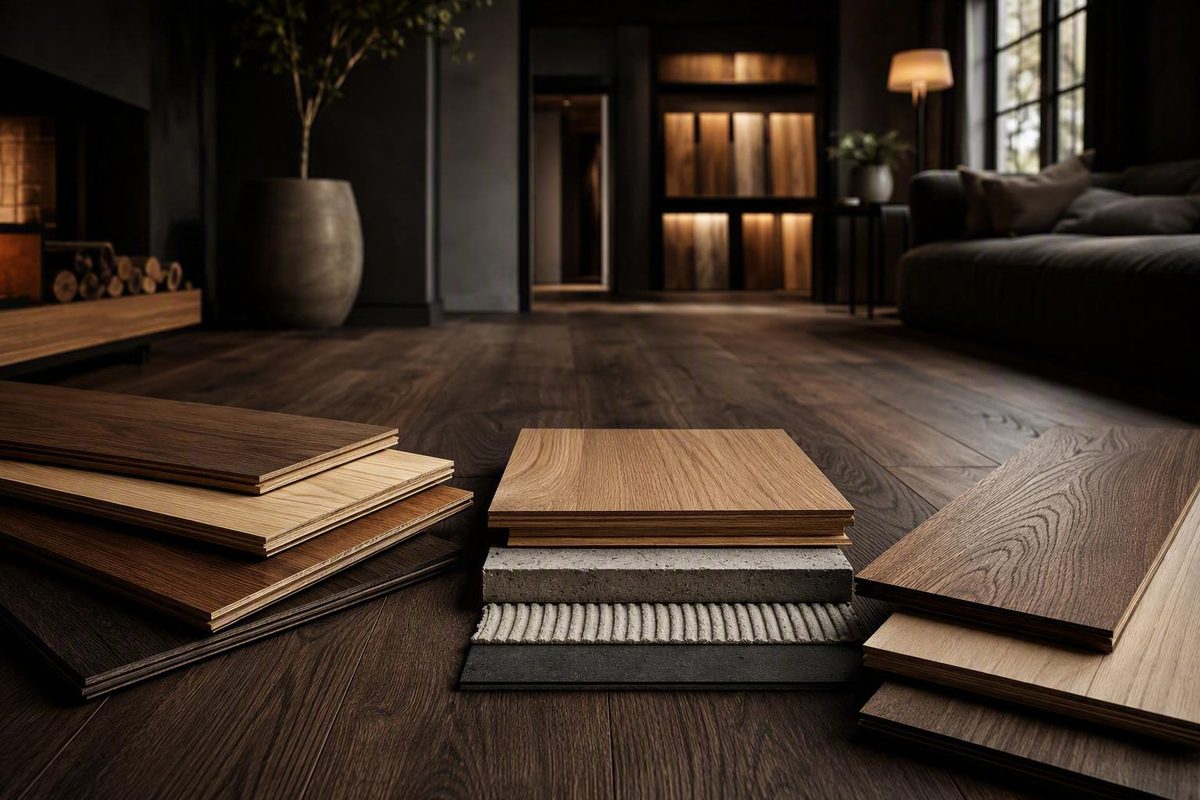
An engineered hardwood floor is a realistic choice only when the exact product is approved for the room’s grade level, substrate, moisture conditions, radiant-heat system, and installation method. Its layered construction can reduce dimensional movement compared with solid wood, but it does not make the floor waterproof. Correct leaks and damp substrates first, then compare written specifications, warranty exclusions, compliance documents, and the full delivered-project cost.
Start here: Is engineered hardwood appropriate for your room?
Answer these five questions before choosing a species, stain, texture, or plank width:
- Is the room above, on, or below grade?
- Is the substrate wood or concrete?
- Is there recurring moisture, leakage, flooding, or standing-water risk?
- Is radiant heat present?
- Which installation methods does the exact product approve?
Engineered construction improves dimensional stability by bonding wood layers with alternating grain directions. It does not stop wood from absorbing and releasing moisture. Depending on conditions, an engineered floor can still swell, shrink, gap, cup, crown, warp, check, or delaminate. The Palacio/Aragon engineered multilayer warranty, for example, describes this continuing response to liquid water, atmospheric humidity, and subfloor moisture.
Use this first-pass decision table to identify what must be confirmed:
| Room or substrate | Possible suitability | Documentation and conditions to verify | Disqualifiers or stop conditions |
|---|---|---|---|
| Above-grade wood subfloor | Often possible | Approved wood-subfloor types; moisture limits; flatness; fastening or floating requirements; required underlayment | Wet, damaged, contaminated, excessively uneven, or structurally unsound subfloor |
| Concrete slab | Conditionally possible | Written slab approval; required moisture-test method and limit; slab preparation; adhesive or floating approval; vapor-control requirements | Unresolved moisture, active intrusion, failed testing, or no written slab approval |
| Below-grade room | Conditionally possible | Written below-grade approval; drainage and moisture history; substrate tests; climate requirements; approved installation assembly | Uncorrected flooding history, recurring leaks, standing water, damp substrate, or absent approval |
| Radiant heat | Conditionally possible | Written approval for the exact product and heating system; surface-temperature limit; startup procedure; humidity range; monitoring and installation method | No product-specific approval, inability to control temperature or humidity, or an incompatible system |
| Recurring water exposure | Generally unsuitable until corrected | Source of water identified and permanently corrected; dry substrate confirmed; seller’s performance claims defined in writing | Active leaks, flooding, standing water, prohibited wet cleaning, or persistent dampness |
Concrete, below-grade, and radiant-heat installations are not automatically approved merely because the flooring is engineered.
Recurring leaks or an unresolved damp slab are building or substrate problems, not flooring-selection problems. Correct them before considering wood. Manufacturer instructions, applicable building codes, local climatic conditions, and actual site conditions take precedence over general advice. The National Wood Flooring Association installation guidelines expressly place manufacturer-specific instructions ahead of general industry guidance.
What engineered hardwood is—and what the construction changes
Engineered hardwood generally consists of a real-wood surface bonded to multiple wood layers. Alternating grain directions partially restrain the movement that occurs as wood gains and loses moisture, giving the plank greater dimensional stability than a comparable solid-wood board. “Greater stability,” however, means reduced movement—not no movement.
Two thickness measurements matter:
- Total plank thickness: The complete thickness of the surface, core, and backing.
- Wear-layer thickness: The thickness of real hardwood available above the core.
A listing that says “1/2-inch engineered hardwood” gives total thickness, not necessarily the usable hardwood depth. It therefore does not establish whether the floor can be sanded. If the wear layer or core construction is missing, request both in writing from the retailer or manufacturer.
The Flooring2 Coast Collection warranty provides a useful but strictly product-specific illustration: a wear layer of at least 4 mm can typically allow two or three professional refinishes; 2–3 mm may allow one careful professional sanding; and less than 2 mm cannot be sanded. The same document warns that improper sanding can void coverage and that its factory-finish warranty ends after refinishing. These thresholds are not universal guarantees and must be checked against the exact floor’s refinishing and warranty terms.
Do not assume that plywood, MDF, particleboard, or another core is inherently best based on its name alone. The useful questions are what the core actually is, whether it is approved for the intended application, how the complete plank must be installed, and which warranty conditions apply.
The specification sheet that matters more than color
Species, color, texture, and width define the visible design. They do not establish whether a floor is appropriate for a basement slab, compatible with radiant heat, or capable of future refinishing.
Build a comparison sheet before collecting samples:
| Field | Product 1 | Product 2 | Product 3 |
|---|---|---|---|
| Manufacturer, collection, and SKU | |||
| Species and color | |||
| Wear-layer thickness | |||
| Core construction | |||
| Total plank thickness | |||
| Plank width and length mix | |||
| Surface texture | |||
| Factory finish | |||
| Approved grade levels | |||
| Approved substrates | |||
| Approved installation methods | |||
| Radiant-heat approval and limits | |||
| Square feet per carton | |||
| Warranty and care-guide version | |||
| TSCA Title VI documentation, if applicable | |||
| Delivered price |
Retail assortments captured in September 2026 illustrate the breadth of appearance choices. WeShipFloors listed oak, acacia, hickory, and elm, including handscraped products as narrow as approximately 4-3/4 inches. Its engineered-hardwood collection is a snapshot of available styles, not a performance ranking.
Floor & Decor’s assortment, also checked in September 2026, included oak, European white oak, acacia, and hickory, with wire-brushed and handscraped surfaces and listed widths up to 9-1/2 inches. These retailer examples show appearance and size options; they do not prove technical suitability.
Consider two hypothetical product records:
| Field | Product A | Product B |
|---|---|---|
| Listing information | Attractive price, species, width, and total thickness | Higher price plus complete technical documents |
| Wear layer and core | Not stated | Both stated |
| Installation approval | Unclear | Methods and substrates identified |
| Warranty | Headline term only | Complete warranty available |
| Buying decision | Pause and request missing details | Continue evaluating room fit and total cost |
Product B is not automatically better, and Product A is not automatically poor quality. Product B is simply easier to evaluate. Product A may become viable after the seller supplies the missing construction, application, and warranty information.
If refinishing is part of your ownership plan, do not buy until the wear-layer measurement and permitted refinishing process are documented. Likewise, treat undefined terms such as “waterproof” as questions, not specifications. Ask what test or warranty language supports the term and which exposures it covers.
Basements, slabs, and radiant heat require written approval
Floor & Decor markets engineered hardwood as a category for basements, concrete slabs, and radiant-heat systems. That is a retailer’s category-level claim, not approval for every construction, product, or site. Its engineered-hardwood category page does not provide all the product-specific limits needed to approve an installation.
For a basement or concrete slab, obtain written answers to these questions:
- Is the product approved for the room’s grade level?
- Which concrete moisture-test method is required?
- What are the passing limits?
- How flat, clean, and sound must the slab be?
- Is glue-down, floating, or another assembly permitted?
- Which adhesive, underlayment, or vapor-control layer is required?
- Are there slab-age, curing, pH, or surface-preparation requirements?
- Who must perform and document the tests?
For radiant heat, confirm the exact product and heating system together. Obtain the manufacturer’s temperature limit, indoor humidity range, startup and shutdown procedure, monitoring requirements, and approved installation method. Do not transfer limits from another collection.
For example, the Palacio/Aragon MultiPly warranty approves a specified 9/16-inch handscraped European white oak product over properly installed radiant heat, subject to a maximum floor-surface temperature of 80°F or 27°C and indoor relative humidity of 35–65%. Its radiant-heat warranty terms also identify floating installation as preferred for that product. Those numbers and that method are not category-wide rules.
Stop the purchase or installation if there is unresolved slab moisture, active water intrusion, no practical way to maintain the required indoor climate, or no written approval for the planned application.
Floating, glue-down, or nail-down: let the product and substrate decide
Floating, glue-down, and nail-down are recognized installation approaches for engineered flooring, but none is universally best. Product construction, joint design, substrate, grade level, moisture conditions, and manufacturer approval narrow the choice.
| Method | Typical substrate context | Approval and preparation to verify | Major risks |
|---|---|---|---|
| Floating | Approved wood or concrete substrate | Joint system, underlayment, vapor control, flatness, expansion space, room-size limits, transitions | Unapproved underlayment, inadequate expansion space, uneven substrate, or moisture below |
| Glue-down | Approved concrete or wood substrate | Adhesive model, trowel, spread rate, open time, slab tests, pH limits, surface preparation | Adhesive incompatibility, contaminated substrate, excessive moisture, or incorrect application |
| Nail-down | Approved wood subfloor or wood system | Fastener type, gauge, length, angle, spacing, subfloor thickness, joist or panel conditions | Wrong fastener, damaged tongues, unsuitable substrate, moisture imbalance, or missed fastening pattern |
Follow the exact instructions for expansion space, fasteners, adhesives, underlayments, and vapor-control materials.
A sound pre-installation sequence is:
- Make the building weather-tight and correct exterior or plumbing water entry.
- Operate HVAC for the period and under the conditions required by the manufacturer.
- Assess room temperature, relative humidity, grade level, and expected use.
- Follow the product-specific conditioning or acclimation instructions.
- Test the flooring, wood subfloor, or concrete using the required methods.
- Inspect substrate flatness, cleanliness, strength, and compatibility.
- Inspect boards in good light and segregate visible defects.
- Record readings, dates, photographs, lot numbers, and approved materials.
Avoid adopting a universal acclimation period. The Coast Collection warranty says five to seven days is typical but still directs purchasers to follow product-specific requirements. Packaging, construction, climate, and manufacturer instructions can change the correct process.
Cutting and sanding wood can create hazardous airborne dust, while powered tools can expose workers to harmful noise. Use suitable dust control and the protective equipment required for the task. Particulate respirators filter particles but do not protect against gases or vapors—an important distinction when adhesives, cleaners, or finishes are also present, as the NWFA safety guidance explains.
Hire a qualified wood-floor installer when concrete testing, moisture mitigation, slab preparation, radiant heat, adhesives, or warranty records exceed your tools or experience. NWFA professional training treats jobsite evaluation, acclimation, moisture testing, and substrate preparation as distinct skills rather than incidental steps.
Moisture stability is not waterproofing
Three terms are often blurred together:
- Dimensional stability describes how much a material changes as conditions change.
- Water resistance describes performance under defined exposure and test conditions.
- Waterproof is meaningful only when the seller identifies what is protected, for how long, under which conditions, and with what exclusions.
Engineered hardwood’s improved stability does not make it immune to spills, leaks, wet subfloors, vapor, standing water, or flooding. As wood gains moisture, boards may swell, cup, or crown. As wood dries, boards may shrink and develop gaps; drying can also contribute to cupping. Species respond at different rates, and small seasonal gaps or natural variation may fall within a product warranty’s definition of normal rather than defective.
Symptoms do not identify the cause by themselves. Cupping, crowning, warping, or delamination can resemble manufacturing failure, yet warranties may exclude the same conditions when moisture, uncontrolled climate, installation, or maintenance caused them. Diagnosis should start with moisture readings, site history, substrate conditions, and installation records—not appearance alone.
The Coast Collection warranty excludes damage associated with wet mopping, steam cleaning, standing water, excessive subfloor moisture, and unapproved cleaners. Follow the care guide for your exact floor and finish rather than assuming that a general wood cleaner or cleaning machine is acceptable.
When a listing calls a product “waterproof,” ask the seller to define the claim in writing:
- Does it cover promptly wiped household spills?
- Is wet mopping permitted?
- How long can water remain on the surface?
- Are plank edges and seams included?
- Does coverage include standing water?
- Is moisture vapor from the subfloor included?
- Are leaks or flooding included?
- What testing standard and warranty remedy apply?
A product name containing “waterproof” does not answer those questions.
Read the warranty before counting its years
The Palacio/Aragon MultiPly and Flooring2 Coast Collection example warranties divide coverage into three broad categories:
- Manufacturing defects, such as qualifying milling, grading, moisture-content, or finish-application problems.
- Structural integrity, sometimes including qualifying delamination.
- Finish wear-through, usually defined as complete wear through the factory finish to bare wood.
That last category is narrower than everyday wear. In these example warranties, scratches, dents, abrasion, gloss reduction, spills, improper cleaning, natural color and grain variation, sunlight-related change, and seasonal movement may be excluded. A 30-year, lifetime, or other long headline term therefore cannot be compared intelligently without reading the definitions and remedies.
Warranty audit checklist
- Is coverage limited to the original owner or installation site?
- Is it transferable?
- Does it apply to residential, rental, or commercial use?
- What temperature and relative-humidity range must be maintained?
- What happens if visible defects are installed?
- Does labor coverage decline or end over time?
- Does screening, recoating, sanding, or refinishing end finish coverage?
- How soon after discovery must a claim be filed?
- Must the retailer initiate the claim?
- Which installation and moisture records are required?
- Are consequential costs, furniture moving, trim, or subfloor work excluded?
- Can the supplier repair only the affected area?
- Is an exact color, grain, or sheen match promised?
Inspect boards before installation and set aside visibly defective pieces. The example warranties may treat installation as acceptance of defects that should have been noticed beforehand.
Keep a complete project file containing:
- Original receipt and finalized quote
- Full warranty, installation guide, and care guide
- Carton ends, product labels, lot numbers, and SKU
- Pre-installation room and substrate photographs
- Temperature and relative-humidity records
- Flooring, wood-subfloor, and concrete moisture readings
- Installer name, scope, dates, and records
- Adhesive, underlayment, and vapor-control product details
- Cleaning and maintenance records
- All claim correspondence and photographs
Read contradictory language especially carefully. The Coast Collection warranty header advertises 15-year residential and 5-year light-commercial coverage, while the body says the warranty applies only to residential applications and excludes commercial use. Obtain written clarification from the supplier before relying on the Coast Collection warranty headline.
Even an approved claim may provide only replacement material or work in the affected area. Labor can be prorated or excluded, consequential expenses may remain with the owner, and replacement wood may not match the installed floor exactly.
What TSCA Title VI compliance does—and does not—tell you
EPA’s TSCA Title VI framework regulates formaldehyde emissions from specified composite wood products, including regulated hardwood plywood, MDF, thin MDF, and particleboard, as well as applicable finished goods containing them. Whether an engineered hardwood floor falls within a particular requirement depends on its actual core and construction under the legal definitions—not the phrase “engineered hardwood.” EPA’s TSCA Title VI implementation FAQ explains that applicability follows the product’s construction and regulatory definitions.
For regulated products manufactured in or imported into the United States after March 22, 2019, regulated composite-wood panels must use the applicable TSCA Title VI certification framework, while labeling, recordkeeping, import, and other supply-chain duties apply according to the product and regulated party. Applicable finished goods may have labeling and related obligations without every finished floor being third-party certified in the same manner as a regulated panel. EPA’s composite-wood formaldehyde standards overview describes these testing, certification, labeling, recordkeeping, and supply-chain requirements.
EPA lists a formaldehyde emission limit of 0.05 ppm for regulated veneer-core or composite-core hardwood plywood. That number does not automatically apply to every floor sold under the engineered-hardwood label; applicability depends on the floor’s construction and the regulatory definitions.
TSCA Title VI compliance does not mean that a floor is formaldehyde-free, non-toxic, allergy-safe, or healthier than a competing product. It indicates compliance with the regulatory emission requirements that apply to the product or its regulated components.
Ask the seller or manufacturer for:
- The floor’s core construction
- The applicable TSCA Title VI compliance statement or label
- Identification connecting the document to the exact product or SKU
- Written clarification if the seller says the rule does not apply
In February 2026, EPA proposed updates to incorporated standards and an additional quality-control test method. Those changes were proposals, not final requirements on the EPA rulemaking page, and should not be treated as binding unless subsequent EPA action finalizes them.
Verify the listing and calculate the project—not just the plank price
Retail prices are snapshots, not national market benchmarks. On the Floor & Decor page captured in September 2026, clearance or Special Buy products appeared at approximately $1.90–$1.99 per square foot, while another listed product was $6.99 per square foot. The page also identified local store inventory and promotional products, so selected store, stock, freight, promotion status, and availability can change the result.
Listings also need a basic consistency check. On the WeShipFloors engineered-hardwood collection captured in September 2026, one product title described a plank as 1/2 inch thick while its URL described it as 9/16 inch; some hickory product titles and URLs showed different carton-area figures; and several $0.99 displays appeared beside titles telling customers to call for pricing. Treat these values as prompts for verification, not firm specifications or purchasable prices.
Listing-audit checklist
Confirm each of these before calculating quantities or placing an order:
- Manufacturer, collection, exact SKU, and lot availability
- Total plank thickness
- Wear-layer thickness
- Core construction
- Plank width and length mix
- Square feet per carton
- Cartons required, including the project’s planned waste allowance
- Stock location and number of matching cartons
- Clearance, promotion, or Special Buy deadline
- Promotion exclusions
- Shipping or freight charges
- Return conditions and restocking terms
- Final delivered price
Total-project worksheet
| Project item | Quantity or basis | Cost |
|---|---|---|
| Flooring | $ | |
| Additional material for waste | $ | |
| Underlayment | $ | |
| Adhesive and application supplies | $ | |
| Vapor or moisture-control materials | $ | |
| Trim and molding | $ | |
| Transitions | $ | |
| Subfloor testing and repair | $ | |
| Delivery or freight | $ | |
| Installation labor | $ | |
| Taxes | $ | |
| Total delivered project | $ |
Compare products on this total, not just the price printed beside one square foot of flooring. A low plank price can lose its advantage if it requires unavailable matching trim, costly freight, extensive slab work, or an installation system that does not fit the project.
Before buying, assemble one pre-purchase packet:
- Technical data sheet
- Complete installation guide
- Complete warranty
- Care and maintenance guide
- Written wear-layer specification
- Written core construction
- Applicable compliance documentation
- Written approval for the room, substrate, grade level, and radiant heat
- Approved installation materials and method
- Finalized quote showing cartons, freight, taxes, and return terms
Choose an engineered hardwood floor only after the room and substrate pass the moisture and application checks. Base the final decision on written product approval, verified wear-layer and core data, a substrate-appropriate installation method, realistic warranty coverage, applicable compliance documents, and the complete delivered-project price—not appearance, marketing labels, or warranty years alone.