
Stone-Look Porcelain Tile: Looks Matter, but Specs Decide
One collection may combine porcelain floor tile with ceramic wall tile, while its mosaic or trim may use another construction.
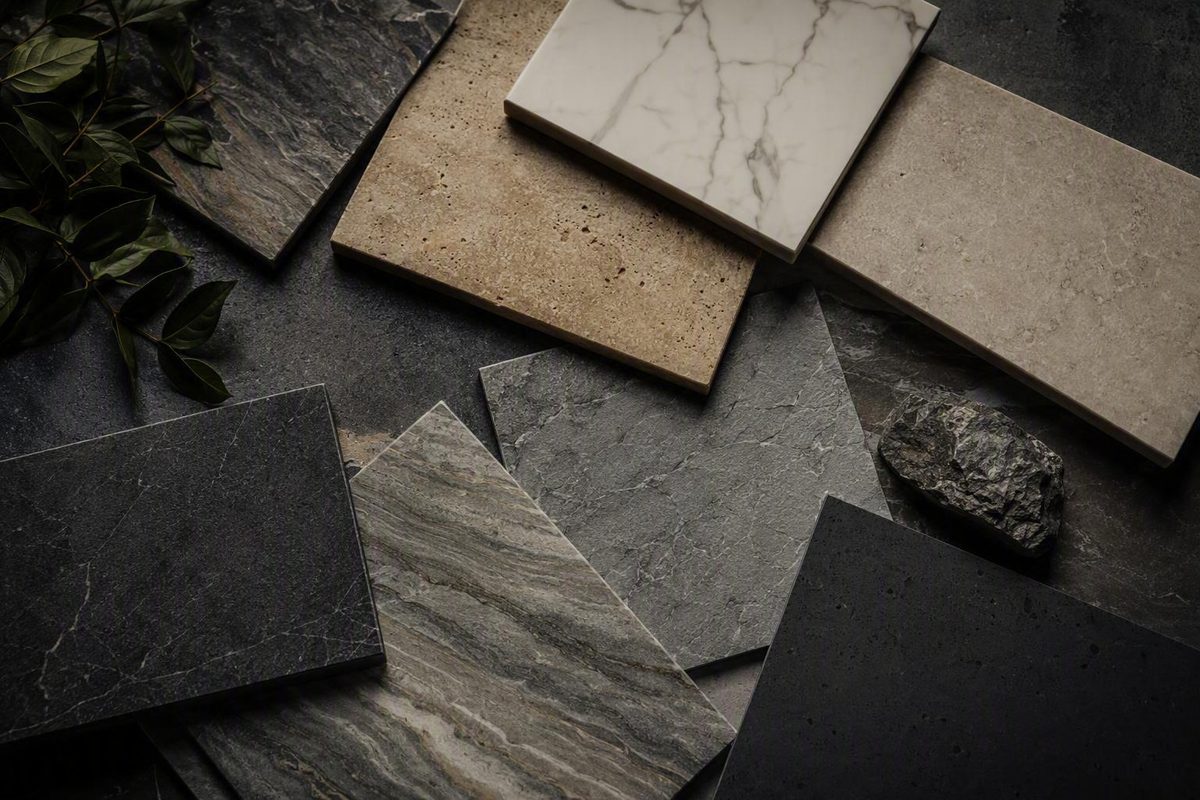
Stone-look porcelain tile can suggest veined marble, warm travertine, quiet limestone, rugged slate, layered quartzite, dark basalt, or other quarried materials without being cut from stone. That range makes the category versatile, but it also makes superficial comparisons risky. Two products described as “stone look” may differ in material, finish, format, graphic variation, thickness, documented applications, and installation requirements.
Choose in two stages. First, decide which stone character, color, finish, format, and degree of variation suit the room. Then verify the exact item—not merely its collection or retail category—for the intended floor, wall, shower, pool, patio, fireplace, countertop, or exterior surface.
What Stone-Look Porcelain Tile Is—and What It Can Imitate
Stone-look porcelain is porcelain tile manufactured to reproduce the visual character of stone. It is not tile cut from a quarried block or slab.
Manufacturers describe creating the effect through printed imagery and physical surface texture. Daltile attributes its stone effects to digital imaging, precision printing, and surface texture, but that manufacturing description does not prove that every product will be indistinguishable from natural stone in person or across a completed installation. Daltile explains how it creates stone-look graphics and texture.
The principal appearances include:
- Marble look: flowing, branching, or dramatic veins, commonly against white, cream, gray, black, or warm-colored backgrounds.
- Travertine look: linear or clouded markings associated with filled, honed, or vein-cut travertine.
- Limestone look: restrained movement, quiet tonal shifts, and occasional fossil-like details.
- Slate look: layered color and a more rugged or cleft-like visual character.
- Sandstone look: granular or softly banded movement, often in warm earth tones.
- Granite look: mottled or granular patterns rather than long directional veins.
- Basalt look: charcoal or dark gray surfaces with relatively subtle movement.
- Quartzite look: sweeping, layered, or crystalline mineral patterns.
- Onyx-inspired look: pronounced bands and dramatic color movement. Porcelain can suggest the pattern, but not the actual optical depth of translucent stone.
The palette is broad rather than universal. White, cream, beige, gray, brown, and charcoal are widely represented, while some collections add black, blue, green, or multicolor options. A travertine-look collection may contain only a few neutral colors; another may reinterpret the same reference in cooler or more dramatic shades.
The category label itself requires scrutiny. A “natural stone look” retail category may combine porcelain, ceramic, natural stone, marble, pebbles, or resilient flooring. TileBar’s category, for example, spans several materials, so shoppers must apply the appropriate material filter and inspect each product listing. TileBar illustrates how a stone-look category can contain multiple materials.
Do not infer material from appearance or collection name. A marble-look floor tile may be porcelain, a coordinated wall tile may be ceramic, and a decorative mosaic or trim may use another construction. Confirm the material for every item number.
The main product groups also differ materially:
- Conventional field tile for broad floor or wall coverage
- Mosaics composed of smaller pieces, often supplied on sheets
- Small-format pool tile
- Thicker outdoor pavers
- Large-format field tile
- Gauged porcelain panels or slabs intended for expansive surfaces
Products may share a color and graphic family without sharing the same finish, thickness, product classification, documented uses, or installation instructions.
Match the Stone Effect to the Room and Design Goal
The stone reference establishes the room’s visual direction. It does not establish technical performance.
Choose by visual character
Marble-look porcelain is a natural starting point when pronounced veining and visual drama are priorities. A fine gray-veined design can function as a neutral background, while broad gold, brown, or charcoal veins make the surface a focal point. Strong directional graphics require more layout planning because rotations and neighboring vein intersections are conspicuous.
Travertine- and limestone-look porcelain generally reads as softer, warmer, and earthier. These looks suit rooms where the surface should add texture without becoming the dominant graphic feature. Beige and cream versions can coordinate with oak, walnut, and other warm timber tones.
Slate- and basalt-look porcelain tends toward a darker, weightier, or more rugged character. Charcoal tile can support a tonal scheme with dark cabinetry and metalwork or create deliberate contrast against pale walls and light wood.
Sandstone- and quartzite-look porcelain often emphasizes grains, bands, layers, or sweeping mineral movement. Depending on color, pattern scale, and finish, these effects can work in either rustic or contemporary interiors.
These are aesthetic tendencies, not performance classifications. A slate look is not automatically an exterior product, and a limestone look is not inherently more suitable for a wet floor than a marble look. Application decisions must be based on documentation for the exact product.
Coordinate color and continuity
Warm beige, cream, taupe, and brown effects can coordinate with warm timber, off-white paint, brass, bronze, and earthy textiles. Gray and charcoal surfaces can support a restrained tonal palette or create contrast with warm wood and pale cabinetry.
One coordinated field tile can establish continuity through connected kitchens, dining rooms, entries, and living areas. That does not require using the same piece on every surface. A collection may include a large field tile for the main floor, a mosaic for a feature area, and a textured or contrasting format for a wall.
Variation can define zones without disrupting the overall palette:
- Continue the field-tile color from a bathroom floor onto the walls.
- Use a coordinated mosaic to distinguish the shower floor, subject to product-level approval.
- Change format rather than color at a backsplash.
- Introduce a textured piece around a fireplace after confirming the specific location is approved.
- Use a darker member of the same family to anchor an island or feature wall.
Larger formats create fewer tile-to-tile joints over the same area, while closely coordinated grout reduces visual contrast at those joints. Mosaics, contrasting grout, and textured pieces create stronger visual breaks.
Application matrix
| Application | Possible visual direction | Documentation or project information to request |
|---|---|---|
| Kitchen floor | Quiet limestone, expressive marble, or rugged slate effect | Floor-use designation, finish, wear information, cleaning instructions, thickness, and installation documents |
| Bathroom floor | Coordinated stone palette with moderate movement | Floor-use designation, wet-use information where applicable, disclosed slip-test method and result, and system requirements |
| Shower wall | Full-height veining or a quieter continuous stone effect | Shower-wall designation, installation instructions, care guidance, and the documents for the specified shower system |
| Shower floor | Coordinated small-format tile or mosaic | Explicit shower-floor designation, disclosed wet-traction information, size and drain compatibility, and system documentation |
| Backsplash | Decorative veining, texture, or mosaic detail | Wall-use designation, care instructions, trim availability, and guidance for nearby heat exposure where relevant |
| Living area | Broad continuity with fewer visual interruptions | Floor-use designation, wear information, format, thickness, and installation instructions |
| Fireplace | Stone character without quarried pieces | Written approval for the particular fireplace location and exposure, plus applicable clearance and setting-material instructions |
| Patio | Indoor-outdoor continuity or a rugged exterior effect | Exterior designation, climate limitations, frost information where relevant, wet-traction data, thickness, and installation method |
| Pool or pool surround | Small-scale mineral texture or coordinated deck color | Pool, submerged, or walking-surface designation as applicable; chemical, climate, traction, and installation information |
| Countertop | Large veined surface with few seams | Countertop designation, thickness, fabrication instructions, edge and cutout guidance, warranty, and fabricator requirements |
Retail application filters are useful for finding candidates, but they do not provide complete product approval. The filter may omit the distinctions among sizes, finishes, climates, exposure conditions, and installation methods. Treat it as the start of the search, not the final specification.
How to Judge Whether the Stone Effect Looks Convincing
A product photograph shows a composition selected by a manufacturer or seller. It may not reveal how the graphic behaves across an entire floor or wall, how often recognizable details repeat, or what the body and cut edges look like.
Realism depends on several interacting details:
- Resolution and subtlety of the printed image
- Relationship between printed markings and physical texture
- Number of distinct printed faces
- Shade and pattern variation among pieces
- Frequency and visibility of repeated graphics
- Edge treatment and body color
- Grout color and joint visibility
- Tile size and installation pattern
- Direction and intensity of room lighting
- Rotation and placement of directional pieces
A collection with many faces can still look artificial if several memorable veins or dark spots are clustered together. A quieter pattern may tolerate more repetition because no single graphic attracts as much attention.
Sample-evaluation worksheet
Inspect several physical pieces together rather than approving the collection from one sample.
- View the pieces in daylight. Move them near windows and into darker parts of the room. Look for unexpected undertones, overly sharp printed details, or variation that changes noticeably with light.
- Repeat the review under artificial lighting. Warm and cool lamps can alter the appearance of cream, beige, gray, blue, and green undertones.
- Compare sheen from several angles. Judge how the finish responds to direct, side, and diffuse light.
- Inspect texture at a low angle. Side lighting can reveal whether the relief relates convincingly to the printed image or follows an obvious repeating pattern.
- Place multiple pieces together. Search for identical veins, dark marks, fossil details, or other recognizable features.
- Rotate directional pieces. Determine whether quarter turns look natural or cause awkward changes in movement.
- Examine the sides and back. Compare the body with the printed face where cuts or exposed edges may be visible.
- Request a cut-edge sample where relevant. Ask how exposed edges, miters, corners, and openings are meant to be finished.
- Place grout samples beside the tile. Review more than one color under the project lighting.
- Photograph the arrangement. A photograph may make repeated graphics or awkward vein intersections easier to notice.
Coordinated grout can reduce contrast at joints, and a larger tile creates fewer tile-to-tile joints across the same area. Neither makes joints disappear.
Printed porcelain has visual limits. Daltile notes that digital graphics may reveal pixels at close range, that sides and backs can differ from the printed face, and that a tile interpretation of stacked stone does not reproduce the full depth or split-face finish of the natural material.
When a design has strong directional movement, plan rotations and prominent vein placement before setting begins. There is no evidence here for a universal layout or waste allowance: room geometry, cuts, pattern direction, fabrication, breakage risk, and retained repair stock all affect the quantity required.
Choose the Right Finish and Format
Finish changes how the stone effect responds to light. Format changes the scale of the pattern and the number of joints. Neither should be selected from appearance alone when an application has specific technical requirements.
Finish comparison
- Polished or glossy: Reflects more light and tends to emphasize color and veining.
-
Matte: Produces a softer, less reflective appearance often associated with limestone, travertine, slate, and restrained marble effects.
-
Textured: Emphasizes physical relief and can suggest cleft, brushed, weathered, or granular stone.
-
Satin or semi-gloss: Creates an intermediate visual response.
- Tumbled-look: Uses softened-looking edges or weathered visual cues to suggest aged material.
Matte is prominent in the surveyed retail catalogs, while honed, polished, glossy, semi-glossy, satin, tumbled, textured, and lappato products are also represented. Bedrosians, for example, lists stone-look porcelain field tile, mosaics, and pavers in matte, honed, and lappato options. The Bedrosians catalog shows variation in stone-look finishes and formats.
Do not convert a finish name into a universal traction or maintenance conclusion. For a consequential application, request the exact item’s documented use, test information, care instructions, and limitations.
Field-tile formats
Common formats represented in the supplied catalogs include 12 x 24, 24 x 24, and 24 x 48 inches. A larger format creates fewer tile-to-tile joints across the same area, allowing broad veins or quiet mineral patterns to read with less interruption. LA Floor Coverings discusses these formats and the visual effect of fewer joints.
Format also changes the questions to ask. Before ordering large pieces, obtain the manufacturer’s installation instructions and have the installer evaluate access, handling, cutting, substrate requirements, layout, edges, transitions, and penetrations. Do not assume that rectified edges permit a grout-free installation or remove the need to follow the specified system.
Field tile, mosaics, pool tile, and pavers
Field tile is the primary unit used across the main area of a floor or wall.
Mosaics consist of smaller pieces, commonly mounted on a sheet. Their smaller units may make them candidates for detailed or changing layouts, but their shape alone does not prove shower-floor approval or wet traction. Ask whether the exact mosaic is documented for the proposed use.
Coordinated trim is not available in every collection, so edge treatment should be planned before purchase.
Pool tile is marketed for pool-related applications and may differ from ordinary field tile in size, mounting, finish, and documentation. Confirm whether approval applies to submerged use, a waterline, a pool wall, or a walking surface.
Pavers are thicker, outdoor-oriented products. Selected collections include 2 cm pavers, but that dimension is not a universal specification for exterior porcelain. Daltile lists 2 cm formats only for designated products or selected colors. Daltile’s collection overview distinguishes conventional tile, mosaics, pavers, and slabs.
Panels and slabs
Large porcelain panels and slabs are a separate planning category from conventional field tile. Manufacturers present them for walls, façades, countertops, islands, furniture, and other expansive surfaces where fewer seams are desired.
Atlas Plan lists stone-look slabs in 6 mm, 12 mm, and 20 mm thicknesses. Those options should not be treated as interchangeable: the correct choice depends on the product’s documented application, support, fabrication, edge, cutout, handling, and warranty requirements. Atlas Plan lists its stone-look slab applications and thickness options.
A specialty retailer’s guide reports a broader commercial panel range of approximately 3 mm to 20 mm and emphasizes that panel work differs from conventional tile and other slab materials. This is an indirect commercial summary rather than a substitute for the selected manufacturer’s technical documents. Architessa discusses gauged-panel terminology, thicknesses, and specialist handling.
Concise glossary
- Field tile: The primary tile covering the main part of a floor or wall.
- Mosaic: An arrangement of smaller pieces, commonly supplied on a sheet.
- Rectified: A product label associated with mechanically finished edges and more consistent sizing. Use the manufacturer’s joint and installation instructions rather than inferring a grout-free result.
- ColorBody: A manufacturer term for porcelain with body color coordinated more closely to the surface. It does not by itself establish that the printed design continues identically through the full thickness.
- Gauged panel: A large ceramic or porcelain product manufactured to a specified thickness. Confirm the applicable technical classification in the manufacturer’s documentation.
- Slab: A commercial term commonly used for a large porcelain surface, especially one intended for fabrication.
- Paver: A thicker product intended for designated paving or exterior applications.
- Honed: A low- or subdued-sheen finish.
- Lappato: A partially polished finish.
- Frost-proof: A product designation concerning freeze-thaw exposure; request the underlying product documentation.
- Slip-resistant: A performance claim that should identify the relevant product, finish, test method, result, surface condition, and intended application.
The Technical Checklist for Floors, Showers, and Outdoor Areas
A dry bedroom wall, busy entry floor, shower floor, patio, pool surround, and submerged surface do not present the same selection questions. Obtain current documentation for the exact item, color, size, and finish.
Ask the seller or manufacturer for:
- Explicit confirmation that the item is porcelain
- Its stated water absorption or product classification
- Documented floor, wall, wet-area, exterior, submerged, or countertop uses
- The applicable slip-test method and result
- Any frost or freeze-thaw designation
- Available abrasion, wear, or service information
- Product thickness
- Explicit exterior-use information
- Chemical-resistance information where pool chemicals or specialized cleaners are relevant
- Current installation instructions
- Cleaning and maintenance instructions
- Product and installation warranty terms
Commercial summaries associate porcelain with water absorption of 0.5% or less. Mineral Tiles connects that limit with the ISO 13006 BIa classification, but its page is a retailer’s summary rather than the underlying standard. Use the figure as a prompt to request the exact product’s classification and current technical sheet, not as proof that an informally labeled porcelain product is suitable for every application. Mineral Tiles summarizes the reported porcelain classification and absorption limit.
Separate three commonly confused attributes
Outdoor approval is a manufacturer or seller designation for specified exterior conditions.
Frost resistance concerns stated freeze-thaw exposure.
Slip resistance concerns traction under a disclosed test method and condition.
Do not use one label as proof of the other two. AquaBlu’s collection illustrates the distinction: its filters listed 68 products as frost-proof but only three as slip-resistant. The category page did not provide enough test detail to approve an item for a particular project, but the mismatch shows that the retail labels are not interchangeable. AquaBlu separates frost-proof and slip-resistant filters in its stone-look collection.
Likewise, matte or textured appearance alone is not adequate evidence for a wet-floor decision. Ask which test applies to the exact finish and size, what result was reported, which use the manufacturer approves, and what additional project requirements the designer, installer, system manufacturer, or local authority identifies.
Compare exact products, not category labels
Use a side-by-side worksheet before choosing between finalists:
| Field | Product A | Product B |
|---|---|---|
| Exact item, color, size, and finish | ||
| Explicitly identified as porcelain | ||
| Water absorption or classification | ||
| Approved floor and wall uses | ||
| Shower-floor or wet-area designation | ||
| Slip-test method and result | ||
| Exterior designation and limitations | ||
| Frost or freeze-thaw information | ||
| Wear or service information | ||
| Thickness | ||
| Chemical-resistance information | ||
| Installation document available | ||
| Care document available | ||
| Warranty and exclusions | ||
| Trim or edge solution |
Leave a field blank rather than converting a retail filter, finish name, or general collection description into an undocumented specification.
Treat the tile and the installation system separately
Before purchase, ask the responsible manufacturer, designer, and installer which documents govern the substrate, water-management system, drainage, setting materials, joints, grout, sealant, transitions, penetrations, and workmanship.
The supplied evidence does not support universal slip thresholds, grout widths, substrate tolerances, mortar-coverage figures, waterproofing details, or code interpretations. Those values should come from current product and system documents and the requirements applicable to the project.
Stone-Look Porcelain Versus Natural Stone
Neither material is the universal winner. Compare a specific porcelain product with a specific stone, finish, application, and installation system.
Appearance and variation
Porcelain provides a manufactured visual system. Its palette, printed faces, formats, and coordinating pieces can be more controlled within a collection. That predictability may help when a project needs a consistent design language across several rooms, but it does not guarantee that future replacement stock will match an earlier production lot.
Natural stone provides geological variation. Veins, fossils, fissures, mineral deposits, and edges arise from the material itself rather than from a print library. Porcelain can imitate those visual cues, but it cannot duplicate the geological uniqueness or full optical depth of every quarried piece.
The choice is partly between controlled visual repetition and inherent natural variation. Some buyers prefer a predictable palette; others value the unpredictability of stone.
Performance and maintenance
Manufacturers and retailers commonly market porcelain as lower-maintenance and more consistently resistant to water absorption than natural stone. Treat those statements as commercial comparisons rather than proof about every porcelain product and every stone type.
Natural stone is not one performance class. Marble, travertine, limestone, slate, granite, and quartzite can differ in finish, porosity, sealing needs, repairability, and use limitations. Two stones sold under the same broad name may also behave differently.
Porcelain requires the same product-level specificity. A glazed field tile, unglazed paver, polished specialty finish, mosaic, and fabricated panel may carry different instructions and approved uses.
Does it need sealing?
Daltile states that its glazed stone-look porcelain does not need sealing. That statement concerns a defined manufacturer surface category; it does not answer every question about grout, exposed body material, cut edges, unglazed pieces, specialty finishes, or products from other manufacturers. Follow the care and installation instructions for every component.
Natural stone should likewise be evaluated by its particular type, finish, exposure, and manufacturer or supplier guidance rather than assigned one universal sealing routine.
Cost
Porcelain is not automatically cheaper. Daltile characterizes stone-look tile as generally less expensive than natural stone while acknowledging that premium porcelain can cost more. That is a manufacturer’s broad commercial comparison, not a complete project-cost study.
The completed price can include:
- Samples
- Freight and delivery access
- Substrate evaluation and preparation
- Cutting and edge treatment
- Seams and fixture openings
- Fabrication
- Setting materials
- Labor and equipment
- Required wet-area or exterior systems
- Sealing where specified
- Retained repair stock
- Disposal
A short decision tree
Choose stone-look porcelain when:
- You want a more controlled visual system.
- The exact item is documented for the intended application.
- Its finish, format, trim, care instructions, and installation requirements suit the project.
- Its complete quoted cost fits the budget.
Investigate natural stone when:
- Unique geological variation is central to the design.
- You are prepared for stone-specific selection, installation, care, and possible sealing.
- The particular stone and finish are documented as suitable for the location.
- You have compared complete project quotations rather than material prices alone.
What Stone-Look Porcelain Tile Costs
The figures below are changeable retail snapshots from the supplied listings. The evidence pack does not provide capture dates, so none should be treated as a current market average, guaranteed price, or installed-cost estimate. Verify price, stock, unit of sale, coverage, freight, and minimum-order terms directly with the seller.
Standard field tile
Bedrosians displayed selected 12 x 24 and 24 x 48 porcelain field tile from $4.99 to $8.69 per square foot. The collection, finish, color, and format affected the listed price. Bedrosians provides the cited field-tile, mosaic, and paver price snapshots.
AquaBlu displayed selected 12 x 24 field tile from $4.66 per square foot. Its visible listings also included larger and specialty formats at higher prices.
Urban Coast showed selected stone-look porcelain starting at approximately $7.99 to $10.49 per square foot, including visible 12 x 24 field tile and 6 x 24 wall products. These were advertised starting prices, not project totals. Urban Coast lists the cited starting prices for selected stone-look products.
Mosaics
Bedrosians listed an Ikonite 4 x 4 honed porcelain mosaic at $17.49 per piece. A per-piece price cannot be compared directly with a per-square-foot field-tile price until sheet coverage, quantity, and the installation area are known.
Ask contractors to price mosaic installation separately rather than assuming its labor cost will match field tile. The evidence supplied here does not establish a universal mosaic labor premium.
Pool tile
AquaBlu’s visible examples extended to $30.95 per square foot for a specialty 3 x 3 pool tile. Visible 6 x 6 pool products occupied a lower listed range, but pool-oriented products should remain a separate budget category from standard field tile.
The same collection page displayed examples ranging from $4.66 per square foot for selected field tile to $30.95 per square foot for the specialty pool tile. Price does not establish pool approval, traction, frost performance, or chemical resistance; request documentation for the exact item. AquaBlu provides the cited field, specialty, and pool-tile price snapshots.
Pavers and specialty slip-resistant products
Bedrosians listed selected 24 x 48 pavers at $9.99 per square foot. Compare them with products intended for similar paving systems rather than averaging them with thinner interior field tile.
AquaBlu displayed selected 35 x 35 products labeled slip-resistant at $12.17 per square foot. The retail label and price still require confirmation against the exact technical documentation and intended application.
Panels and slabs
Budget large panels and slabs separately. Material may be quoted by sheet, slab, square foot, or project. Ask whether the quotation includes templating, fabrication, openings, edge work, crating, transport, specialist handling, installation, and breakage responsibility.
A nominal square-foot material price without those items is not a dependable comparison with conventional tile or natural stone.
Total-budget worksheet
| Item | Questions to answer |
|---|---|
| Samples | How many pieces are needed to assess variation, finish, edges, and grout? |
| Tile or panels | Is the price per piece, sheet, box, slab, or square foot? |
| Freight | Are crating, liftgate service, insurance, or job-site delivery additional? |
| Cuts and breakage | How complex are the room, pattern, openings, and edge details? |
| Repair stock | What quantity should be retained, and where will it be stored? |
| Substrate work | What evaluation or correction does the installer include in the quotation? |
| Wet-area or exterior system | Which specified components are excluded from the tile price? |
| Setting materials | Which mortar, primers, membranes, and accessories are included? |
| Grout and sealant | Which products, colors, and quantities are priced? |
| Trim and transitions | Are matching trims available, or is another edge treatment required? |
| Fabrication | Are cutouts, miters, seams, reinforcement, or polishing required? |
| Labor | How is the selected format and pattern priced? |
| Sealing | Is sealing specified for any component or specialty surface? |
| Disposal | Who removes packaging, demolition debris, offcuts, and damaged pieces? |
The evidence does not support one universal waste percentage or a complete installed-cost comparison between porcelain and natural stone. Obtain a project-specific quantity and quotation based on geometry, layout, fabrication, breakage risk, and desired repair stock.
Before You Order: Samples, Documentation, and Installation Planning
A disciplined purchase sequence reduces the risk of approving the right appearance but the wrong product.
Pre-purchase sequence
- Confirm the material. Verify that every field tile, mosaic, trim, paver, or panel is explicitly identified as porcelain.
- Obtain current documents. Request the technical sheet, installation instructions, care guidance, and warranty.
- Verify every intended application. Obtain written product-level information for each proposed floor, wall, shower, pool, patio, fireplace, façade, or countertop use.
- Inspect several samples. Assess variation, graphics, texture, sheen, edges, and body color under project lighting.
- Calculate the complete scope. Include accessories, preparation, fabrication, freight, labor, and retained repair stock.
- Retain the documentation. Give the installer the current product and system instructions rather than relying on a category description.
Questions for the seller or manufacturer
Ask:
- What shade-variation classification applies?
- How many distinct printed faces are included?
- Is a small sample representative of the full variation?
- Does the physical texture align with the printed graphic?
- What colors are the edge and body?
- Are matching trims or documented edge treatments available?
- What joint and layout instructions apply?
- Which setting materials are approved?
- Are there special cleaning or grout-haze instructions?
- Is sealing specified for any component?
- Which slip test was used, and what result applies to this finish and size?
- Is the product documented for exterior, freeze-thaw, shower-floor, pool, or submerged use?
- What does the warranty cover and exclude?
- What should buyers know about later availability and production-lot variation?
Review pieces from multiple boxes before setting begins, particularly when graphics are directional or highly varied. This may reveal the available shade range, repeated faces, or directional movement while layout changes are still possible. It does not guarantee matching across production lots or eliminate every visual issue.
Large formats need a different plan
A 24 x 48-inch tile creates fewer tile-to-tile joints than a 12 x 24-inch tile across the same area, but size alone does not establish suitability. Ask the product manufacturer and installer how the selected format affects delivery access, handling, cutting, substrate evaluation, layout, alignment, edges, transitions, and penetrations.
Before ordering, determine:
- Whether pieces can reach the installation area intact
- How they will be moved, cut, and supported
- Which manufacturer requirements apply to the substrate and setting system
- How the layout meets walls, drains, cabinets, doors, and transitions
- How exposed edges and openings will be finished
- Whether the installer has completed comparable projects with the selected product
Treat panels as specialist work
Gauged porcelain panels and slabs require planning that differs from ordinary tile. Architessa’s specialty guide says their handling, fabrication, tools, and installation methods differ from those used for conventional tile, natural-stone slabs, and engineered quartz.
Use the selected manufacturer’s current documents and a fabricator or installer experienced with that product and application. This is especially important for countertops, façades, large wall panels, sink cutouts, miters, exposed edges, pools, showers, and exterior work.
Red flags before placing the order
Pause the purchase if you encounter:
- A mixed-material category with no item-level confirmation that the product is porcelain
- No current technical sheet
- A vague “outdoor,” “pool,” or “shower” claim without details
- No disclosed test information for a wet walking surface
- A frost label being used as proof of traction
- One small sample being used to approve a highly varied design
- No information about printed faces or repetition
- No plan for trims, edges, cuts, openings, or transitions
- A large format selected without checking access and product instructions
- A proposed panel installer who cannot explain how the product differs from conventional tile
Frequently asked questions
Does stone-look porcelain tile need to be sealed?
Daltile states that its glazed stone-look porcelain does not require sealing, but that statement should not be generalized to every porcelain product or every component of an installation.
Check the exact manufacturer’s instructions for the tile and finish. Evaluate grout, cut or exposed edges, unglazed pieces, specialty surfaces, and natural-stone accents separately. Do not apply sealer solely because the tile resembles porous stone, and do not assume that no component requires sealing merely because the field tile is porcelain.
Is stone-look porcelain suitable for shower floors or pool surrounds?
It can be a candidate when the exact item is documented for the proposed application.
For a shower floor, request the shower-floor designation and applicable wet-traction information for the selected size and finish. If considering a mosaic, confirm its documented use rather than assuming that small pieces are automatically suitable.
For a pool surround, request the walking-surface, exterior, climate, chemical, and installation information relevant to the project. For submerged use, obtain an explicit submerged or pool-use designation.
The tile’s documentation does not replace the instructions for the specified shower or pool system. Have the responsible professionals identify which current product, system, and local requirements govern the installation.
Are frost-proof and slip-resistant porcelain tile the same thing?
No. Frost resistance concerns stated freeze-thaw exposure, while slip resistance concerns traction under identified test conditions. Outdoor approval is a separate designation.
A product may carry one label without the others. Verify each attribute required by the project and request the test method, result, application context, and current product documentation.
Does 24 x 48 tile look more like continuous stone than 12 x 24 tile?
It can. A 24 x 48-inch format creates fewer tile-to-tile joints over the same area than a 12 x 24-inch format, allowing broad veins or quiet mineral patterns to read with less interruption. Coordinated grout can further reduce joint contrast.
The result still depends on the graphic, number of distinct faces, layout, grout, room geometry, cuts, lighting, and workmanship. A repetitive 24 x 48 design may look less convincing than a well-varied 12 x 24 collection.
Choose the larger format only when both its visual scale and the selected product’s handling and installation requirements fit the project.
How can I tell whether a stone-look tile is porcelain rather than ceramic?
Read the individual product description and technical sheet. Do not rely on the collection name, stone-look category, or appearance.
Look for:
- Explicit identification of the material as porcelain
- A stated water-absorption result or recognized product classification
- Documentation tied to the exact item, size, color, and finish
- Manufacturer information for the intended application
Check every coordinating component separately. One collection may combine porcelain floor tile with ceramic wall tile, while its mosaic or trim may use another construction.
Ultimately, make the decision in three parts: choose the stone character and format that work visually, verify the exact product against the demands of its location, and plan the complete installation rather than budgeting for tile alone. The strongest purchase is not the one with the broadest marketing claims; it is the one whose samples, documentation, format, and project requirements all align.