
Does the Quartz Tariff Apply to Flooring Tile?
Yes, if imported tile qualifies as manufactured quartz surface. Check composition, origin, HTSUS classification, entry date, and quota status.
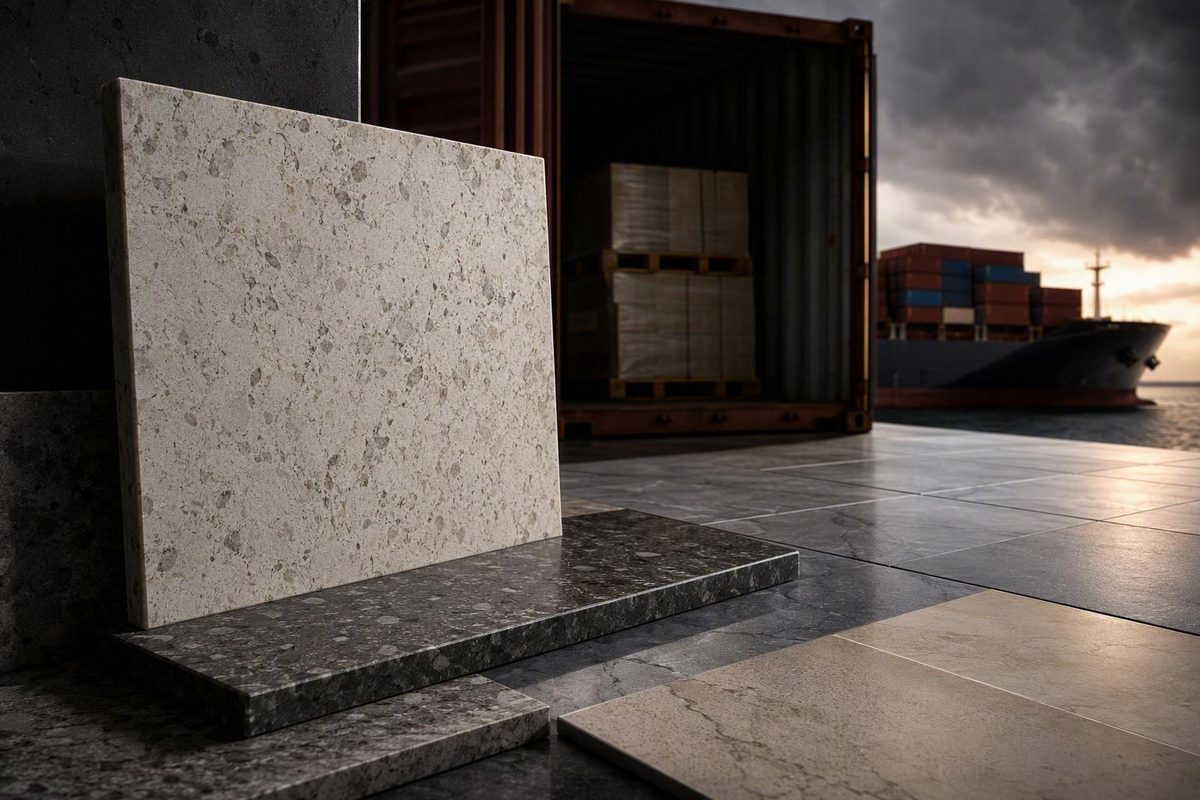
Yes, an imported flooring tile can be covered when it qualifies as a manufactured quartz surface product—but “quartz” in the product name is not enough. Buyers need to establish what the tile is made from, where it was manufactured, how it is classified, and when it was or will be entered for consumption. For the reported 2026 safeguard, country exclusions and quota availability may also matter.
“Quartz tariff” can mean either the reported 2026 Section 201 safeguard or the separate antidumping and countervailing duty orders on certain quartz surface products from China. A tile could potentially face one, both, or neither. Because the available Section 201 information comes from secondary summaries rather than the controlling proclamation, tariff schedule, and current customs instructions, use this article as a purchasing screen—not as a shipment-specific legal or duty determination.
The short answer: some quartz flooring tile is covered
Flooring and tiles are expressly named among the quartz surface products that can fall within the reported 2026 Section 201 safeguard. A trade-law analysis describes the safeguard as covering flooring and tile, while another identifies the customs classifications and separate codes for in-quota and over-quota entries (Diaz Trade Law’s safeguard analysis; customs and international trade law summary).
That does not mean every product sold as “quartz tile” is covered. A showroom label might refer to an engineered-quartz composite, natural quartzite, quartz-look porcelain, or another material. The product must satisfy the definition and customs requirements of the relevant measure.
The two regimes are different:
- The reported 2026 Section 201 safeguard: A four-year tariff-rate quota for covered imports from non-excluded origins.
- The China AD/CVD orders: Antidumping and countervailing duty orders on qualifying quartz surface products from China.
The Section 201 account and the China orders use different legal authorities and coverage tests. Quota treatment under the safeguard does not resolve coverage under the China orders.
Product coverage and the amount owed are also separate questions. Even if a tile is covered, a shipment-specific calculation can depend on its origin, entry date, quota position, producer or exporter, and other applicable duties. A retail description cannot answer those questions.
First identify what the tile is actually made from
Start with the technical data sheet or bill of materials, not the color, pattern name, or showroom category.
| Product description | Initial tariff-screening result | Documentation to request |
|---|---|---|
| Resin-bound engineered quartz | Screen under both regimes, depending on origin | Silica percentage, resin content, manufacturer, origin |
| Natural quarried quartzite | Excluded from the cited China AD/CVD scope | Quarry origin, stone declaration, invoice |
| Quartz-look porcelain | Do not classify from appearance alone | Ceramic composition, product standard, declared HTSUS code |
| Crushed-glass composite | Review every exclusion criterion | Material percentages and glass-particle specifications |
| Other mineral composite | Composition-dependent | Bill of materials and manufacturing process |
For the China orders, covered quartz surfaces are made from a mixture containing a resin binder in which silica—such as quartz, quartz powder, or cristobalite—exceeds every other single material by actual weight. The written scope includes flooring and tiles in different sizes, shapes, thicknesses, and finishes (International Trade Administration’s China quartz case scope).
Quarried granite, marble, soapstone, and quartzite are expressly excluded from that China-specific scope. Natural quartzite is quarried stone; engineered quartz is a manufactured composite containing a resin binder. A similar name or appearance does not make them the same product.
Likewise, porcelain printed to resemble quartz remains porcelain if that is its actual construction. Terms such as “quartz look,” “quartz white,” or “quartz effect” do not turn ceramic tile into engineered quartz.
Crushed-glass products require closer review. The China scope provides a limited exclusion, but the product must satisfy every listed requirement concerning composition, visible glass, particle size, and spacing. A “recycled glass” label alone does not establish the exclusion.
How to screen a tile under the 2026 Section 201 safeguard
Because the available evidence consists of secondary reporting, treat this as a preliminary five-step screen:
- Confirm that the product is a covered quartz surface product. Obtain its actual composition and construction rather than relying on the SKU name.
- Check the declared HTSUS classification. Secondary trade-law reporting identifies 6810.99.0020, 6810.99.0040, and 7020.00.6000 for covered products.
- Establish the actual country of origin. The seller’s address, export port, warehouse location, or country of packaging may not resolve legal origin.
- Identify the entry-for-consumption date. This is not necessarily the order, invoice, sailing, arrival, or warehouse-delivery date.
- Determine whether the entry is within or above quota. Treatment may depend on quota availability when the customs entry is made.
A trade-law summary reports that the safeguard applies to covered goods entered for consumption on or after 12:01 a.m. Eastern Time on August 15, 2026. It identifies 9903.45.30 for in-quota entries and 9903.45.31 for over-quota entries, along with the three product classifications listed above (summary of the reported classifications and effective time).
The measure is reported as a four-year tariff-rate quota, not a universal flat tariff. In-quota and over-quota entries receive different treatment, and that treatment changes over the measure’s life.
KPMG reports exclusions for Canada, Mexico, Australia, several free-trade partners and beneficiaries, and qualifying developing countries that remain below specified import-share thresholds (KPMG’s safeguard summary). Those exclusions still require a valid origin analysis. Shipment from an excluded country does not by itself prove that the tile legally originates there.
Do not use an online rate table as the sole basis for a project calculation. The supplied secondary summaries conflict over the first-year in-quota rate, and the controlling government records are not available here to resolve that conflict. Before relying on a rate, the importer or broker should check the current HTSUS provisions, quota records, and CBP instructions for the actual entry date.
The China quartz orders are a separate duty question
Chinese engineered-quartz flooring may also fall within antidumping and countervailing duty orders. These orders are separate from the reported 2026 safeguard, and safeguard quota status does not decide whether the China orders apply.
The written China scope covers manufactured surfaces—including flooring and tiles—made from a resin-bound mixture in which silica exceeds every other single material by actual weight. For these orders, the written scope controls. An HTSUS number can help identify an entry, but neither that number nor a retail product name determines coverage by itself.
An otherwise qualifying product generally remains within scope regardless of its size or thickness, or whether it has been polished, cut, cured, edged, finished, fabricated, or packaged. Finishing or fabricating qualifying Chinese-manufactured quartz material in another country does not automatically remove it from scope. The importer needs records showing where the underlying surface was manufactured and what processing occurred later (International Trade Administration scope description).
Following sunset reviews, Commerce continued the China antidumping and countervailing duty orders effective January 24, 2025. The continuation notice reiterates the scope and says the written description is controlling (Federal Register continuation notice).
Do not take a percentage from an enforcement case, another importer, or a different exporter and apply it to a flooring quote. Cash-deposit and final-duty treatment can depend on facts that are not visible in a product listing.
A practical decision table for a flooring quote
| Product or shipment | Initial screen | Next step before approval |
|---|---|---|
| Engineered quartz from a non-excluded country | Potential Section 201 coverage | Verify composition, classification, entry date, and quota status |
| Engineered quartz from a reported excluded country | Possible safeguard exclusion | Obtain origin records and a written importer or broker analysis |
| Chinese engineered quartz finished elsewhere | Possible Section 201 and China AD/CVD exposure | Document original manufacture and all later processing |
| Natural quartzite | Excluded from the cited China scope | Confirm it is quarried stone and classify it separately |
| Quartz-look porcelain | Not engineered quartz merely because of its pattern | Obtain the ceramic specification and declared classification |
| Inventory that already cleared customs | Import treatment may already be reflected in cost | Ask whether the price includes all import duties paid |
Two visually similar gray tiles can therefore receive different treatment. One might be resin-bound engineered quartz from a covered origin; the other might be quarried quartzite or porcelain with a quartz pattern.
For Chinese quartz finished in another country, ask for the manufacturing source of the original slab or surface—not merely the country printed on the carton. A supplier or broker’s written analysis is useful supporting documentation, but it is not the same as a binding CBP ruling. If origin remains materially uncertain, the importer should obtain qualified customs advice and consider whether an authoritative ruling is needed.
For material already in domestic inventory, ask when it cleared customs and whether the dealer’s price includes the importer’s duties. A tariff percentage does not necessarily produce an equal retail-price increase because inventory timing, contracts, margins, and supplier pricing also affect the quote.
Keep installation performance separate from customs status. Tariff treatment does not establish slip resistance, water-exposure limits, substrate requirements, movement accommodation, thickness suitability, or fitness for a particular room.
Documents to request before committing to the material
Send the supplier, importer, or customs broker this checklist:
- [ ] Technical composition sheet
- [ ] Silica content by actual weight
- [ ] Resin type and resin content
- [ ] Manufacturer’s legal name
- [ ] Country of manufacture
- [ ] Origin of the slab or other major input
- [ ] Complete third-country processing history
- [ ] Commercial invoice
- [ ] Declared HTSUS classification
- [ ] Actual or expected entry-for-consumption date
- [ ] In-quota or over-quota status
- [ ] Relevant Commerce scope ruling, if any
- [ ] Relevant CBP classification or origin ruling, if any
Ask for a written response to this question:
Is this exact SKU considered subject to the Section 201 quartz safeguard, the China quartz AD/CVD orders, both, or neither, and what records support that conclusion?
The quote should also state whether applicable duties are included, how long the price remains valid, who bears a later tariff adjustment, and whether the supplier may substitute another product or origin without written buyer approval.
Industry guidance reports that the safeguard can be cumulative with applicable antidumping, countervailing, and other duties. It also says an order or shipment made before the effective date was not automatically protected if entry for consumption occurred after the safeguard began.
Engineered-quartz flooring can fall within the reported 2026 safeguard, the China-specific orders, or both, but its name does not settle the issue. Before paying a deposit, identify the material and have the importer verify the current official classification, origin, entry treatment, and applicable duties with a licensed customs broker or qualified trade professional. Classifications, exclusions, quota availability, and implementation instructions can change.
Are quartz flooring tiles ordered or shipped before August 15, 2026 automatically exempt?
No, according to the available industry guidance. The reported trigger is when covered goods were entered for consumption, not when they were ordered, contracted, paid for, shipped, or placed on the water. A pre-August 15 order could therefore be affected if its customs entry occurred on or after 12:01 a.m. Eastern Time on August 15, 2026. Ask the importer for the entry date and supporting entry documents (Rockheads USA’s effective-date guidance).
Can the retailer’s location tell me the tile’s country of origin?
No. A U.S. retailer can sell tile made elsewhere, while a foreign seller can ship goods manufactured in another country. The export port, warehouse, or place of final packaging does not necessarily establish legal origin. Request the manufacturer, original surface source, processing history, and the importer or broker’s origin analysis; seek authoritative customs guidance when the facts remain uncertain.