
Outdoor Terracotta Tiles: When They Work and When They Fail
Terracotta suits mild, drying sites with exterior approval; freeze-thaw patios need a documented frost pass. Screen absorption, wet DCOF and sealer limits.
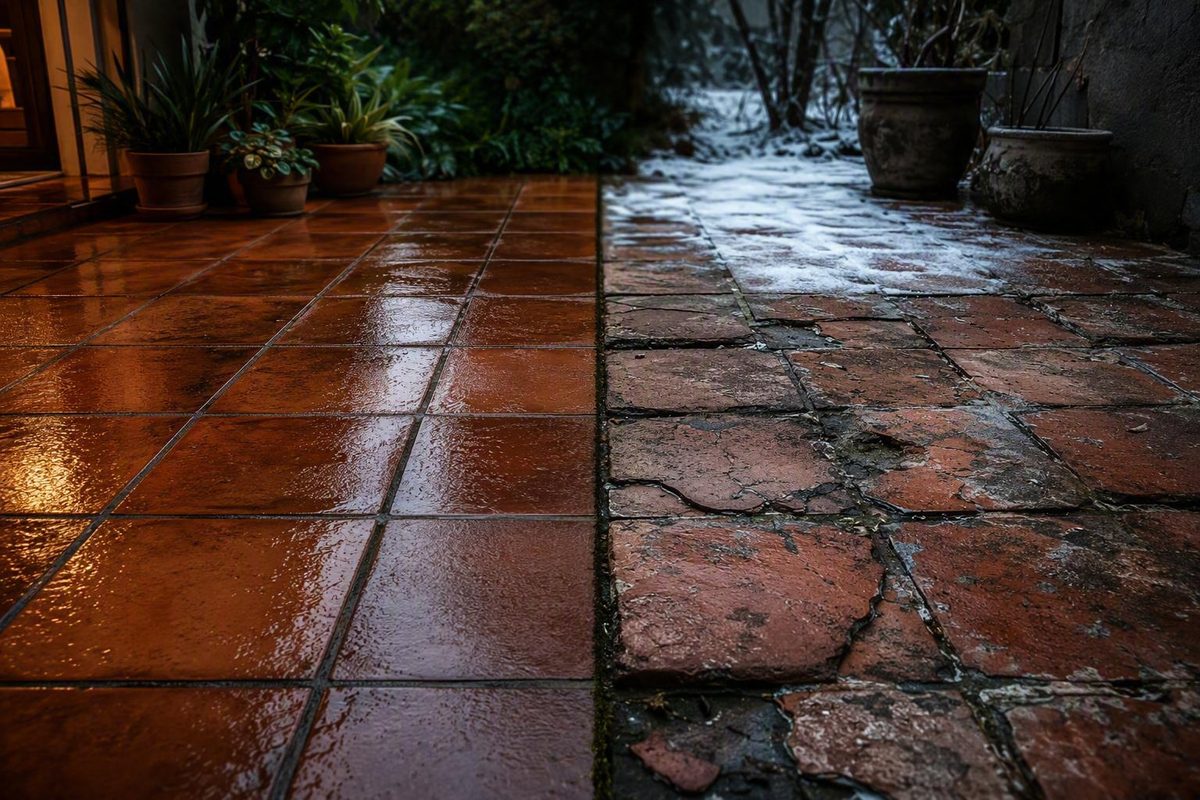
Terracotta works outdoors when the site does not freeze after it gets wet and the exact tile carries exterior approval on its technical sheet. In a wet freeze-thaw climate, only a tile with a documented freeze-thaw pass belongs outside, and most natural terracotta cannot show one; an exterior-rated terracotta-look porcelain is usually the lower-risk choice there. Sealer manages stains and slows water uptake. It does not make an indoor tile exterior-rated or frost-resistant, and neither a salesperson’s assurance nor an “outdoor” filter on a retail page substitutes for the sheet.
Pick your climate, location and tile; the verdict and the evidence to request update beside the controls.
Does Terracotta Pass on This Site?
Add the technical sheet details (optional)
Lowest-risk case for terracotta
A covered area that does not freeze mainly risks staining, ponding and bond failure. Natural terracotta still needs sealing and a compatible mortar.
Ask the seller for
- Exterior-floor approval for this exact color, finish and thickness (not yet on file)
- Substrate requirements and the approved mortar for this tile
- A drainage plan so water leaves the assembly
- The compatible sealer and the pre-seal-before-grout sequence
Enter absorption or wet DCOF to screen the numbers against published benchmarks.
Benchmarks: absorption above 3% is a freeze-thaw concern and 0.5% or below the strongest-frost-resistance benchmark (Design and Direct Source); wet DCOF at least 0.60 for level exterior areas and pool decks, 0.65 for ramps (Daltile guidance). Screening only, not a pass or fail verdict; sealer never supplies frost resistance.
Freezing After Saturation Is the Failure That Matters
Two questions sort most projects. Will the surface freeze after it becomes wet? And how often will it be wet while someone walks on it, barefoot or on an incline?
A roof cuts direct rain but not wind-driven water, condensation, irrigation, wet footwear, drainage faults or moisture rising from below. Porous fired clay absorbs water, and when that water freezes it creates pressure that flakes, cracks or spalls the tile. Recognized ceramic frost-test methods include ASTM C1026 and EN ISO 10545-12; which one applies depends on the product and jurisdiction (Digitalfire’s technical overview of weather-resistant ceramics).
| Condition | Principal risk | Minimum evidence |
|---|---|---|
| Covered area, mild or dry climate | Staining, ponding, bond failure | Exterior approval, substrate requirements, compatible sealer |
| Uncovered wet patio | Repeated saturation, standing water, slipping | Exterior approval, absorption data, wet-use classification, drainage plan |
| Freeze-thaw climate | Cracking or spalling after absorbed water freezes | Exterior approval, absorption data, recognized freeze-thaw result |
| Shaded, damp courtyard | Slow drying, algae, slipping | Exterior wet-use data, drainage plan, approved cleaning method |
| Pool surround | Frequent water, bare feet, pool chemicals | Pool-specific wet-slip data, chemical limits, local code review |
| Steps or ramps | Higher consequence of a slip on an incline | Incline-specific wet-slip data, edge details, local code review |
Terracotta is straightforward where temperatures stay mild, exposure is limited and the assembly can dry. Pool surrounds, steps and ramps need a separate slip review: a rough-looking face in a showroom says nothing about how the tile behaves wet, dirty, worn or sealed.
“Terracotta” Names a Color as Often as a Material
Retail searches mix genuine fired-clay terracotta with terracotta-look porcelain, terrazzo mosaics and anything with a warm clay color. Sort the product before comparing prices.
- Natural unglazed terracotta: fired clay with an exposed, generally porous body. Color, texture, edges and dimensions vary. It commonly needs sealing.
- Glazed terracotta: a clay body with a fired glaze face. The face absorbs less, but the body, edges, back and any glaze crazing still take water outdoors.
- Saltillo: a highly absorptive clay tile that needs an installation system built for that absorption. Ordinary terracotta instructions do not transfer automatically.
- Reclaimed terracotta: salvaged tile with patina but uncertain composition, firing, absorption, prior treatments and test history.
- Terracotta-look porcelain: porcelain made to mimic clay color and variation. Absorption may be far lower, but exterior and slip suitability still depend on the exact finish and sheet.
Reclaimed tile is the hardest case. Without traceable data there is no way to establish exterior approval, absorption, frost resistance, strength or compatibility with modern mortars and sealers. Testing representative pieces can make sense on a large job; surviving somewhere else is not evidence.
Handmade tile varies box to box. If the supplier recommends blending, open several boxes and spread the tones and textures across the layout before setting begins.
Order a sample before approving anything. Confirm it is the material advertised, wet it to see how fast and how unevenly it darkens, and apply only the manufacturer-approved sealer. Sealing can deepen color, change sheen and emphasize variation, so approve the sealed, wetted sample rather than the raw tile.
The Numbers to Demand on the Technical Sheet
Ask the seller to fill this in for the exact color, finish, size and thickness you intend to buy. A value from another collection, or another finish in the same collection, may not transfer.
| Specification | What to record |
|---|---|
| Exact product | Manufacturer, collection, SKU, color, finish, size, thickness |
| Material | Natural terracotta, Saltillo, glazed clay, reclaimed clay or porcelain |
| Approved exterior uses | Patio, walkway, balcony, pool surround, steps, ramp, wall |
| Water absorption | Test method and reported result |
| Freeze-thaw performance | Method, result, finish and thickness tested, report date |
| Product-use classification | ANSI A326.3 category, including Exterior Wet if applicable |
| Wet-slip result | Wet DCOF or other test, conditions, finish tested |
| Physical performance | Thickness and breaking-strength result |
| Installation system | Approved mortar, grout, membrane, sealant, substrate |
| Sealer | Compatible product, sequence, cure time, renewal method |
| Warranty | Climate, installer, maintenance and system conditions |
Absorption is the first screen because water in a porous body is what cracks or spalls the tile when it freezes. Design and Direct Source cites absorption above 3% as a rule-of-thumb concern for freeze-thaw exposure and below 0.5% as the benchmark associated with the strongest frost resistance, while stressing that outdoor suitability varies by exact product (Design and Direct Source’s terracotta specification guide). Those are screening figures, not pass-fail thresholds. Absorption alone says nothing about pore structure, firing, strength, thickness, glaze condition, salt exposure or how readily the assembly dries.
For a freezing site, ask which recognized freeze-thaw method the exact tile passed and request the report. ASTM C1026 and EN ISO 10545-12 are the usual candidates, but check the applicable product standard and local requirements before insisting on either.
ANSI A326.3 covers laboratory and field DCOF testing, specifications and product-use classifications for hard-surface flooring. Its classifications, including Exterior Wet, are application-oriented rather than a single number treated as a safety verdict (Tile Council of North America’s ANSI A326.3 overview).
Daltile’s selection guidance lists a wet DCOF of at least 0.60 for level exterior pedestrian areas exposed to water, excluding ice, and at least 0.65 for ramps and inclines, with the caveat that drainage, maintenance, footwear and actual end use must be considered alongside the number (Daltile’s DCOF application guidance). That is Daltile’s guidance for its wider tile range, not a terracotta standard, and DCOF says nothing about absorption, frost resistance, strength, waterproofing or installation quality.
Do not accept “outdoor suitable,” “non-slip” or “frost resistant” without the sheet or report behind it. The document should name the body, finish, size or thickness where relevant, test method, result and approved application.
Wet-Slip Performance Depends on the Finish, Not the Look
No floor tile is slip-proof. Wet performance changes with slope, drainage, contaminants, cleaning residue, footwear, bare feet, wear, sealer and maintenance. Surface type is only a first filter.
- Smooth or glossy: a poor starting point where water or contaminants are expected unless application-specific testing supports it.
- Matte: worth considering for walking areas, but “matte” describes appearance, not a measured slip result.
- Textured: more practical grip than a smooth face, though deep texture holds dirt and algae if cleaning and drainage are poor.
- Unglazed: usually more surface texture than a glossy glaze, with greater porosity and sealing needs.
| Application | Wet-performance question | Site question |
|---|---|---|
| Level patio | Classified for exterior wet use with footwear? Does sealing change the tested surface? | Where does rain drain, and can water pond? |
| Wet walkway | Was this exact finish tested wet? How does it behave with tracked soil or leaves? | Shaded, irrigated, or collecting organic debris? |
| Pool surround | Is the result intended for frequent water and bare feet? | Drainage, pool-chemical and local code requirements? |
| Steps or ramps | Is there incline-specific data for treads and nosings? | Slope, edge design, drainage path, expected footwear? |
Smaller formats mean more grout joints. Joints help form slopes and transitions and can add practical traction, but cracked or eroded grout is a route for water into the assembly. Algae, leaves, soil and cleaning residue make any installed surface more slippery than its laboratory result, so a shaded courtyard that stays damp needs a stricter drainage and cleaning plan than an open patio that dries fast.
The Assembly Fails Before a Good Tile Does
A technically suitable tile can still fail on a weak, wet, poorly drained, or moving base. Plan in this order:
- Evaluate the structure and substrate: load capacity, stability, cracks, contamination, moisture and suitability for direct bonding.
- Establish drainage so water leaves the assembly rather than collecting at walls, edges, drains or low spots.
- Determine membrane requirements. Decide whether waterproofing, drainage components, or crack isolation are required for the substrate and exposure.
- Accommodate movement: thermal movement, changes of plane, perimeters, existing joints and transitions.
- Choose one compatible system of mortar, grout, membrane, sealant and sealer matched to tile, substrate, climate and use.
- Respect weather limits for each product and protect the cure from traffic and weather for the specified period.
For direct bonding, concrete must be clean, dry, sound and free of wax, curing compounds, paint, oil, old adhesive or laitance. LATICRETE’s thin-set FAQ gives 1/4 inch of variation over 10 feet as flatness guidance and explains that highly absorptive Saltillo quickly pulls moisture out of conventional dry-set mortar, recommending a suitable high-strength latex-fortified thin-set for its referenced applications (LATICRETE’s thin-set and substrate-preparation FAQ). Those are manufacturer recommendations, not a complete specification; the right mortar still depends on substrate, exposure, membrane, tile size and the rest of the system.
Drainage matters even with a sealed face, and in freezing conditions retained moisture is exactly what drives freeze-thaw damage. Hot weather shortens mortar working time; follow the maker’s temperature, open-time and pot-life limits and never revive stiffening mortar with extra water.
There is no single slope, coverage percentage, membrane, grout width or movement-joint spacing that fits every outdoor terracotta job. Get those from the tile manufacturer, the installation-system manufacturer, a qualified installer or designer, and local rules.
Sealer Is Maintenance, Not a Material Conversion
Many installations are pre-sealed before grouting to limit grout staining, then receive final coats after grouting and cleaning. The sequence, coat count, cure time and compatibility must come from the tile, grout and sealer manufacturers together.
Sealer does not make an unsuitable body frost-proof. It cannot correct standing water, a failed membrane, damaged grout, missing movement joints, weak bonding or the wrong tile for the climate.
| Task | Timing or trigger |
|---|---|
| Sweep leaves and organic debris | Routinely, after storms and during leaf fall |
| Clean with an approved pH-neutral product | When soil or residue appears |
| Inspect grout, sealant, edges and drainage | Seasonally and after severe weather |
| Investigate algae, efflorescence, darkening, loose tile, cracks or spalling | As soon as observed |
| Reseal | When staining increases, water darkens the tile faster, or the sealer maker’s test says so |
OUTERclé gives one to two years as a typical outdoor resealing interval depending on climate and exposure, and advises preventing standing water and avoiding deicing salts not approved for the material (OUTERclé’s outdoor tile maintenance guidance). Treat that as an example; condition-based inspection beats calendar resealing.
Design and Direct Source recommends pH-neutral cleaning for terracotta and specifically warns against acids, vinegar, ammonia and excessive water (Design and Direct Source’s terracotta care guidance). Test any new cleaner somewhere inconspicuous.
Natural Terracotta Versus Terracotta-Look Porcelain
Natural terracotta and terracotta-look porcelain solve different priorities. The first offers genuine clay variation and a developing patina; the second cuts moisture risk if the exact exterior product has the documentation.
| Factor | Natural terracotta | Terracotta-look porcelain |
|---|---|---|
| Character | Warm variation, irregularity, patina | Manufactured clay look; variation depends on product |
| Porosity | Generally higher; varies by body and firing | Can be very low; verify the exact product |
| Sealing | Often pre-sealed and periodically renewed | Often less; grout or some finishes still need treatment |
| Freeze-thaw evidence | Essential in freezing climates, often unavailable | Available for some exterior products; must match finish and thickness |
| Impact | Softer, may chip when struck | Harder, though edges still chip |
| Wet-slip data | Required for the intended use | Also required; porcelain is not automatically slip-safe |
Tile Mart describes terracotta as softer than porcelain and liable to chip under heavy impact, and notes that color and surface variation are normal for the material.
The T-850 Terrestial porcelain sheet shows what documentation for an exterior porcelain can look like: water absorption of no more than 0.5%, freeze-thaw resistance, breaking-strength figures and finish-specific wet DCOF results, with the outdoor slip values applying only to the named 2 cm and Grip versions (T-850 Terrestial porcelain technical sheet). None of that transfers to natural terracotta, to other porcelain, or to another finish or thickness of the same line.
Choose natural terracotta when its variation and patina justify the extra selection, sealing and maintenance and its documentation fits the site. When documentation is missing, or the site is both wet and freeze-prone, exterior-rated porcelain is the lower-risk answer.
Format, Quantity and the Pre-Order Check
Terracotta catalogs run to squares, rectangles, hexagons, chevrons, fans, pickets and stars. Availability in a shape establishes design choice, not outdoor suitability; a floor tile can be sold without approval for an exposed freeze-thaw patio. Complex patterns and handmade dimensional variation add sorting, dry layout, cutting and replacement material.
About 10% extra is a common retail planning allowance for cuts and breakage (Lowe’s terracotta tile buying guidance). Intricate or diagonal layouts, strong shade variation, selective sorting and future repairs justify more. Keep labeled attic stock from the same order with the manufacturer, collection, color, finish, size and lot recorded; a later firing may not match closely enough for an invisible repair.
Before placing the order, confirm:
- [ ] The material is verified, not merely “terracotta” in color.
- [ ] The exact tile and finish are approved for this exterior application and climate.
- [ ] Absorption and freeze-thaw documentation are on file where the site freezes.
- [ ] Wet-use classification or test results match the patio, path, pool area, steps or ramp.
- [ ] Substrate, drainage, membrane, movement joints, mortar, grout and sealant form one approved system.
- [ ] The compatible sealer and maintenance sequence are documented.
- [ ] A sample has been approved after sealing and wetting.
- [ ] Quantity covers cuts, sorting, breakage and spare stock.
- [ ] A qualified installer, designer or local authority has reviewed pool, step and ramp details.
Decide in this order: climate and exposure, exact material, documented exterior and freeze-thaw performance, wet-slip evidence, complete installation plan, realistic maintenance. Only then let color, shape, pattern and price settle the purchase.