
Flooring for a Washroom: Choose by Water Exposure
Compare tile, sheet vinyl, vinyl plank and laminate for washrooms, then check wet grip, waterproofing, subfloor condition and installation details.
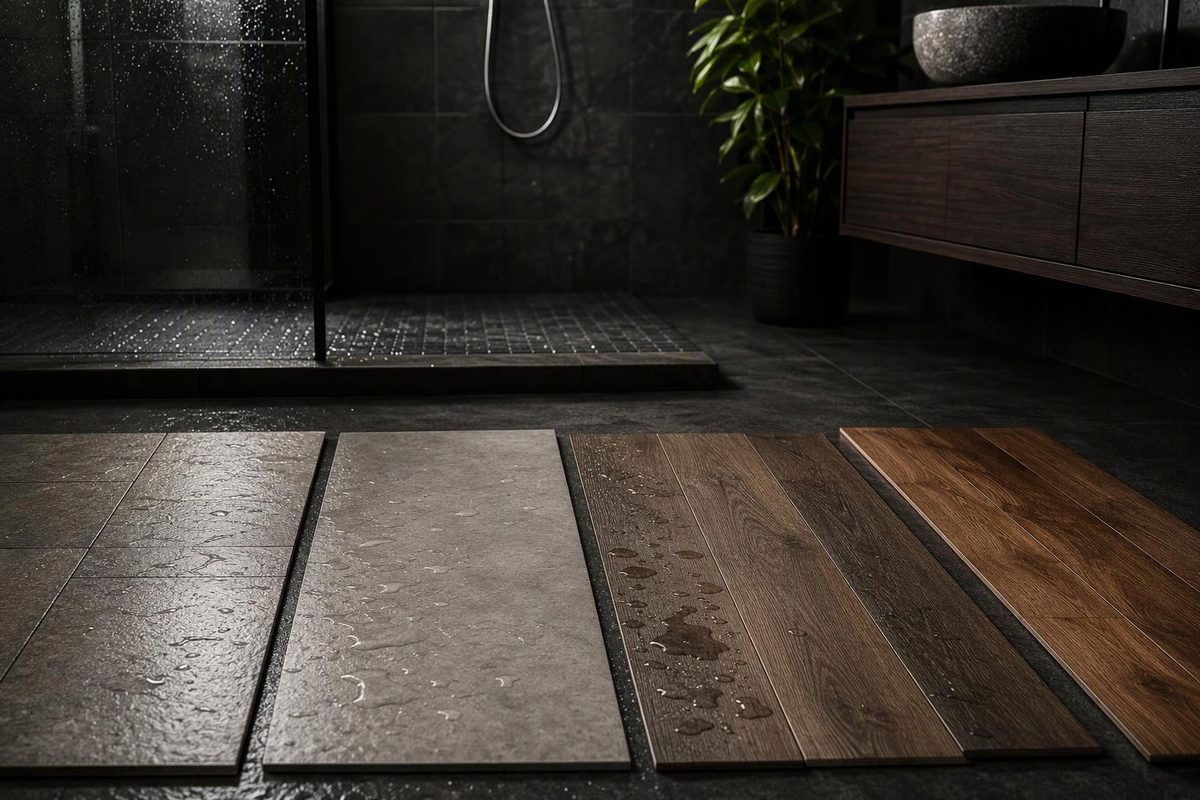
For a typical home washroom, start with floor-rated porcelain approved for wet interior use, bathroom-approved sheet vinyl, or bathroom-approved luxury vinyl plank or tile. Choose between them by how wet the floor gets and what installation work the room needs—not just by a “waterproof” label.
A toilet-and-basin room is different from a family bathroom where water regularly escapes the tub. A wet room, where shower water reaches the main floor and drains away, needs a waterproofing and drainage assembly, not simply a water-resistant floor covering.
1. Identify the room’s water exposure
Use this shortlist before comparing colours or patterns:
| Room condition | Start by considering | Detail that decides suitability |
|---|---|---|
| Toilet and basin only; occasional splashes | Porcelain, floor-rated ceramic, sheet vinyl or luxury vinyl | Exact product approval, wet traction and substrate condition |
| Bath or enclosed shower; regular splashing outside it | Porcelain with planned substrate protection, or bathroom-approved sheet vinyl or luxury vinyl | Edges, seams, penetrations and required sealing |
| Open shower or floor regularly washed toward a drain | A purpose-designed wet-room system, such as tile over compatible waterproofing | Drain connection, floor slope, waterproofing continuity and shower-floor suitability |
Stop if water may already be getting beneath the floor. A soft patch around the toilet, swollen edges, persistent dampness or a ceiling stain below calls for leak investigation and substrate assessment before replacement flooring goes down.
This guide concerns domestic washrooms. Public or commercial restrooms need a separate specification for their traffic, cleaning methods and applicable requirements.
2. Compare the practical choices
Porcelain tile: a strong starting point for frequent splashing
Porcelain offers low water absorption and is widely used for bathroom floors. Ceramic can also suit lighter-use washrooms, but choose a product expressly rated for the floor and intended conditions—not a wall tile that happens to match. Daltile’s comparison distinguishes porcelain’s wet-area applications from lighter-duty ceramic uses.
The important limitation is underneath: tile and grout are not inherently waterproof. In a shower or wet room, the waterproofing must connect properly to drains, corners and penetrations. Schluter’s shower-system guidance explains that distinction.
Even a waterproof membrane needs its specified joint treatment. For example, Schluter requires KERDI-BAND at DITRA seams and floor-to-wall transitions when creating a waterproof assembly. That is a system-specific detail, not permission to mix any membrane, tape and mortar. See the DITRA installation requirements.
For the tile-specific selection and subfloor checks, use our guide to bathroom tile flooring.
Sheet vinyl: worth considering when fewer seams matter
Sheet vinyl can cover a small washroom without field seams when the room shape and sheet width allow. Mannington identifies seam-free installation as a reason its sheet vinyl suits bathrooms and other high-moisture rooms. See Mannington’s sheet-vinyl overview.
Ask the installer to confirm the seam layout and the product’s required treatment at the tub, doorway, walls and pipe openings. A continuous sheet still has a perimeter and cut-outs; do not treat it as a complete wet-room lining unless the specified system supports that application.
Luxury vinyl plank or tile: check more than the waterproof core
Luxury vinyl belongs on the shortlist for an ordinary bathroom when the exact product allows that use. But a moisture-tolerant plank does not fix a damp subfloor or protect against every plumbing leak.
Mannington’s March 25, 2026 ADURA Rigid guide, for example, requires concrete moisture checks, specifies substrate flatness and excludes warranty issues arising from flooding or leaking plumbing. It also prohibits installing cabinets over that floating floor. These are product-specific rules; check how your chosen system handles the vanity, toilet and transitions before buying. See the ADURA Rigid installation guide.
If you choose click-lock vinyl, our vinyl plank installation guide covers the planning sequence.
Laminate and wood: conditional choices, not defaults
Do not assume every laminate is unsuitable—or that every “waterproof” laminate suits a wet room. The bathroom section of Pergo’s Installation Essentials Guide permits bathroom installation with specified silicone sealing, but prohibits rooms with floor drains. The document contains separate product instructions; obtain the current manual for the exact collection rather than transferring these details to another floor.
Keep real wood off the shortlist for a regularly wet family bathroom. Mannington’s hardwood care instructions require prompt spill removal and warn that flooding with water can severely damage the floor. A mostly dry powder room is a separate decision, subject to the product’s room approval. Hardwood care requirements explain the maintenance constraint.
3. Check wet traction, not just appearance
A matte or textured appearance is not proof of suitable wet grip. Ask for the manufacturer’s intended-use classification and confirmation for the specific location—main bathroom floor or shower floor, including expected barefoot use.
The Tile Council of North America explains that DCOF, a friction measurement, does not predict whether someone will slip. Water, soap, wear, drainage and maintenance also matter. Do not treat a single test number as a universal safety guarantee. TCNA’s friction guidance explains the limits.
4. Get these details into the quote
Before ordering, have the installer record:
- Substrate: plywood, OSB or concrete; necessary repairs, moisture testing and preparation. For tile, confirm that the structure and subfloor match the chosen installation assembly.
- Water protection: ordinary splash exposure or a wet-room assembly; seam, edge and penetration details.
- Fixture layout: how the floor meets the vanity, tub and toilet, including any toilet-flange work.
- Finished height: doorway transition, door clearance and adjoining-floor level.
- Full scope: removal, disposal, preparation, waterproofing, trim and fixture removal or refitting—not flooring alone.
If existing resilient flooring or adhesive is unidentified, have it assessed before disturbing it. Do not sand, dry-scrape or mechanically grind it as routine preparation. Mannington’s installation safety warning notes possible asbestos and crystalline silica hazards and says to presume asbestos unless positively certain otherwise.
Choose the appearance only after the room exposure, product approval and installation details all agree.